Owner Dependency as a Valuation and Deal Completion Risk
Buyers pay only for cash flow that survives the founder's departure.

A buyer in any acquisition is purchasing one thing: the cash flow that continues after the seller leaves. Valutico's 2026 exit valuation guide puts it this way: "buyers are not paying for what you have built, they are paying for what they will receive after the transition. Succession Strength states the same idea as a rule rather than a observation: "buyers pay for transferable cash flow; if the cash flow depends on the owner, it is not transferable."
That rule changes what "the business" even means at the negotiating table. A founder may see fifteen years of relationships, judgment calls, and reputation built one deal at a time. A buyer sees a stream of future cash and asks a narrower question: does this stream keep flowing once the person who built it walks out the door? Where the owner sits at the center of client relationships, daily decisions, and the knowledge that keeps operations running, the answer is often no, and that answer is what reshapes every number that follows.
Signs of an owner-dependent business
Diligence teams know what to look for, and they look fast. Website Closers defines an owner-dependent business as one that "cannot reliably sustain its historical performance without the direct management of the owner," and that definition translates into specific, checkable signals.
On the operational side, a diligence team watches for the owner handling sales conversations, quoting, invoicing, even customer service personally, work that should sit with staff in a company of any scale. Standard operating procedures are thin or missing, and the knowledge that keeps the business running lives in the founder's head rather than in any document a successor could pick up.
Relationship signals matter just as much. Vendor relationships, too, often run on personal rapport with the founder rather than on terms the company would keep regardless of who runs it.
On governance, Strategic Exit Advisors frames the risk in terms of knowledge transfer: "the most dangerous risk to your legacy is institutional knowledge that exists only in your head." A seller's narrative and a company's calendar can tell very different stories, and buyers are trained to notice the gap.
Three distinct mechanisms by which dependency cuts the sale price
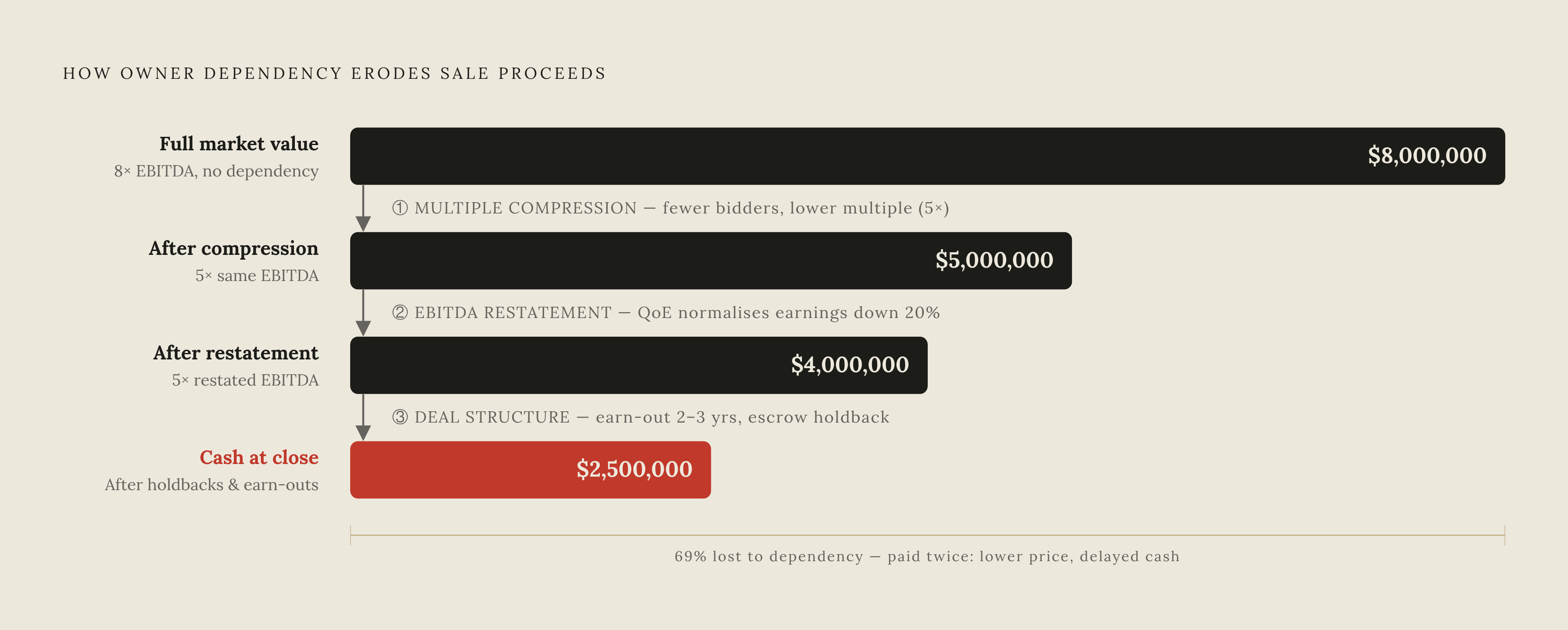
Owner dependency is rarely a single deduction on a term sheet. It moves through three separate mechanisms, each one compounding on the last rather than substituting for it, and each one rational from the buyer's side of the table.
The first mechanism sets the ceiling: multiple compression. Buyers apply a lower EBITDA multiple to a business that depends on its founder than they would to a comparable business with real management depth in place. Financial buyers tend to stay at the table, but they price in significant key-person risk. Both reactions shrink the effective multiple, and the shrinking buyer pool compounds the problem on its own: fewer bidders means less competitive tension, and a negotiation with one serious buyer runs every concession in one direction. Two businesses generating identical EBITDA can trade at meaningfully different multiples for no reason other than whether the management team can run the company without the founder in the room.
The second mechanism works on the number the multiple gets applied to, not the multiple itself. During Quality of Earnings review, every line item the founder personally touches gets re-examined. Valutico explains that buyers apply their multiple to "normalised EBITDA," adjusted for both risk and transferability, and owner dependency touches both halves of that adjustment at once. The number a seller walked into diligence expecting is often not the number the buyer ends up pricing.
The third mechanism absorbs whatever risk the first two haven't already priced away: deal structure. Where a lower multiple and a re-cut EBITDA base still don't cover the buyer's exposure, the risk moves into the structure of the deal itself. Strategic Exit Advisors describes the pattern directly: extended earn-outs requiring two to three years of post-closing involvement from the seller, larger escrow holdbacks, and less cash paid at completion. So the seller ends up paying for the same dependency twice: once through a lower headline price, and again through delayed payments that carry their own risk and typically land under less favorable tax treatment than cash at close. Earn-outs don't actually eliminate the buyer's reliance on the seller. If the seller is still the person who has to show up to hit the targets, the buyer is still relying on the same person they were trying to get away from, and the seller is, in practice, still working in the business they thought they'd sold.
Owner dependency in the 2026 deal market
Two shifts in the current deal environment have made owner dependency cost more than it did in the cheap-debt years, and they've widened the reward for the sellers who fix it before going to market.
The first shift concerns how disciplined buyers have become about cash at completion. Valutico's market analysis notes that the Federal Reserve cut rates several times in late 2025 but then held a cautious stance, and borrowing costs have stayed meaningfully higher than they ran through most of the prior decade. The default response to founder-risk, in this environment, is to shrink the cash portion and stretch the earn-out further. Valutico also documents a broader shift in buyer preference, away from growth-at-any-cost and toward stable margins and predictable cash flow, a reversal from the buyer behavior seen at the 2021 to 2022 peak. Owner-dependent revenue is, by its nature, less predictable, which puts it on the wrong side of exactly the quality buyers are now paying up for.
The second shift concerns timing. Management interviews, customer reference calls, and reviews of operating data such as decision logs and escalation patterns now happen earlier in the deal process than they did five years ago. Founder dependency used to get priced softly, folded quietly into a multiple discount late in negotiations, but now it gets priced explicitly and early, through deal structure as much as through price. The gap between a seller who prepared and one who didn't has grown wider, not narrower, because buyers are testing for dependency before either side has invested much time in the deal.
There's a real tailwind in this market too, but it only helps sellers who've done the work. Valutico points to the Baby Boomer exit wave, where a large share of US business owners plan to exit by 2027, as a force that increases buyer selectivity. If an owner clears the management-depth bar, they step into a genuine auction. An owner who doesn't ends up negotiating with whichever single buyer is still willing to engage, and that buyer knows it.
Where owner dependency can kill a deal entirely
The most severe outcome of owner dependency isn't a lower multiple or a heavier earn-out, but the deal not happening at all, a risk most owners haven't mentally priced in by the time they reach the table.
Strategic buyers, the acquirers who typically pay the richest valuations, often skip the renegotiation step entirely and walk. Strategic Exit Advisors states this directly: strategic buyers "often walk away entirely from founder-dependent businesses." These buyers are typically folding a target into a larger existing operation rather than rebuilding its management layer from scratch, so a single point of failure at the top is a reason for them to pass, not a pricing problem.
In rare, extreme cases, a business depends so completely on a founder's personal license, credential, or irreplaceable skill that no buyer at any price can make the transaction work. Website Closers acknowledges that "certain enterprises possess truly irreplaceable founders whose unique capabilities cannot be transferred," though the firm is careful to note that most businesses facing owner dependence are dealing with a solvable structural issue.
Execution risk after closing adds to the risk that the deal falls apart before closing. Revenue can look stable in the financial statements, but it can decline if customers, suppliers, and employees who stayed loyal to the owner personally start drifting away after the transition. Buyers aren't guessing when they discount for dependency; they're pricing a failure mode that plays out often enough to underwrite against, and that is what sits behind every pricing discount and earn-out demand discussed earlier.
Financing availability narrows the buyer pool on its own. Heavy key-person dependency can lead SBA lenders to deny financing to a prospective buyer, because lenders see a business that relies too heavily on one person, or on one customer, as carrying repayment risk, and they aren't willing to underwrite that. That removes a meaningful category of otherwise qualified acquirers from the field before a deal ever gets discussed, which feeds directly back into the multiple compression and structural concessions described earlier: fewer buyers at the table means less leverage for the seller, full stop on the mechanism, start on the consequence.
The personal goodwill wrinkle, where dependency can lower the tax bill if handled early
One narrow opportunity cuts against the general pattern. The same personal relationships and specialized knowledge that drag down a sale price can, if you use the right entity structure and prepare in advance, be allocated as personal goodwill and taxed at capital gains rates.
The distinction that matters here is who owns the goodwill. Personal goodwill belongs to the individual, built from that person's own relationships, reputation, and expertise, separate from the company's institutional value. In C-corporation transactions especially, if you structure a personal goodwill allocation properly, it can meaningfully reduce the total tax owed on the sale. The allocation has to be decided and documented before the deal closes, with the decision ideally reflected as early as the letter of intent, not assembled after the fact once the IRS or an auditor starts asking questions. For this to hold up, the owner generally needs to have no existing employment agreement or non-compete with the company, since either one gives the IRS and the courts grounds to argue the goodwill in question belongs to the business.
The IRS doesn't accept these allocations passively. The IRS may also treat value claimed as personal goodwill as disguised sale consideration, a constructive dividend, or evidence that the business interests transferred were undervalued.
None of this changes the underlying case for reducing dependency before a sale. It's a planning opportunity for owners who are already thinking several moves ahead, and it rewards documentation, timing, and qualified tax and legal counsel instead of offering a shortcut around the work described in the rest of this piece.
The remediation timeline
A buyer who sees a hurried, reactive sale process reads it correctly: the owner is responding to a deadline, not operating from a position of preparation. So that reading widens discounts and pushes deal structure further toward earn-outs and extended seller notes, because a rushed process signals the very dependency the buyer is trying to price around. Remediation has to show up in the operating history a buyer reviews during diligence. A promise in an information memorandum doesn't carry the same weight as two years of calendars and client correspondence that already reflect the change.
Four areas of work come up consistently across the sources on this subject. The first is systematizing operations: building out documented processes, SOPs, templates, and checklists for every core function, so performance doesn't depend on the owner's personal judgment in the moment. PCE Companies identifies this as the starting point: clear documentation lets new team members get up to speed quickly and stops routine issues from escalating straight to the owner's desk.
The second is building an actual leadership team, meaning people who can own functional areas, run meetings, handle escalations, and talk to clients and vendors without the owner in the room. PCE Companies notes that buyers ask early who runs the business day to day, and the honest answer needs to name a team. Strategic Exit Advisors lays out the core roles a buyer wants to see filled: an operations leader, a sales manager, a finance professional, and someone running service delivery.
Before any of that remediation work starts, Succession Strength recommends a structured assessment across four dimensions: leadership independence, client institutionalization, knowledge continuity, and governance. Buyers test these same dimensions in diligence, so this self-assessment works as a starting point for building a transfer plan, not as a separate exercise. If an owner measures dependency honestly before a buyer does, they get to fix problems on their own timeline instead of negotiating around them on someone else's.
What a buyer-ready, low-dependency business achieves at the table
An owner who puts in the work to become genuinely replaceable before going to market gets more than just avoiding the discounts described earlier.
The outcomes show the structural difference. Cash at completion runs higher, earn-out periods shrink or disappear, and escrow requirements come down, so sellers get more of the headline number sooner.
Buyers don't take a founder's word for it that dependency has been addressed. An experienced M&A advisor's job, in part, is presenting the remediation work the way a buyer's diligence team actually evaluates it, which is often different from how that same progress looks from inside the business. Pairing that advisory work with AI-driven buyer matching, which connects a business to buyers for whom its specific management infrastructure and customer base are genuinely transferable, cuts down further on the friction that produces the discounted, earn-out-heavy structures described throughout this piece.
Timing determines how much of this is even possible. An owner starting six months before going to market is managing how the business appears rather than changing what it actually is, and buyers, more often than not, can tell the difference. PCE Companies makes the larger point: reducing owner dependency is useful for more than just preparing for a sale.