Representation and Warranty Insurance Availability for Sub-$50M Deals
Smaller deals can now access insurance that reduces escrow risk.

Representation and warranty insurance (RWI) has quietly become one of the most consequential tools in private M&A, but for years it was functionally unavailable to anyone selling a business below a substantial deal-size threshold. The market for RWI below that threshold has opened up in real, specific ways over the past several years, and founders preparing to sell need to understand both what has actually shifted and where the product still does not pencil out.
What representation and warranty insurance does in a deal
RWI shifts the financial risk of a bad representation from the seller to an insurance carrier. In a purchase agreement, a seller makes dozens of factual assertions about the business: that the financial statements are accurate, that taxes have been paid and filed correctly, that pending litigation has been disclosed, that material contracts are in good standing, that the company complies with applicable regulation. These statements are the representations and warranties that give the buyer confidence to close. If one of them turns out to be false after closing, and the buyer suffers a loss as a result, someone has to pay for it.
Without RWI, that someone is the seller. The standard mechanism is an escrow holdback: the buyer withholds a portion of the purchase price at closing and sets it aside for a defined survival period, often running 36 to 60 months, during which the buyer can bring an indemnification claim against those withheld funds if a representation proves inaccurate. The seller does not get full access to the sale proceeds until that period runs clean.
RWI replaces that arrangement with an insurance policy. In the dominant structure, a buy-side policy, the buyer is the named insured. If a covered representation breaches after close, the buyer claims against the insurance carrier rather than chasing the seller for money that may no longer be sitting in an account. The seller's contractual indemnity exposure on general representations shrinks substantially at closing, and in some structures disappears entirely: so-called "no-seller indemnity" deals eliminate the seller's liability for general reps altogether, leaving the carrier as the buyer's only recourse. The carrier takes on the downside up to the policy limit, and the deal's risk allocation moves from a private contractual promise between two parties to a priced, underwritten insurance product.
Why indemnification tails and escrow matter more to a founder-seller
A financial sponsor running a portfolio of a dozen acquisitions treats an escrow dispute as a line item. A founder selling the business that represents a career's worth of work experiences the same mechanics very differently. Escrow money is what separates a clean exit from years of waiting to find out whether the proceeds are actually the founder's.
Without RWI, that wait can be long. Indemnification tails of 36 to 60 months are standard, and escrow holdbacks of roughly 10 to 15 percent of transaction value are typical, which on a lower mid-market sale means several million dollars locked up and exposed to claims for years after the papers are signed. With RWI in place, those terms compress meaningfully: indemnification tails fall to 12 to 24 months, and escrow requirements drop to a fraction of their traditional size in the framing used for lower mid-market deals in 2026. That compression changes what the closing date actually means for a founder. Instead of a partial, conditional liquidity event followed by years of contingent risk, the founder gets a closing that resembles what it was supposed to be: a transfer of the business for the agreed price, with escrow and tail exposure mostly resolved.
There is a second, quieter benefit. Because the carrier, not the seller, bears the downside under an RWI policy, the seller can agree to broader representations without insisting on heavy materiality and knowledge qualifiers in the purchase agreement. That tends to accelerate closing and reduce negotiation friction, since the parties are no longer locked in a fight over how much risk the seller is personally willing to carry. A buyer running acquisition after acquisition can treat an unfavorable escrow outcome as the cost of doing business across a portfolio. A founder selling once cannot diversify that risk away; the tail and the escrow size deserve more scrutiny from a founder-seller than from an institutional buyer, not less.
The cost floor behind the lower mid-market's historical exclusion
RWI's absence from smaller deals was not a function of the insurance rate being too high as a percentage. It was a function of fixed costs that do not scale down. Underwriters charge a non-refundable underwriting fee at the start of diligence, win or lose, and layer a minimum premium on top of whatever the policy ultimately costs. Those fixed costs are sized for the underwriting work involved, not for the size of the deal, and that work (quality-of-earnings reviews, management interviews, legal diligence review) looks roughly the same whether the enterprise value is many times larger or much smaller.
On a large transaction, that fixed cost is a rounding error. On a small one, it can consume a disproportionate share of the transaction's value. Kean Miller's 2025 analysis notes that because of pricing constraints, RWI may be cost-prohibitive for deals below a certain value threshold, even though smaller deals are sometimes insured where buyer and seller demand is strong enough to justify it. The baseline, as characterized by S5, is that RWI remains most common in larger deals, with increasing but not yet dominant prevalence at smaller sizes. That is a description of where the market sits today, not a reason to write the product off for the lower mid-market.
The policy limit compounds the problem. Coverage is typically capped around 10 percent of enterprise value, so a smaller deal produces a smaller coverage ceiling against the same fixed underwriting cost. On a large deal, the premium buys a coverage amount that is economically proportionate to what was paid for it. On a small deal, the same floor cost buys a coverage ceiling that can feel thin relative to what it took to get there. That asymmetry, not the insurance rate itself, is the structural reason the lower mid-market was effectively shut out for so long. It explains why "RWI is now available for smaller deals" is a meaningful development and not simply a marketing claim: the underwriting infrastructure had to be rebuilt to make the economics work at all, a point the next two sections take up directly.
Where the market has opened up, and where it has not
The RWI market has genuinely expanded downward from its traditional floor, but that expansion is uneven across deal sizes, and founders should understand exactly where the line currently sits. The lower mid-market band, broadly the range just below the historical floor, is where the product is now genuinely accessible. The smallest deals, those well under $20 million, are increasingly insurable but require more deliberate structuring to make the economics work. Deals below $10 million remain uncommon.
For founders selling in the lower mid-market, the case for RWI is strongest. S5 identifies this band as the zone of increasing RWI prevalence, and the math on escrow reduction is most persuasive here: without RWI, escrow at this deal size frequently runs into the millions of dollars, locked up for years. With RWI, that figure can fall to a fraction of what it would have been. For founders selling smaller businesses, closer to the $20 million mark and below, Kean Miller confirms that deals in this range are sometimes insured, driven by rising demand from both buyers and sellers, but each transaction needs its own economic scrutiny rather than an assumption that the product will simply be available on standard terms.
Part of what has made this possible is competitive pressure among the carriers themselves. In a subdued M&A environment with a limited pool of deals to underwrite, more insurers are quoting on smaller transactions, timelines for binding coverage have compressed, and some carriers are willing to engage on deals they would have passed on a few years ago. Canada offers a useful illustration of how this plays out over time: RWI has become a fixture of private M&A there over the past decade, with more insurers entering the market and competition driving more favorable terms specifically in the lower mid-market, a segment that was previously too cost-inefficient to serve.
None of this amounts to a revolution, and it would be a disservice to founders to describe it as one. The honest picture is a real but bounded expansion: genuinely accessible in the lower mid-market, achievable with effort in the sub-$20 million band, and still rare below $10 million. A founder selling at the smaller end of that range should expect to work harder, and possibly accept narrower terms, to get a policy bound.
Two product innovations specifically built for the sub-$20M market
What has actually moved the needle for the smallest insurable deals is a new category of product engineered from the ground up to make underwriting economically viable at lower deal sizes, rather than simply applying a smaller fee to the same process.
Two named products illustrate the two different paths this re-engineering has taken. MIO Fusion is structurally different from traditional RWI: it uses synthetic representations rather than the negotiated representations found in a purchase agreement, which removes much of the back-and-forth negotiation that drives underwriting cost and timeline on a conventional policy. Blue Chip Aqua takes the opposite approach: it keeps the traditional representation and warranty structure intact but streamlines the underwriting process around it, built for speed and a lower cost basis than a conventional policy would carry at the same deal size. A founder going through a competitive sale process may find a prospective buyer proposing either structure, or evaluating both against each other.
A third approach, described in Jen Cap Group's analysis of RWI for smaller deals, pairs two policies issued at the same time: a buyer-side policy covering first-party losses from breaches, including breaches the seller knew about going into the deal, alongside a seller-side policy that protects the seller from third-party liability. Issuing both simultaneously gives each party its own layer of protection rather than forcing the smaller deal to make do with a single policy built for a larger one.
These products show that the cost floor described earlier is not immovable, though the smallest-deal market has not become as deep or as liquid as the market well above it. A founder evaluating RWI at this size should treat these structures as real options worth investigating with a broker, not as commodity products with established, predictable pricing the way a larger deal's RWI policy has become.
The risk profile of smaller deals, according to RWI claims data
Whether RWI is available at smaller deal sizes is only part of the picture; the underlying risk also has to justify buying it, and claims data suggests it does. The categories of breach that generate RWI claims, and the losses that follow from them, are not concentrated in large, complex transactions. They show up consistently across deal sizes. The protection logic that built the market for RWI among large buyers applies just as much to a founder selling a much smaller business.
Tax matters and financial statements sit among the four most common categories of RWI claims notifications, and together with two other recurring categories, these four account for the substantial majority of all RWI claim notifications, Fasken's 2025 trends analysis found. Measured by severity rather than frequency, financial statements, material contracts, and compliance with laws together account for the large majority of all losses paid out under RWI policies. These are the same representations that any founder-led business, with a standard set of financials, customer contracts, and regulatory obligations, makes as a matter of course in a sale agreement.
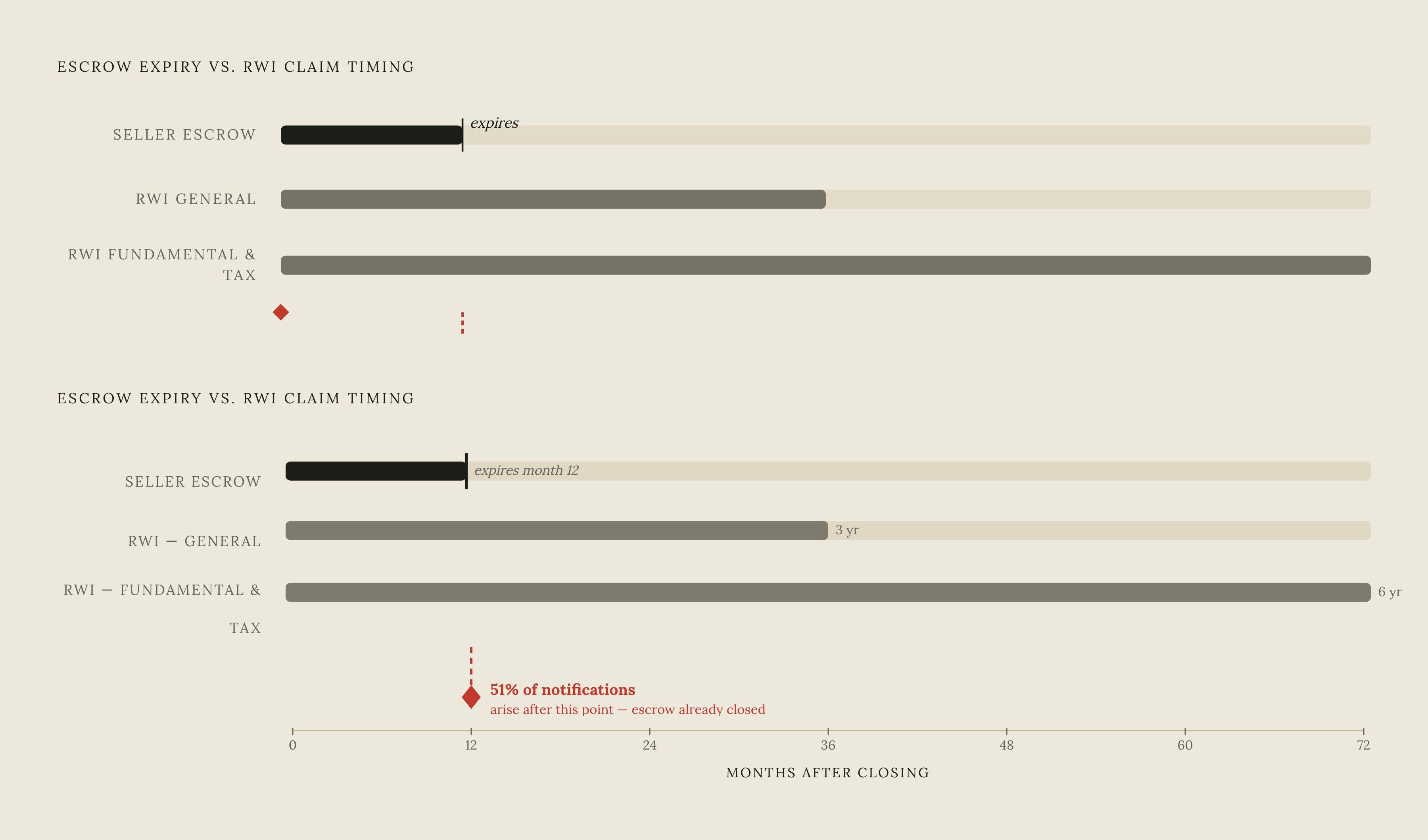
Timing compounds the case. Fasken's analysis reflects Aon's finding that 51 percent of R&W insurance notifications arise more than 12 months after closing. A founder relying on a traditional 12-month seller escrow in place of RWI would find that the escrow period had already closed by the time the majority of claims would have surfaced, leaving no fund left to claim against for the bulk of the risk the escrow was meant to cover. RWI's policy period runs considerably longer: three years for general representations and six years for fundamental and tax representations. That duration, not simply the presence of coverage, is what makes RWI structurally better suited to the actual timing of claims than a short escrow negotiated without it.
The five standard exclusions founders must understand before assuming they are covered
RWI's limits matter as much as its coverage, and founders selling businesses with less formal documentation and fewer in-house compliance functions should read the exclusions as carefully as the coverage grant.
Known issues, anything disclosed during diligence or listed on the schedules to the purchase agreement, are not covered, because that follows directly from what a representation is. If the seller disclosed a tax exposure or a pending lawsuit, it cannot later be breached, because the buyer already knew about it going in. A known exposure needs its own solution, whether a special indemnity, a price adjustment, or a separate standalone tax policy, rather than an expectation that the RWI policy will absorb it.
Forward-looking statements and projections fall outside the policy as well. RWI covers representations about current and historical fact, not promises about future performance, so a buyer who sees projected revenue fail to materialize after closing has no claim under a standard RWI policy; this is Jen Cap Group's analysis. Kean Miller notes that purchase price adjustments are excluded too, and this exclusion is worth taking seriously because working capital and purchase price disputes are a recurring source of post-closing conflict in founder-led deals regardless of whether RWI is in place.
None of these exclusions make RWI a weaker product. They define what the product is actually insuring: the accuracy of representations about the business as it exists and has existed, not a guarantee against every form of post-closing disappointment a buyer might experience. A founder who understands that boundary going into the negotiation is in a far stronger position to decide what belongs in the purchase agreement, what belongs in a side indemnity, and what an insurance carrier was never going to cover.
Sources
- Representation and Warranty Insurance
- Representations & Warranties Insurance: What You Need to Know
- Indemnification in M&A Transactions
- Representation and Warranty Insurance for M&A Deals: Cooling Market and Emerging Trends
- Representations and Warranties Insurance in M&A Transactions: An Overview and Evolving Market Trends