Deal Process Timeline Differences Between Large and Small M&A Transactions
Larger deals require longer due diligence and regulatory review, stretching timelines by years.

A business sale under $500,000 closes in roughly six months on average. A lower middle market company valued between $5 million and $50 million takes about twelve months. A mega-deal above $5 billion can run 12 to 24 months, with some stretching to three years. These numbers, drawn from Q4 2025 market data on small business transactions and separately on the largest global deals, describe the same basic transaction type, a change of ownership, yet the time required scales by a factor of four or more across the size spectrum. That spread is not noise, and it is not a function of how motivated the parties are. Deal size sets the depth of due diligence a transaction must survive, the weight of regulatory obligation it must satisfy, and the complexity of the buyer relationship it must manage, and those three forces together set the pace from first contact to close. For a founder selling a profitable business in the lower middle market, the process will not resemble the nine-figure and ten-figure deals that dominate financial press coverage, but it also won't move at the speed of a small main-street business changing hands over a handshake and a bank loan. It sits in a distinct, fairly predictable middle range, and understanding why requires walking through the mechanics phase by phase.
Seven phases every transaction moves through
Every acquisition, regardless of size, moves through the same seven-phase sequence. What changes is how long each phase takes and how much slack exists between phases for things to go wrong.
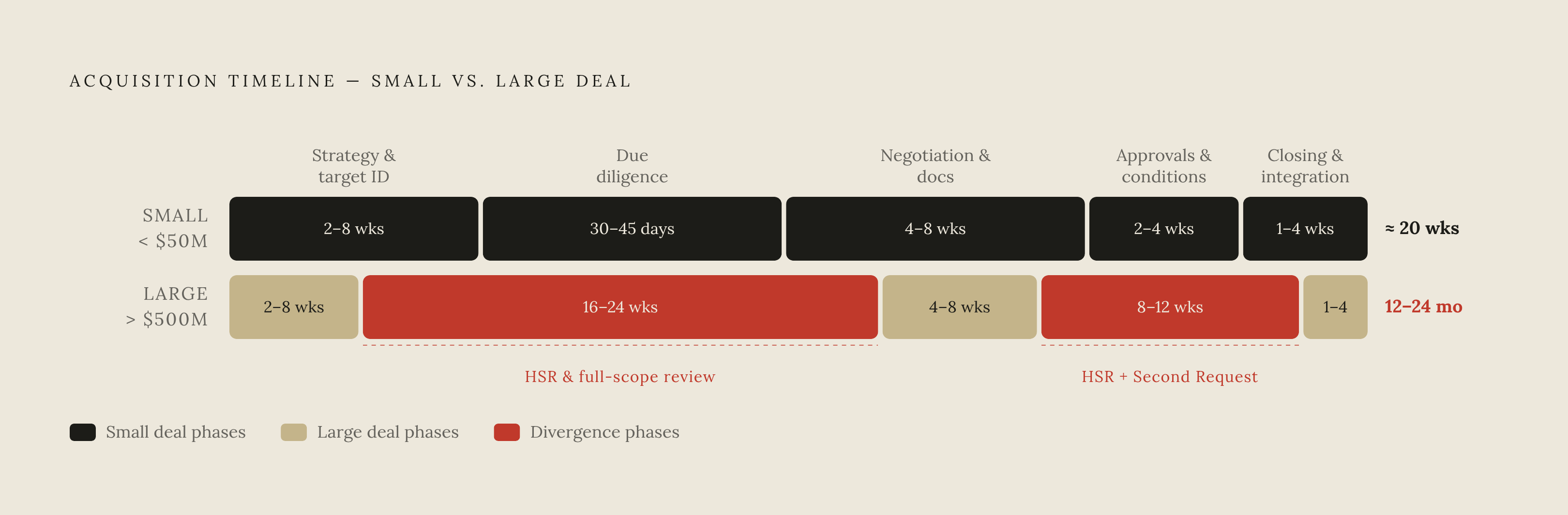
Strategy and target identification, where a buyer defines what it's looking for and begins sourcing candidates, typically runs 2 to 8 weeks. Full due diligence, the longest and most variable phase, takes 6 to 12 weeks, and because it is the phase where size differences become most visible, it gets its own treatment in the next section. Negotiation and documentation of the definitive agreement runs in parallel with diligence for much of its 4 to 8 week span, with indemnification terms, earnout structures, and disputes over representations and warranties doing most of the work of extending it. Approvals and the satisfaction of conditions precedent follow, and here the range is widest of all, 2 to 12 weeks, because this is the phase where regulatory size thresholds create the sharpest divergence between a small deal and a large one. Closing and the early stages of integration close out the sequence, typically in 1 to 4 weeks.
Laid end to end, these phases would produce a transaction lasting anywhere from roughly 20 weeks to nearly a year, and in practice they frequently overlap and run concurrently. But the capacity to run phases in parallel is itself a function of size. A small deal, often run by a single advisor or a lean two- or three-person team on each side, has far less capacity to parallelize. The seven phases are the same map for every transaction, but the number of people available to move through that map at once is what makes a small deal close in months while a much larger deal closes in years.
Due diligence volume and workstream count by deal size
Due diligence is the phase where the structural gap between small and large transactions becomes impossible to miss. For deals under $50 million, due diligence typically runs 30 to 45 days, with buyers reviewing somewhere between 500 and 2,000 documents across three to five workstreams, usually financial, legal, operational, and tax. That is a workload a lean advisory team can manage concurrently, with each track proceeding on its own schedule without waiting heavily on the others.
Large transactions, those above $500 million, operate at a different order of magnitude: document volumes run from 10,000 to more than 50,000, spread across eight or more workstreams. Eight semi-independent review tracks multiplied against each other produce the arithmetic behind a 16- to 24-week large-deal diligence period, compared to 30 to 45 days for a small one.
What this means for a lower middle market seller is that the diligence they face is real but contained. Four workstreams is a manageable, bounded exercise, provided the underlying records are in order, a point the final section of this piece returns to directly. The four-workstream diligence process facing a lower middle market seller is narrower than what a billion-dollar deal must survive, but it is not toothless, and the findings it generates carry real financial consequences.
The regulatory fault line at $133.9 million
For nearly every founder selling a business in the lower middle market, federal antitrust filing requirements never enter the picture. But understanding where that line sits, and what happens to a transaction once it crosses that line, explains a meaningful share of why large deals take as long as they do, and it confirms why a lower middle market sale does not carry that burden.
The relevant figure is a federal antitrust filing threshold, a size-of-transaction cutoff set at $133.9 million for 2026. Deals valued at or below that amount are not reportable to federal antitrust regulators and face no mandatory waiting period before they can close. Deals above it must file, and that filing triggers an initial 30-day waiting period before closing can occur. If regulators issue what's called a Second Request, a demand for substantially more information and documentation, the waiting period extends well beyond those initial 30 days, sometimes by many months.
Goodwin Law's analysis of global deal data found that the gap between signing and closing has grown materially for transactions above a certain scale, with the very largest deals taking meaningfully longer to close than transactions just above the reporting threshold. Large deals also face obligations beyond antitrust: foreign direct investment screening, national security review, sanctions compliance, data privacy and cybersecurity assessments, and for qualifying European transactions, the EU Foreign Subsidies Regulation, which applies where the acquired company generates at least €500 million in EU turnover and the parties received more than €50 million in foreign financial contributions. None of these typically touch a lower middle market Canadian founder sale.
The regulatory landscape governing these large-deal filings is itself unsettled. Rule changes to the HSR filing process introduced in 2025 were struck down by the Fifth Circuit in March 2026, reinstating the pre-2025 filing requirements, and the FTC has signaled it intends to propose a revised rule by the end of 2026. That uncertainty matters enormously for anyone planning a transaction near or above the $133.9 million threshold. It is close to irrelevant for anyone selling below it.
The sign-to-close mechanics diverge just as sharply as the filing requirements. A lower middle market founder, in nearly every case, experiences the former. Regulatory review, the single largest source of delay at the top of the market, simply does not apply.
Buyer type shapes the clock as much as deal size does
Deal size sets the outer boundaries of a transaction's timeline, but within those boundaries, buyer type does a great deal of the remaining work. Two transactions of identical size and identical business quality can close months apart, and the difference often comes down to who is sitting across the table.
Add-on acquisitions, where a private equity firm is buying a business to fold into an existing portfolio company, close fastest, typically in 3 to 5 months, and they carry a lower rate of failure after a letter of intent is signed. This speed comes from structure, not motivation: the platform already has a diligence team in place, an existing lender relationship it can draw on for financing, and an integration thesis already built around how the acquisition will fit. None of that infrastructure needs to be assembled from scratch, which is what slows other buyer types down.
Strategic acquirers, companies buying a competitor or an adjacent business to expand their own operations, occupy the middle of the range. They bring real corporate process and often move with deliberate discipline, but they lack the pre-built infrastructure of a PE add-on, and they introduce approval chains of their own: board sign-off, integration committee review, sometimes a parent company's capital allocation process. Those internal checkpoints add weeks that a private equity platform, with a standing investment committee and a thesis already approved, simply doesn't need to clear.
First-time individual buyers sit at the slow and fragile end of the spectrum. Lower middle market processes run through an advisor see roughly a third of letters of intent end without a completed deal, while add-ons to existing PE platforms fail at letter-of-intent stage at a meaningfully lower rate. A founder weighing timeline expectations needs to know which of these three buyer types is most likely to be sitting across the table before setting a date on the calendar.
That buyer-type distinction also explains much of why deals die after a letter of intent is signed. Across deal sizes, the leading cause of post-LOI failure is a discovery made during due diligence, followed by financing falling through, followed by a valuation gap that never closes. Buyer type bears heavily on the first two: a PE add-on with existing lender relationships rarely sees financing collapse mid-process, while a first-time individual buyer's financing is often the most fragile part of the entire deal.
Sellers below the upper end of the market in the 2026 two-speed market
Boston Consulting Group's M&A report found that global deal value rose materially over the first eight months of the year, but that growth was concentrated almost entirely at the top of the market. The number of megadeals climbed above the prior record for the period, while deal activity at the lower end of the market remained below its longer-term historical norms.
That divergence carries a specific, reassuring implication for a lower middle market seller: the business is not competing for buyer attention against a wave of megadeal-driven appetite. The capital chasing the largest megadeal transactions is not the same capital, nor the same buyer pool, that evaluates a lower middle market business. The buyer pool for a lower middle market seller in 2026 is private equity sponsors executing add-on strategies, strategic acquirers running defined acquisition programs, and individual buyers, the same three buyer categories described in the previous section, each carrying its own timeline and its own failure rate. One might argue that a hot megadeal market should pull capital and attention away from smaller transactions. The data suggests something closer to the opposite in practice: the two ends of the market function on separate tracks, with separate capital sources, separate buyer motivations, and separate timeline dynamics. A founder's planning should be grounded in the behavior of buyers who actually operate in their size range, not in headlines about record-setting megadeals that have no bearing on how their own process will unfold.
Specific risks that extend or kill timelines for small deals
Having established what drives timeline length at every level of the market, the more useful question for a lower middle market founder is what can actually be done about it before a deal ever launches. Regulatory delay, the dominant force at the top of the market, is largely absent here. Goodwin Law's warning that closing timelines are lengthening worldwide applies disproportionately to deals that face HSR waiting periods and the kind of scrutiny described above; below the $133.9 million threshold, the clock is set by process quality and by how ready the seller actually is, not by any regulator's calendar. That reframes timeline risk for a lower middle market seller as operational rather than regulatory, and operational risk, unlike a government filing requirement, is addressable in advance.
Three factors do most of the damage: owner-dependence, disorganized records, and diligence discoveries. Owner-dependence is the most structural of the three. A small business is typically priced on a multiple of its EBITDA, but that price begins to erode in a sophisticated buyer's eyes the moment it becomes clear the seller is the business, that the customer relationships, the vendor terms, and the operational knowledge sitting in one person's head won't transfer cleanly to a new owner. That erosion appears as a price haircut at best and a collapsed deal at worst, and it is precisely the kind of risk a founder can reduce years before a sale by documenting processes and building relationships that don't depend on a single signature.
Disorganized data rooms are the most directly controllable source of delay in the entire process. A clean, well-indexed virtual data room lets a buyer answer its own questions by reading the documents in front of it, rather than submitting a new information request every time a question arises, a dynamic that can compress the 6- to 12-week full due diligence phase meaningfully on its own. And undisclosed issues inside the financials carry their own cost: the $690,000 price reduction that followed the discovery of incorrectly normalized personal expenses in one HVAC business's quality-of-earnings review shows the cost of leaving that discovery to the buyer's advisors. A founder who runs a financial review before going to market surfaces that kind of issue while still holding full negotiating leverage, rather than after signing a letter of intent and losing much of it to exclusivity.
None of these three risks is regulatory, and none of them requires a government filing or a waiting period to resolve. They are operational choices a founder makes, or fails to make, well before the first buyer conversation ever happens, and they shape whether a lower middle market sale closes in five months or twelve more than any of the structural forces described earlier in this piece.