When to Sell a Business Based on Market Conditions vs Personal Readiness
Focus on operational and personal readiness, not market timing, to maximize your sale price.

A competitor sells for a number that surprises everyone. Any of these can trigger the question that eventually reaches every owner: is now the time to sell? Most owners answer it by looking outward, at interest rates, GDP reports, and deal-volume news, treating those signals as the dial that should set the decision. The instinct makes sense on its surface. The instinct also runs into a timing problem: the transaction data shows a sale takes six to twelve months from the decision to move forward to the day it closes, and by the time an advisor is engaged, materials are prepared, a process is run, and a deal gets negotiated, the market conditions an owner set out to capture may have already shifted in either direction. Macro timing is not a tool an owner can reliably use. Personal and operational readiness is the variable you can actually reach, so the rest of this piece works through why.
Small business valuations have stayed flat across a decade of macro turbulence
Analysis of more than 10,000 Main Street transactions shows small business valuations holding within a narrow band of Seller's Discretionary Earnings for over a decade, a range that persisted through recessions, bull markets, interest-rate shocks, and the volatility of the pandemic.
Three patterns explain that headline number. Small business valuations show no meaningful tie to the broader economic cycle: a severe public-health shutdown, the rapid recovery that followed, and the inflationary surge after it barely moved multiples. They also show no correlation with public markets. The S&P 500's price-to-earnings ratio has swung considerably over the same period, but small-business multiples have stayed in their narrow band. And they show limited sensitivity to interest rates: the Federal Reserve raised rates sharply between 2022 and 2023, yet transaction multiples did not materially compress. Most Main Street deals run through standardized government-backed loan programs with fixed terms, which mutes the pass-through effect that rate changes have on larger, more rate-sensitive transactions.
If you watched 2026 rates sit higher than they did a few years back, you might reasonably expect multiples to have fallen in response. Q1 2026 data points the other way: median sale price has held steady and median cash flow has grown modestly. That is a market holding its footing, not one buckling under rate pressure.
None of this means the market is frictionless or that every seller gets a fair shake. It means the variable most owners fixate on, the macro backdrop, does not explain the variation in outcomes they actually experience. Something else is doing that work, and it is the subject of the next section.
What determines the multiple a business receives
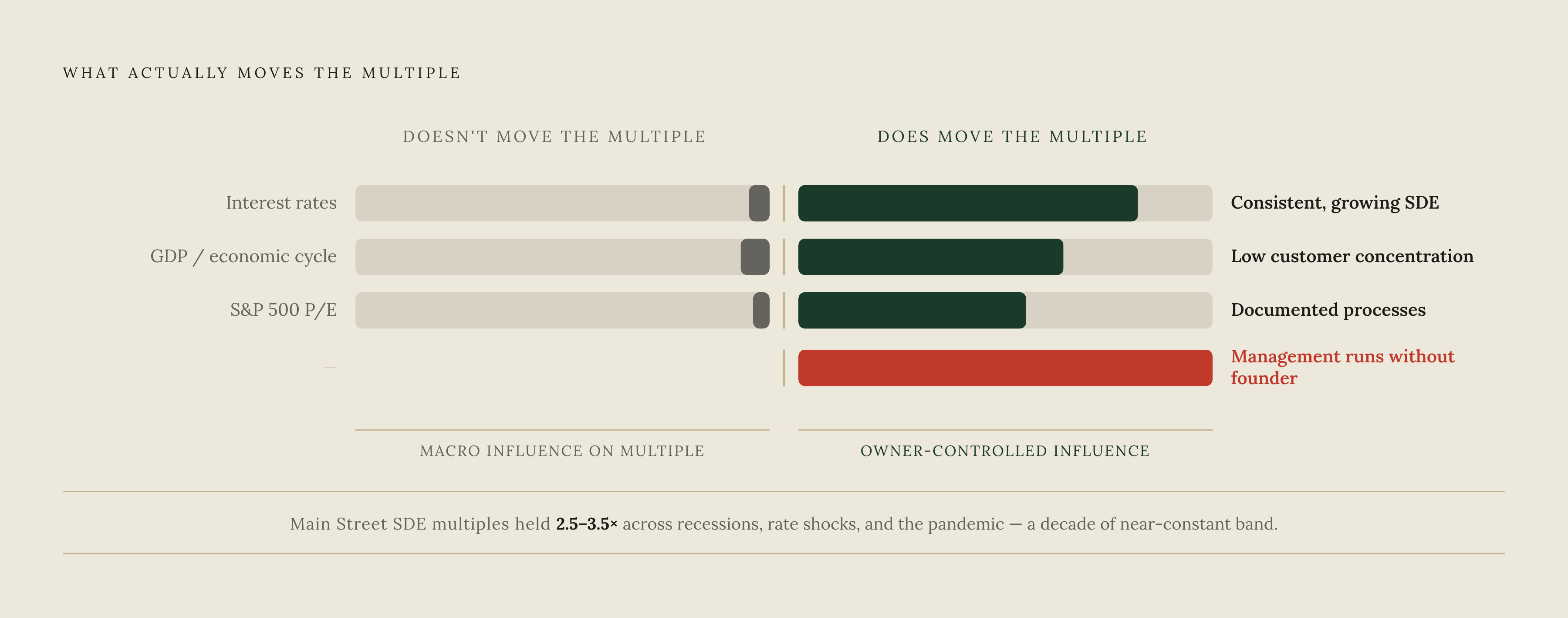
If the macro lever does not move the multiple, the question becomes what does. The answer splits into two categories: financial quality and operational independence, and both sit largely inside the owner's control.
On the financial side, buyers anchor their offers to trailing twelve-month performance, and they typically want at least three years of tax returns before they will engage seriously. A business with consistent or growing SDE draws a higher multiple than one with volatile or declining earnings, because predictability is what a buyer is actually purchasing along with the cash flow. Customer concentration factors in too: when a single customer accounts for an outsized share of revenue, buyers discount for the risk that the relationship walks away after the sale.
On the operational side, owner dependency is one of the most reliable value destroyers in a Main Street transaction. If the business cannot function without the person currently running it, a buyer is not purchasing a business so much as buying themselves a job, and jobs trade at lower multiples than businesses do. Buyers are, in effect, testing whether the business survives the founder's absence, and documented processes, delegated operations, and a leadership team that can execute without the owner in the room all push the multiple up. A clear growth pathway, an identifiable market, repeatable revenue, a visible pipeline, signals upside and lowers the buyer's perceived risk.
The consistency of these multiples across a full decade of macro turbulence means an owner selling today is competing on the same valuation fundamentals as an owner who sold a decade ago, which makes preparation, not market conditions, the actual differentiator between outcomes. Tools built for AI-driven business valuation analysis can help an owner see exactly where the business stands against these controllable factors before it reaches the market. And the data on why advised engagements end without a deal supports the point directly: the most common reason is a valuation gap, followed by unreasonable demands, not a cold market. That gap traces back to preparation almost every time. It is where strategic guidance earns its keep: businesses that have clarified their financials, documented their operations, and built a management team capable of running without the founder are the ones commanding multiples aligned with their cash flow quality, rather than the ones negotiating downward because the groundwork was incomplete.
Personal readiness: the variable owners underestimate most
A business can be fully prepared for sale well before its owner is, and that gap, not the market, causes most failed or delayed exits. Personal readiness breaks into three components, and each one affects the negotiating table whether or not the owner intended it to.
The first is a clear reason to exit. It appears as hesitation during due diligence, as second-guessing during negotiation, and as a deal that drags for reasons the owner cannot quite name.
The second is emotional preparedness to let go. Most exit delays and last-minute withdrawals trace back to emotional blocks, not to any actual business problem.
The third is a post-sale plan. Knowing what comes next, whether that is retirement, consulting, a new venture, or simply time with family, reduces the anxiety that otherwise keeps an owner from staying focused through to closing.
One might argue that regret after a sale is mostly about price, that an owner who feels bad afterward simply left money on the table. The research says otherwise. Findings from the Exit Planning Institute and PricewaterhouseCoopers show that a large share of business owners report profound regret within a year of selling, and the cause is rarely the number on the closing statement. It is the identity, the structure, and the daily purpose the business provided, all of which leave with the business itself. That reframes personal readiness as a legitimate variable in the timing decision rather than a soft concern to set aside until after the financial questions are settled.
Burnout deserves particular attention here because owners tend to misread it. Burnout functions as an early signal to begin the process.
The risk runs in both directions. Selling before personal readiness has set in leads to regret and, often, to the owner unconsciously sabotaging the deal. Waiting too long while burnout quietly erodes the business leads to a weaker asset and a worse outcome at closing. Neither extreme serves the owner. Readiness, examined honestly, has to sit at the center of the timing decision rather than at its edge.
The cost of waiting: how delay erodes value in practice
The most expensive timing mistake an owner can make is waiting until growth slows or earnings start to decline before beginning a sale process. By that point the story is harder to tell, and buyers discount hard for it.
Buyers pay for momentum. A business with stable or improving financials draws genuine attention, while a business on a downward trajectory triggers what buyers describe as catching a falling knife: they either walk away entirely or price in the risk with a steep discount. Delay does not quietly bank value for later. Business value tracks performance, profitability, growth potential, and risk, not the simple passage of time, so an owner who waits without actively preparing is not preserving value so much as letting the clock run against it.
Deal structure compounds the erosion further.
The 2026 market is actively sorting prepared sellers from unprepared ones. Sophisticated buyers compete hard for quality listings, but demand has softened considerably for businesses with flat financials, no documented processes, and heavy owner dependency. The distance between a well-prepared business and an unprepared one has widened, not narrowed. Part of what is driving that sorting is a wave building on the supply side: a meaningful number of founders delayed their exits between 2022 and 2025, and a larger group is now eyeing a transition sometime in the 2026 to 2028 window. As more of those businesses reach the market at once, buyers will have more choices, and the owners who invested in preparation ahead of time tend to close faster and give up fewer concessions along the way.
None of this argues for selling immediately regardless of circumstance. It argues that delay without active preparation is the riskier path, not the cautious one, a distinction that matters most for owners who are still three to five years out from an actual sale.
When market conditions do matter: sector-specific consolidation windows
The strongest challenge to everything argued so far is straightforward: surely market conditions matter somewhere. They do, in one specific circumstance. When an industry is going through active private equity rollup activity, timing genuinely moves the number, and it can be worth one to two full EBITDA turns, so it becomes a real secondary variable for sellers who operate in those sectors.
The mechanism is competitive pressure rather than sentiment. When several PE platforms roll up a subsegment at the same time, selling into that wave tends to produce a premium over selling outside it, because multiple buyers are competing for the same limited pool of acquisition targets. The best window inside a wave sits in the middle: after platforms have formed and multiples have expanded, but before the late-cycle compression that sets in as the wave matures and integration risk starts to rise for buyers. Selling too early in a wave leaves money on the table; waiting too long inside one carries its own penalty, as platforms mature, multiples peak, and new entrants become scarce.
Research points to a specific set of industries expected to see consolidation activity in the 2026 to 2028 window: electrical contracting, IT managed service providers, accounting firms, marketing agencies, funeral services, eldercare, residential cleaning, masonry, and paint contractors. The IT managed service provider rollup sits mid-cycle as of 2026, with multiples likely to compress modestly over the following 24 to 36 months as the wave matures, which suggests that sellers above a meaningful EBITDA threshold in that sector may be looking at a near-term window that is genuinely timing-optimal. More broadly, Q1 2026 buyer demand runs strongest in home services, technology-enabled businesses, healthcare services, and niche B2B, while retail, restaurants, and manufacturing face more headwinds. Part of what sustains this activity across sectors is sheer capital pressure: private equity firms globally hold in excess of $2 trillion in uncommitted capital, and lower middle market businesses remain a preferred hunting ground for deploying it.
But how does this square with the argument built across the rest of the piece? It does not overturn it so much as sharpen it. Consolidation timing works as a sector-level filter you apply on top of personal and business readiness. An unprepared business caught in the middle of a hot consolidation wave still underperforms a well-prepared business in a quieter sector, because buyers in even the most active rollup are still pricing financial quality and operational independence the same way they would anywhere else. The exception confirms the rule rather than breaking it.
A practical framework for making the timing decision
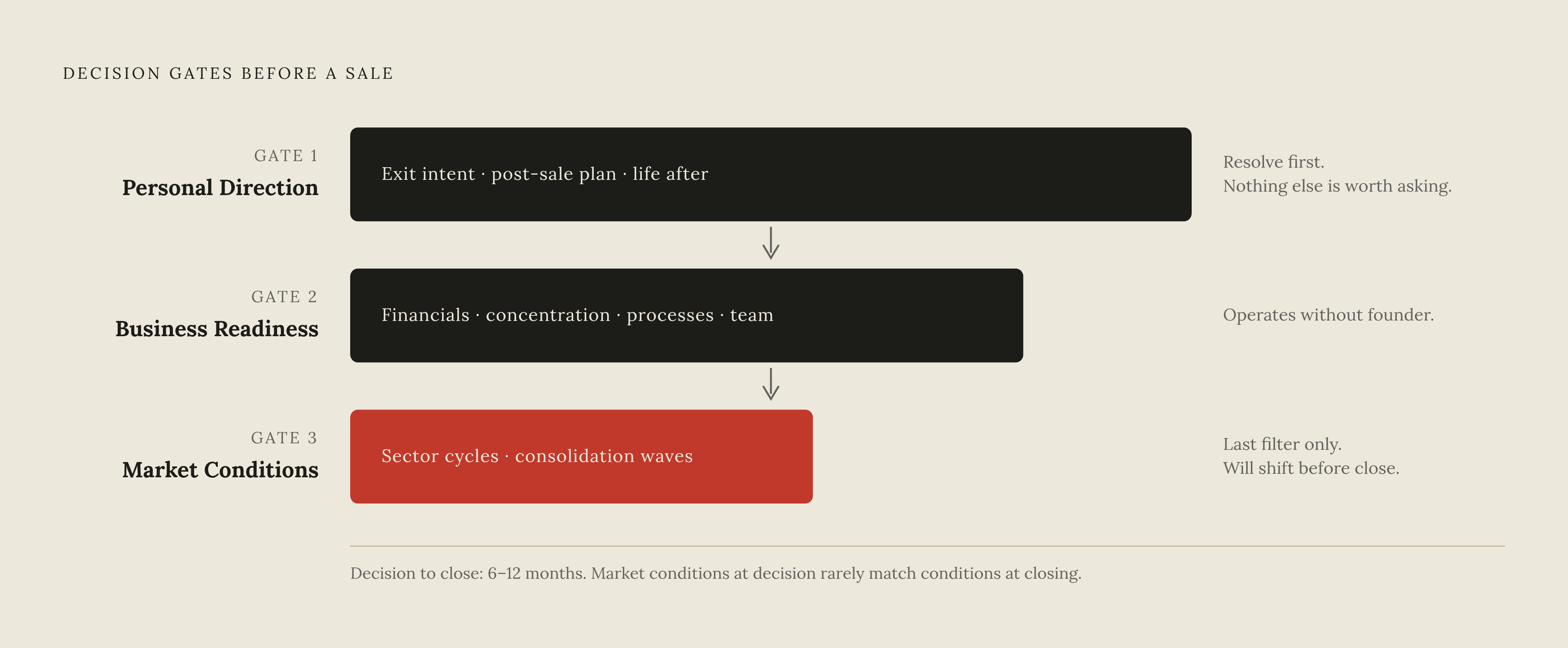
Put together, the evidence points to a specific order of operations: personal direction first, business readiness second, market conditions third, each one filtering the decision before the next is even worth asking.
Personal direction comes first because nothing downstream matters much if this part is unresolved. Does the owner want to fully exit, or stay involved in some capacity after the sale? Is there appetite to keep operating for several more years, and what would that cost in terms of performance and personal wellbeing if the answer is yes? Are there health, family, or other personal considerations shaping the realistic timeline? And can the owner actually describe what life looks like on the other side of a sale? Owners who can answer that last question tend to make sharper decisions than owners who are only running away from exhaustion or frustration without anything pulling them forward.
Business readiness comes second: it is most within an owner's direct control, and the data says it actually sets the multiple, through clean, consistent financials; a recast that shows true earnings; low customer concentration; documented processes; and a management team that can run the business without the founder in the room.
Market conditions come third, and they belong there as a secondary filter rather than a gating event. For most owners, in most industries, the consistent 2.5x to 3x SDE range holds regardless of the headlines, which makes waiting for a better macro moment a bet against a decade of evidence. For owners in the handful of sectors moving through an active consolidation wave, the sector timing is worth factoring in, carefully, and only once the first two questions have real answers.
Because a sale takes six to twelve months to move from decision to close, the market conditions an owner is reacting to on the day they decide to sell will likely look different by the time the business actually changes hands.