Strategic Buyer vs. Private Equity Acquirer for Small Business Sellers
Strategics pay for synergies; PE firms pay for standalone cash flow.

Strategic Buyer vs. Private Equity Acquirer for Small Business Sellers.
Buyer type importance for sellers
Global M&A deal value climbed 40% in 2025 to reach $4.9 trillion, and roughly 80% of M&A executives surveyed expect that pace to hold or accelerate through 2026. That volume matters to small business owners for a specific reason: McKinsey projects that close to 6 million U.S. small and mid-sized businesses will change hands by 2035, with more than 1 million of those representing viable sale candidates worth up to $5 trillion in combined enterprise value. Most owners approaching that transition fixate on one number, the headline price, and treat everything else as detail to sort out later. That's backwards, given that everything else in the deal, from structure to terms, shapes the outcome just as much as the headline price.
A strategic acquirer might see a company as a customer list and a set of contracts to bolt onto its existing platform. A private equity firm might see the exact same business as a standalone cash-flow machine worth leveraging and growing before flipping it again. Neither view is wrong. But conflating them, or worse, not knowing which one you're negotiating with, is how sellers end up surprised at the closing table.
This piece exists to close that gap. None of this tells anyone which buyer to choose. It's meant to hand over enough structural knowledge that the choice becomes a decision instead of a guess.
Goals of strategic buyers and PE firms
Strategic buyers are usually competitors or companies operating in adjacent markets, and they're not buying a business so much as buying a capability: new market access, proprietary technology, a supply chain advantage, or simply the removal of a rival from the field. Their math starts with a question that has nothing to do with the target's income statement: what does this business add to what we already have? That's a fundamentally additive lens. Revenue synergies, cost overlaps that can be trimmed, customer relationships that cross-sell into existing product lines. None of that appears in a seller's standalone EBITDA, and yet it's precisely what often drives a strategic's offer higher than anyone modeling the business in isolation would expect.
Private equity firms operate on a completely different axis. Once a small business gets acquired by a PE firm, it becomes a portfolio company, not a division absorbed into a larger corporate body. The target's standalone performance, debt serviceability, and the gap between the entry multiple paid today and the projected exit multiple years from now all feed into an underwriting model built around hitting an internal rate of return, typically somewhere in the 20 to 25%-plus range. That IRR target isn't a preference; it's the entire reason the fund exists, and it disciplines every price a PE firm is willing to pay.
Add one more pressure to the PE side of the ledger: strategic buyers often pay a premium because they factor synergies into price, while PE firms are disciplined by IRR math and entry multiple targets.
One might argue that comparing these two buyer types head-to-head oversimplifies a market that also includes individual buyers, family offices, search funds, and ESOPs. Fair enough, and those buyer types deserve their own treatment elsewhere. PE firms hold approximately $1.6 trillion in dry powder heading into 2026, creating competitive pressure to deploy capital PE Rollover Equity: Why the Second Bite Pays More - Livmo.
How each buyer approaches valuation
A strategic buyer often pays a premium because it's pricing in synergies that a PE firm's model has no room for, while PE firms stay disciplined by an entry-multiple-versus-exit-multiple calculation that a strategic doesn't need to run. A strategic buyer can justify paying above what the standalone numbers suggest because the acquisition accelerates something the strategic already needs: faster revenue growth, cost savings from combined operations, a foothold in a new geography, access to a customer base that would take years to build organically, or simply locking down talent that's scarce in the market. None of that value exists on the seller's own books, but it exists once the deal closes.
That doesn't mean PE always loses the bidding war. When a business looks like a strong platform candidate, large enough and stable enough to serve as the base for future bolt-on acquisitions, or when its growth trajectory supports a higher entry valuation than a simple multiple would suggest, PE can match or beat a strategic offer. Rollover equity, covered in more depth further down, also changes the total economics in ways that make a lower headline number competitive once the math accounts for future upside.
Context from the broader market helps calibrate expectations here. Median U.S. middle-market valuation multiples reached 6.9x adjusted EBITDA in Q2 2026, up from 6.5x across all of 2025, a signal that prices are firming even while overall deal volume stays fairly subdued.
Inside PE specifically, pricing splits sharply by the role a deal plays in the firm's strategy. Add-on or bolt-on acquisitions, businesses folded into an existing platform, typically run 4 to 6x EBITDA Private Equity Roll-Up Strategy: 2026 Complete Guide. Why does size compress the multiple this dramatically? Smaller businesses carry more concentration risk (fewer customers, thinner management benches), and PE underwriting prices that risk directly into the multiple offered.
Average net debt-to-EBITDA in PE deals fell from 6.2x in 2024 to 3.4x in 2025 Capstone Partners. Less leverage in the capital stack means PE firms simply have less borrowed money to spread across the purchase price, which caps how much they can offer in cash and pushes more of the burden onto seller rollover. That's a structural, market-wide shift, not a one-off.
A seller who runs a process with only strategic buyers, or only PE buyers, risks leaving real money on the table. Size matters significantly: businesses at $10M–$25M enterprise value drew a median of 5.7x adjusted EBITDA, with smaller sellers facing a meaningful gap versus mid-market peers. Platform acquisitions typically command 6–9x EBITDA Private Equity Roll-Up Strategy: 2026 Complete Guide. Sub-$1M businesses in a roll-up typically trade at 2–4x SDE. $1–5M EBITDA add-ons typically trade at 3–5x EBITDA.
Deal structure: what the offer looks like beyond the headline number
Strategic deals tend to run cleaner. Cash at close typically ranges from 80 to 100%, rollover equity is minimal or absent entirely, and transition periods run shorter because certainty of outcome is baked into how strategics structure offers FE International. That's their structural advantage over PE, and it serves sellers well when liquidity today matters more than optionality tomorrow.
PE deals mix things up more. A typical structure blends upfront cash with rollover equity and performance-based earnouts, so the headline number often looks larger on paper, but the actual proceeds get spread across time and tied to risk that hasn't been resolved yet. As a market-wide baseline, all-cash deals fell to just 51% in 2025, meaning nearly half of all transactions, regardless of buyer type, now include some form of deferred or contingent consideration.
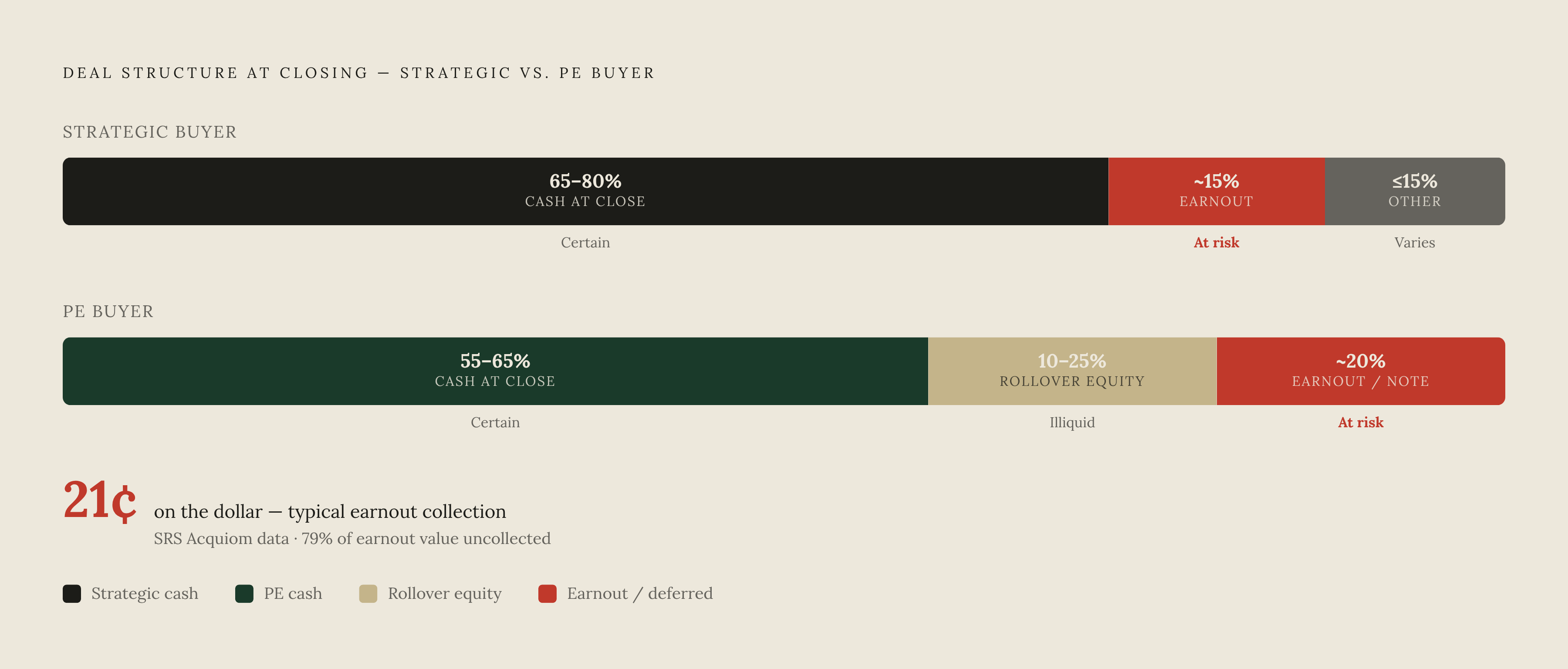
Sellers need to slow down and read the fine print carefully. Earnouts sound like extra upside until the actual payout data comes into view: SRS Acquiom reports earnouts pay out at roughly 21 cents on the dollar. That's not a rounding error, that's the majority of promised earnout value simply never getting paid out. Treat any earnout as speculative upside, never as money already in the seller's pocket.
Put the two structures side by side and the contrast sharpens. A typical PE offer runs roughly 55 to 65% cash at close, with the rest split between rollover equity and an earnout or seller note. A typical strategic offer runs 65 to 80% cash at close with a comparatively modest earnout layered on top FE International. On a risk-adjusted, after-tax basis, that gap between the two offers often narrows considerably, and in some cases it reverses entirely, even when the strategic's headline number looked smaller at first glance. The message here is straightforward: model every offer on net proceeds, timing, and risk, not the number printed on the letter of intent. SRS Acquiom reported earnouts in 24% of non-life-sciences deals completed in 2025, with earnouts appearing in 29% of deals in the lower middle market specifically, rising to 35% for deals up to $25M.
Rollover equity and the second bite of the apple
Rollover equity means the seller keeps a slice, typically 10 to 25%, of their equity in the newly formed acquisition entity rather than converting the entire sale into cash at closing. Why is this becoming more common rather than less? Circle back to that debt figure from the last section: with average net debt-to-EBITDA falling from 6.2x to 3.4x, PE firms have less leverage available to fund purchase prices, so seller rollover increasingly fills the gap that debt financing used to cover.
The prevalence numbers back this up. Rollover equity appeared in 63.6% of middle-market PE deals in 2024, averaging 14.5% of the purchase price. Zoom out further and the trend keeps climbing: rollover as a share of total enterprise value rose from 14.0% in 2021 to 16.9% through the third quarter of 2025. And the prevalence scales directly with deal size.
What's the actual upside case here? PE firms buy a platform company and bolt on smaller acquisitions, growing the combined entity, then sell the whole thing years later at a higher multiple than they paid going in. A founder who rolled equity in at a 5x entry multiple and exits when the platform sells at 10x captures multiple expansion layered on top of whatever organic growth happened in between. That's the second bite of the apple, and it's the entire reason rollover appeals to sellers who aren't ready to walk away from the upside.
But the downside case deserves equal weight. Rollover proceeds stay at risk the entire time they're held. If the PE-backed business underperforms, or the exit market cools by the time the platform is ready to sell, that rolled equity can be worth meaningfully less than it looked on paper at the original closing. Strategic buyers, for what it's worth, rarely ask for rollover at all, since their structure is generally a clean, full buyout. The second bite simply isn't on the menu with that path. Deciding between the two comes down to conviction: does the seller believe in where the business goes next, and can they stomach continued exposure to that outcome? If liquidity and certainty outweigh upside for the seller, a clean strategic exit probably serves better. In $500K–$2M EBITDA search fund and independent sponsor deals, rollover occurs in 45–60% of transactions, typically representing 10–25% of net consideration.
Your Team and Brand After the Deal Closes
Strategic acquisitions are built around integration, and that's not incidental, it's the entire point of the deal. The target business typically gets folded into the acquirer's existing organizational structure, reporting lines, and systems. Decision-making authority over pricing, hiring, vendor relationships, and capital allocation tends to shift toward corporate leadership or a dedicated integration team fairly quickly after close. The seller's brand may get absorbed into the acquirer's or retired, and roles on the team can get restructured or eliminated as the acquirer captures the cost synergies it paid for. Transition periods here tend to be defined and finite, a clear start and a clear end.
Is that a problem? For some sellers, no, not at all. Owners who are ready for a clean exit, who feel worn down by the daily grind, or who genuinely believe their business belongs inside a larger platform often find this outcome the most satisfying one available.
PE ownership looks different in almost every respect. The acquired business typically stays independent, and PE firms generally leave existing leadership and day-to-day operations in place, especially when the company was already performing well before the deal closed. But independence doesn't mean autonomy. Governance tightens considerably: structured KPI dashboards, monthly financial reviews, board consent required before making acquisitions, changes to executive compensation structures, and board sign-off on major capital decisions all become part of the operating rhythm. Staying "in control" under active board oversight looks nothing like running the business as a sole owner did. PE firms also typically expect the founder or operator to stay involved for at least a few years, helping steer the business toward its next exit. For a seller who wants continued purpose and a shot at more upside, that's a feature. For someone who's ready to step away entirely, it's friction, plain and simple.
Brand and culture diverge along the same line. PE buyers tend to preserve the brand, the workforce, and the existing operating culture, largely because their entire investment thesis depends on the business continuing to perform the way it always has. Strategic buyers, by contrast, prioritize integration efficiency over continuity, because their thesis depends on combining operations, not preserving them intact. Neither outcome is objectively better. What matters is whether it lines up with what the seller actually wants, both for themselves and for the people who depend on them.
Confidentiality, deal certainty, and process differences sellers should anticipate
Selling to a direct competitor carries a risk that's easy to underestimate until it's staring back at you across the negotiating table. Opening the books to a strategic buyer means exposing customer lists, pricing structures, operational details, and information about key people, and if the deal falls apart partway through, that competitor still walks away with everything it learned. Mitigating that risk takes deliberate planning: staged disclosure that only reveals sensitive detail as the process advances, strong non-disclosure agreements, and holding back the most sensitive material until late in diligence. This isn't something to figure out on the fly once a strategic buyer shows interest.
PE buyers bring a different kind of process. Most are professional, repeat acquirers running practiced diligence workflows on defined timelines with capital already lined up and ready to deploy. Even so, PE buyers appeared in just 11% of lower middle market transactions in the most recent published study, drawn from more than 4,400 private-target deals. Their processes, despite that relatively low participation rate, have grown more rigorous over time, not less.
Strategic buyers vary far more widely in sophistication. Some are seasoned, repeat acquirers who know exactly how to move through a deal. Others are buying a company for the first time, and that inexperience produces slower pacing, unexpected board approval requirements, or difficulty lining up financing. Knowing where a specific strategic buyer falls on that spectrum shapes realistic expectations about timeline and where the deal might stall.
Once a letter of intent gets signed, the balance of leverage shifts toward the buyer, regardless of buyer type. That non-binding document sets the tone for how the business will be run after close and locks in key terms before diligence even begins in earnest. Sellers who negotiate LOI terms carefully, rather than treating the document as a formality to sign quickly, protect themselves from renegotiation attempts once diligence uncovers something the buyer wants to use as leverage. The practical implication follows naturally from everything above: running a competitive dual-track process, engaging strategic and PE buyers at the same time, builds real negotiating leverage and keeps any single buyer from dictating pace or terms.
Matching Personal Priorities to the Right Buyer Type
A handful of honest questions tend to surface the right answer faster than any spreadsheet. Does the seller want to keep leading the business, or are they ready for a clean, final transition? Does cash certainty at close outweigh the total potential proceeds available down the road? Is there any appetite left to participate in the business's next growth chapter, or is that risk something the seller is simply done carrying? How much weight does brand continuity, team preservation, and cultural legacy carry relative to the number on the closing statement? And can the seller live comfortably with ongoing board accountability and structured reporting, or does a defined, final ending matter more?
A strategic buyer tends to fit best when maximum upfront liquidity is the priority, when the business is a strong operational match for an identifiable acquirer already in the market, when the seller wants a clearly bounded transition period, and when the synergy-driven premium is realistically achievable given the buyer's position.
A PE buyer fits better when the seller wants to stay involved and share in whatever upside comes next, when the business has a clear growth runway that a capital partner could genuinely accelerate, when rollover equity economics pencil out favorably, and when preserving the brand and the team matters as much as the price.
Neither buyer type is a default choice dictated by industry convention or deal size alone. The right answer depends entirely on what the seller is actually trying to accomplish, which is exactly why defining those goals before engaging either type of buyer changes the entire negotiation. Sellers who walk in with clarity about what they want negotiate from a position of knowledge. Sellers who don't tend to react to whatever offer lands first, and that's a much weaker position to negotiate from.
Advisors who understand both buyer types
A seller without visibility into both buyer pools simply can't create the competitive tension that drives value in the first place, and that tension between buyer types, not within one category, is where the real gains show up. Recall that PE buyers were involved in just 11% of lower middle market transactions in the most recent study covering more than 4,400 deals. Most sellers who don't actively go looking for the PE channel never see a PE offer at all because nobody brought their business in front of that buyer type.
Running a genuine dual-track process, qualifying strategic and financial buyers at the same time rather than sequentially, forces both categories to compete on price and terms instead of negotiating without any real pressure. Good advisory work in this context means more than shepherding paperwork toward a closing date. It means identifying and qualifying buyers across both categories, positioning the business credibly against each buyer type's specific thesis (synergy for strategics, standalone cash flow and growth runway for PE), and structuring the eventual transaction to protect what happens after close, not just what happens at the signing table.
The choice between a strategic buyer and a private equity firm was never really a question of which one pays more. It's a question of what kind of outcome a seller is actually building toward, and getting that answer right starts with understanding, in concrete terms, what each buyer is optimizing for.