Search Fund Deal Activity in the Lower Middle Market
Search funds are raising record capital to chase a shrinking pool of targets.

Search Fund Deal Activity in the Lower Middle Market.
Search funds and the distinct buyer type the model creates
A search fund is a vehicle where a single entrepreneur raises a modest pool of capital, then spends roughly 20 months hunting for one privately held company to buy and run personally Stanford GSB 2026 Search Fund Study. That is not much money by private equity standards, and that is precisely the point: it funds a search, not an acquisition.
The structure runs in two distinct stages, and understanding the gap between them matters more than it might first appear. Investors commit search capital first, essentially funding the searcher's time and expenses while they look for a target, then face a separate decision later about whether to fund the acquisition itself. Nothing about stage one obligates anyone to stage two.
What separates a search fund buyer from a private equity buyer is not just size, it is intent. A search fund investor is not diversifying across a portfolio of operating companies and is not planning to install a management team and step back. The searcher relocates, becomes CEO, and typically holds the business for years. That concentration of risk and commitment is what makes the model attractive to the investors who back it, and it is also what makes the operational relationship with a seller more intense than a typical financial buyer transaction.
Who actually does this? Since 2022, professionals coming out of investment banking and finance have overtaken those from private equity as the most common prior background Stanford GSB 2026 Search Fund Study. That is a meaningful signal about who is entering the pipeline, and it says something about how the model is being taught and marketed inside finance career tracks more broadly.
Two structural variants exist within the traditional model. A traditional search fund relies on an investor syndicate, which spreads risk across backers and dilutes the searcher's ownership stake in exchange for lower personal financial exposure. A self-funded search flips that trade: the searcher puts up personal capital, assumes more risk, but keeps a larger ownership position if the deal works. Both variants are still hunting in the same lower middle market pond, so the distinction matters more to the searcher's own risk tolerance than to the seller on the other side of the table.
A newer wrinkle appeared in the Stanford 2026 Study for the first time: long-duration enterprises, or LDEs Stanford GSB 2026 Search Fund Study. These are vehicles where the founder raises a committed capital pool upfront and plans to hold for a decade or longer, pursuing multiple acquisitions rather than the traditional single-target search Stanford GSB 2026 Search Fund Study. The format is young but growing fast. Of the 67 LDEs Stanford tracked, 63% launched in 2024 or later, which suggests this variant is still finding its shape as an asset class Stanford GSB 2026 Search Fund Study.
Why should a seller care about any of this? Because a search fund buyer is not extracting value and flipping the business inside a few years. This is someone betting a career on the acquisition, and that changes what a seller should expect during negotiation, how much hand-holding the transition period will require, and what kind of cultural fit actually matters when evaluating an offer.
The asset class's growth and where fund formation stands today
The Stanford GSB 2026 Search Fund Study remains the field's reference dataset, and its scope has expanded meaningfully. It now tracks 862 traditional search funds launched in the U.S. and Canada between 1984 and 2025, up from 681 funds in the prior 2024 edition Stanford GSB 2026 Search Fund Study. The study is biennial with a December 2025 data cutoff for this latest release, so the increase from 681 to 862 funds reflects 181 qualifying fund launches identified in the 2024 to 2025 window rather than researchers simply finding funds they missed before Stanford GSB 2026 Search Fund Study.
That is a concentrated burst of new entrants in a short span. Stanford's data shows new fund formation peaked in 2023 and has held near record levels straight through 2025 Stanford GSB 2026 Search Fund Study. So the model is not slowing down. If anything, more searchers are entering the field at once than at almost any prior point in the study's history.
The geography is worth a beat too. Through Stanford's partnership with IESE, the 2026 study identified 503 known core search funds operating outside the U.S. and Canada as of December 2025 Stanford GSB 2026 Search Fund Study. The model has clearly outgrown its North American origins and taken root internationally, though the deal dynamics discussed through the rest of this piece focus on the domestic market, where the data is deepest and the competitive pressure most measurable Stanford GSB 2026 Search Fund Study.
None of this growth is happening in a vacuum, though. More funds chasing acquisitions does not automatically mean more acquisitions get made, because the universe of businesses that actually fit what a search fund needs to buy has not grown at anywhere near the same pace. That mismatch, more capital hunting a roughly fixed target pool, is the tension that shapes everything from here forward.
Search fund targets and the narrow qualifying universe
What does a search fund actually buy? The Stanford 2026 Study's 2024 to 2025 cohort gives a specific answer: a median target generates about $8.1 million in revenue and $2.5 million in EBITDA, at a 25% EBITDA margin, employs around 30 people, and has been growing EBITDA at roughly 12% a year Stanford GSB 2026 Search Fund Study. The median purchase price for that profile came in at $16.0 million, a 6.2x multiple on EBITDA Stanford GSB 2026 Search Fund Study.
That $16.0 million figure is the second-highest median purchase price on record in the study's history, trailing only one prior cohort, and it sits well above the $13.5 million median across every acquisition Stanford has ever tracked Stanford GSB 2026 Search Fund Study. Prices have climbed steadily even as the multiples paid have actually softened somewhat compared to earlier cohorts, which is an interesting split: businesses are getting more expensive in absolute dollar terms even as the price relative to their earnings compresses slightly Stanford GSB 2026 Search Fund Study.
Where are these buyers looking? Services, software, and education lead the pack in the 2026 data, part of a broader pattern favoring profitable, durable, often unglamorous businesses: business services firms, vertical software companies, education providers, tech-enabled service businesses, and healthcare services operators Stanford GSB 2026 Search Fund Study. Nothing flashy. That is by design.
The $2.5 million EBITDA figure is not arbitrary, and understanding why it sits where it does explains almost everything else about this segment Stanford GSB 2026 Search Fund Study. It is large enough to support a full-time, professionally paid CEO, a real finance function, and enough debt capacity to make an acquisition financeable Stanford GSB 2026 Search Fund Study. Go much smaller and the business cannot support the overhead a search fund needs to install. Go much larger, and the business starts drawing attention from lower middle market private equity funds, who generally set their entry threshold meaningfully higher. Search funds occupy the gap between those two floors, and it is a narrower gap than the sheer number of small businesses in a given economy might suggest Stanford GSB 2026 Search Fund Study.
How narrow? That is the real constraint on this market. It is not that search fund buyers lack appetite, it is that qualifying supply is genuinely scarce Stanford GSB 2026 Search Fund Study.
The typical qualifying business shares a recognizable shape: it is founder-owned, has no institutional shareholders on the cap table, keeps reviewed rather than audited financials, and has a customer base that is stable but often under-managed Stanford GSB 2026 Search Fund Study. Recurring or repeat revenue matters. So does a fragmented customer list and an owner who is ready to exit but has no succession plan in place. That last detail describes a huge number of businesses whose owners simply do not know this buyer type exists or how to find one.
It is worth putting today's prices next to history for a sense of how far the market has moved. The 2008 to 2009 cohort, which went on to post some of the strongest investor outcomes in the study's history, bought businesses for a median of just $6.5 million Stanford GSB 2026 Search Fund Study.
How acquisition rates have shifted as competition intensifies
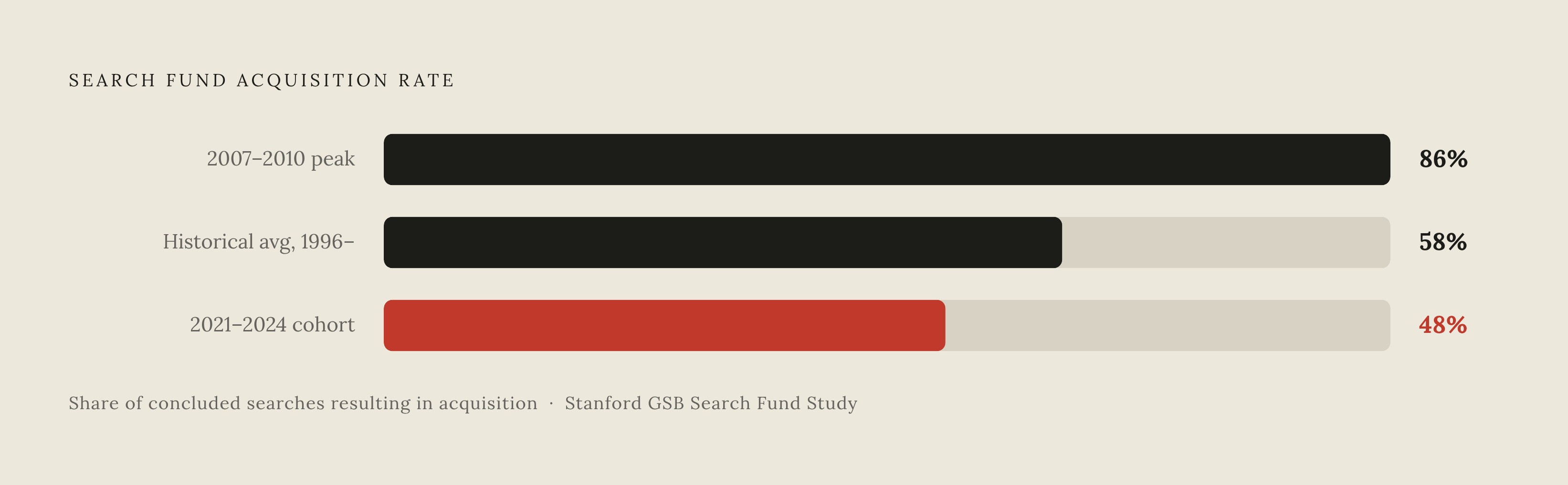
Since Stanford's first search fund report in 1996, the aggregate rate at which concluded searches result in an actual acquisition has run at 58% Stanford GSB 2026 Search Fund Study. That is the long-run baseline. But baselines can mask a lot of movement, and the movement itself produces a genuinely dramatic shift within this one.
Searchers who launched between 2007 and 2010 closed deals at an 86% rate Stanford GSB 2026 Search Fund Study. Searchers who launched between 2021 and 2024 are closing at roughly 48% Stanford GSB 2026 Search Fund Study. Less than half. That is not a minor drift, it is close to a halving of the odds that a given search actually ends in a purchase, and it happened inside about a decade and a half.
What explains the drop? Stanford's own read splits it roughly down the middle: about half the decline traces to tougher market conditions and more competition for the same targets, and the other half traces to a wider spread in searcher preparedness now that the model has become far more mainstream and attracted a broader range of talent into the pipeline. It is not a single-cause story, and resisting the urge to pin it on one factor is probably the right instinct here.
The number of letters of intent it takes to close even one deal reveals the friction in the process. Searchers who succeeded in closing an acquisition during 2024 and 2025 signed an average of 2.5 letters of intent before one of them actually made it to closing Stanford GSB 2026 Search Fund Study. Why do the rest fall apart? Diligence findings were cited as a primary reason by 79% of respondents, valuation disagreements by 45%, and lack of investor support by 40% Stanford GSB 2026 Search Fund Study Axial. A separate survey of the broader lower middle market found the same basic pattern: valuation expectations and diligence findings top the list of reasons deals fail, which suggests this is not a search fund quirk but a feature of the segment generally Stanford GSB 2026 Search Fund Study.
What should a seller take from this? An LOI from a search fund is a statement of serious interest, not a finished transaction. Diligence is where deals go to die most often, and a seller who has not organized their financials, contracts, and customer concentration data for scrutiny is taking on real closing risk no matter how enthusiastic the buyer sounded in the first meeting. It is also worth considering that 42% of concluded searches never close any deal at all Stanford GSB 2026 Search Fund Study. The risk in a search fund negotiation is not split evenly between buyer and seller. Sellers should go in knowing they may be spending months with someone who, for reasons outside anyone's bad faith, simply does not get to the finish line Stanford GSB 2026 Search Fund Study.
Search funds relative to other active buyers in the lower middle market
Search funds are not a niche curiosity anymore. In 2025, they accounted for 14% of closed deals on Axial's platform, a record share and a concrete data point for how much room this buyer type now occupies in a major lower middle market deal channel Stanford GSB 2026 Search Fund Study.
Set that against the rest of the buyer landscape and a bigger story becomes visible in the numbers. Private equity funds and independent sponsors together made up 45% of closed Axial deals in 2025, down sharply from 61% in 2021 Stanford GSB 2026 Search Fund Study. Family offices, holding companies, and other buyer categories have picked up the difference. The buyer mix in this market is genuinely diversifying, not just adding search funds at the margin but reshuffling who closes deals overall Stanford GSB 2026 Search Fund Study Axial.
Part of that reshuffling traces to the sheer growth in the number of buyers operating in this space. McGuireWoods estimated roughly double the number of independent sponsor firms active in 2026 compared to 2019 Stanford GSB 2026 Search Fund Study. That is an entire category of financial buyer that barely existed at scale a decade ago now competing directly for the same targets search funds want.
The broader private equity backdrop complicates the picture further. PwC's midyear outlook found overall deal volume down sharply, 67% fewer transactions in the first half of 2026, even as aggregate deal value rose almost 10% because the deals that did happen skewed larger Stanford GSB 2026 Search Fund Study. Middle market activity specifically saw hesitation tied to persistent valuation gaps between buyers and sellers Stanford GSB 2026 Search Fund Study. One might argue that caution among larger PE buyers creates relative opportunity for search fund-sized transactions, since less competition is chasing that segment from above. But it also means less capital is being recycled out of exits, which tightens the overall system.
And buyers themselves seem to expect prices to keep climbing. BDO's 2026 Private Equity survey of 400 fund managers found 82% expecting deal prices to rise as competition tightens Stanford GSB 2026 Search Fund Study. That is buyer sentiment, not seller sentiment, and it is a telling signal: even the people writing the checks think they are going to pay more going forward Stanford GSB 2026 Search Fund Study.
Axial recorded over 2,600 new buyside members joining its platform in 2025, a meaningful year-over-year increase Stanford GSB 2026 Search Fund Study. That growth reflects an expansion of organized, professionalized buyers across the board, not just search funds specifically Stanford GSB 2026 Search Fund Study. For a seller, the takeaway is straightforward: search funds are a real and growing category worth understanding on their own terms, but they are one buyer type among several, family offices, independent sponsors, holding companies, strategic acquirers, and running a credible sale process means knowing what each type values differently rather than assuming any one of them is the obvious best fit.
Search fund deal financing and its effect on deal certainty
How does a search fund actually pay for a $16 million acquisition when the investor syndicate only committed a few hundred thousand dollars during the search phase Stanford GSB 2026 Search Fund Study? The answer is in the capital stack.
The SBA 7(a) program is not a fallback option here, it is a primary financing mechanism for a large share of these deals Stanford GSB 2026 Search Fund Study. The program funded a substantial volume of loans in FY2025, and acquisition financing made up a rising share of that loan count according to the SBA's own FY2025 Annual Performance Report Stanford GSB 2026 Search Fund Study.
Seller financing deserves a specific mention, because sellers sometimes misread it. Sellers who understand that going in negotiate from a more informed position than those who treat every ask for seller paper as a red flag.
The bigger risk sits with the investor syndicate itself. The syndicate that funded the search has to re-affirm its commitment when it comes time to actually fund the acquisition, and that re-affirmation is not automatic, particularly if diligence turns up something the investors do not like Stanford GSB 2026 Search Fund Study. A seller negotiating with a searcher is, in a real sense, also negotiating with a group of people they may never meet.
On pricing, the segment trades at a modest discount to the broader lower middle market. Financing conditions at the smaller end of the market have also held up better than they have further up market, where private credit has tightened more noticeably. But the specific instrument financing a given deal, SBA loan, bank facility, or private credit, shapes both the structure and the timeline in ways that are not interchangeable.
What should a seller do with all this? Read the financing stack behind an offer before accepting an LOI. A deal that depends on SBA approval runs on a different clock and carries different risk than one backed by equity that is already fully committed and just waiting on diligence Stanford GSB 2026 Search Fund Study. Knowing which one is in front of you changes how a seller should plan the rest of the transition. The Stanford GSB 2026 Search Fund Study shows seller financing is structural in most cases, with the 10%–20% seller note functioning as a normal part of the deal, and sellers should understand this going in. GF Data's Q1 2026 M&A Report puts the median lower middle market buyout multiple for deals under $25M EV in Q1 2026 at 6.7x EBITDA, and the search fund median of 6.2x in 2024–2025 is modestly below that broader LMM median, consistent with the segment these buyers target; the Stanford GSB 2026 Search Fund Study confirms this.
The next decade's ownership transition wave and the expanding qualified seller pool
The demographic backdrop here is large enough that it is not really a matter of opinion. McKinsey's Institute for Economic Mobility put the number of small and medium-size businesses facing ownership transitions by 2035 at roughly six million, representing as much as five trillion dollars in enterprise value Stanford GSB 2026 Search Fund Study. That scale is not anecdotal, and it sets the stage for everything discussed in this section.
Much of that wave traces back to a single generational fact: the youngest baby boomers turned 60 in 2024 Stanford GSB 2026 Search Fund Study. An estimated 2.3 million U.S. businesses are boomer-owned, and a significant share of them will need to transition over the coming decade, whether through sale, family succession, or simple wind-down Stanford GSB 2026 Search Fund Study. Roughly half of lower middle market sellers cite retirement as their primary motivation for selling, and that motivation lines up neatly with what a search fund buyer actually offers: someone who intends to run the business forward, not strip it for parts.
But raw numbers can mislead if taken at face value. More sellers entering the market over the next decade does not automatically translate into more qualified targets for search fund buyers Stanford GSB 2026 Search Fund Study. Most businesses that come up for sale still will not clear the filters discussed earlier, adequate EBITDA, clean financials, recurring revenue, no institutional ownership tangle Stanford GSB 2026 Search Fund Study.
That tension should not be resolved too quickly. It also creates a kind of urgency on both sides of the table. Lower middle market multiples have expanded modestly as the asset class has matured, and the gap between lower and upper middle market pricing has narrowed over time, meaning sellers who wait to bring their business to market are, on balance, entering under somewhat stronger conditions than historical norms would have predicted. For the founder-owned business specifically, running an organized, well-prepared sale process now, while buyers are active and financing remains available, beats waiting until a compressed window forces a flood of similar businesses onto the market all at once.
Investor return data: findings and limitations
The headline number from the Stanford 2026 Study is an aggregate pre-tax IRR of 33.9% and a 4.75x return on invested capital across all U.S. and Canadian core search funds through December 31, 2025 Stanford GSB 2026 Search Fund Study. Funds that both acquired a company and fully exited it did even better on average, 39.3% IRR and 5.98x ROI Stanford GSB 2026 Search Fund Study. Measured against the public markets, the aggregate public market equivalent across every search fund tracked comes out to 2.88x Stanford GSB 2026 Search Fund Study.
Those are genuinely strong numbers. But what do they conceal? Bad outcomes make up a meaningful chunk of that aggregate. Roughly 31% of acquired companies end up generating losses for their investors, and recall from earlier that 42% of concluded searches never close a deal at all, which means investors in those funds never even got to the operating stage Stanford GSB 2026 Search Fund Study. Strip the largest outlier winners out of the dataset entirely, and the picture settles closer to a 2.8x ROI and 27% IRR; Papermark's analysis of the underlying Stanford numbers shows this Stanford GSB 2026 Search Fund Study. Still solid, but a noticeably different story than the headline suggests.
Independent research backs up this skew. A Yale SOM dataset of 768 observations found a mean MOIC of 2.78x versus a median MOIC of 1.60x, a gap confirming that a small number of outsized winners pull the average up while the typical deal outcome sits meaningfully below that headline figure Stanford GSB 2026 Search Fund Study. Separate independent research tracking LP portfolios has landed closer to 2.5x MOIC, broadly consistent with Yale's finding and a useful gut check against the headline figures Stanford GSB 2026 Search Fund Study.
What does any of this mean for a seller sitting across the table from a searcher? A buyer backed by an experienced, well-resourced group of search fund investors is genuinely better positioned to close than one whose syndicate is thin or largely untested. The quality of the money standing behind a searcher matters just as much as the searcher's own resume, maybe more, when it comes to actually getting to a signed deal. And the return skew itself explains something about investor behavior at the negotiating table: sophisticated search fund investors keep backing this model, despite a real failure rate, because the winners are large enough to justify the risk across a portfolio of bets. Sellers do not need to adopt that same risk calculus themselves, but understanding it clarifies why a searcher's backers behave the way they do when diligence gets hard or valuation talks stall.
Takeaways for sellers and their advisors
Put the pieces together and a clear picture forms. Search fund buyers are serious, well-capitalized, and growing in number, but they are also disciplined to the point of narrowness about what they will actually buy, and a meaningful share of the searches that reach out to a given seller will not end in a closed transaction regardless of how the early conversations go. That is not a reason to dismiss the buyer type. It is a reason to prepare for it correctly.
Sellers whose businesses fit the profile discussed throughout this piece, roughly $2.5 million in EBITDA, clean and reviewed financials, recurring revenue, no messy cap table, sit inside a genuinely narrow and valuable target zone Stanford GSB 2026 Search Fund Study. Advisors working with these sellers should treat an LOI as the start of the real work, not the finish line, and should push early for clarity on how a given searcher's deal is financed and how committed the investor syndicate actually is behind them Stanford GSB 2026 Search Fund Study. The businesses that move fastest through diligence tend to be the ones that came prepared for it before the first term sheet ever landed.