Private Equity Activity in the Canadian Lower Middle Market
Most Canadian PE deals are small, founder-led businesses being acquired for existing platforms.

What Canadian PE's headline numbers show once you strip out the mega-deals
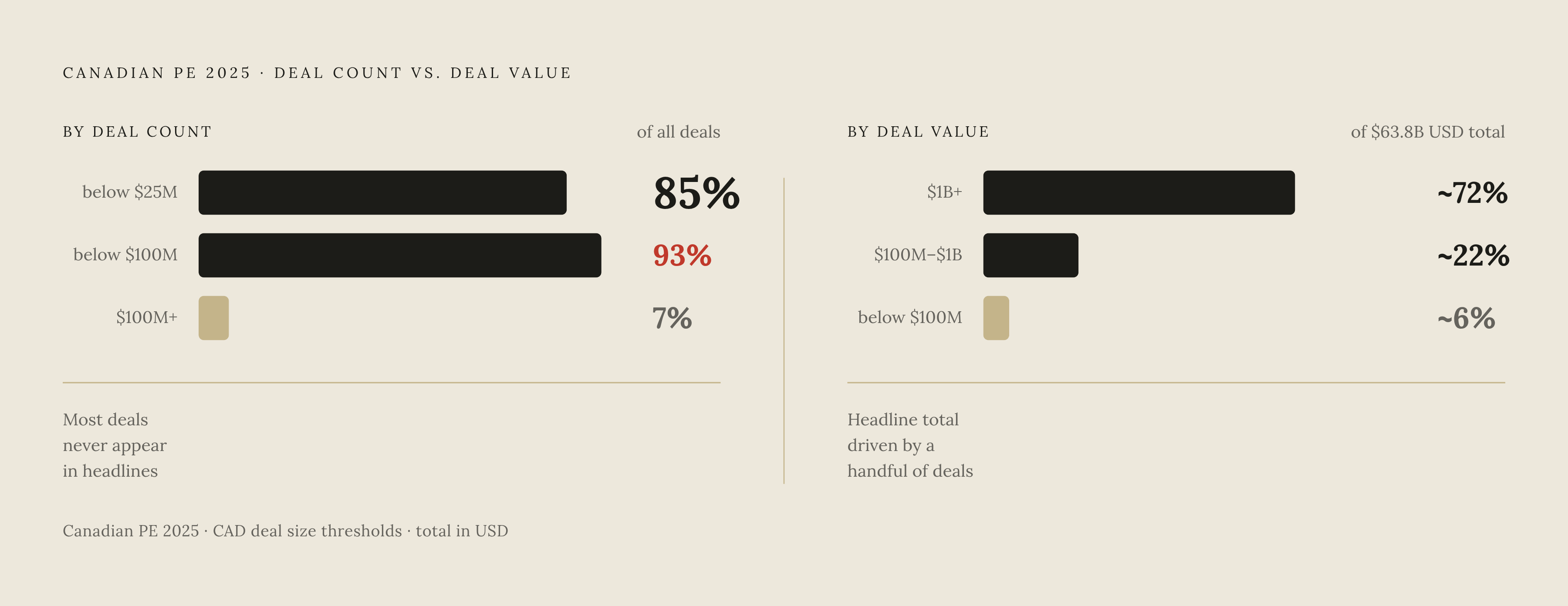
Canadian private equity looked enormous in 2025 on paper. The year-end tally most business press picked up put full-year deal value at $63.8 billion USD across 596 completed transactions. CapitalPad's version puts it at CAD $57.5 billion deployed over the same stretch, with the gap between those two numbers coming down to currency, scope, and cutoff dates. That's normal in private markets reporting. What matters more is what's actually driving the dollar total, and the answer is a handful of privatization deals large enough to bend the whole curve. What's left after stripping those out is still almost everything, at least by deal count.
What's left after stripping those five or six deals out is still almost everything, at least by deal count. According to the CVCA, almost everything, at least by deal count. Ninety-three percent of Canadian PE deals in 2025 closed below CAD $100 million. Eighty-five percent closed below CAD $25 million. So the $63.8 billion headline and the 93%-under-$100M reality are both true, and they describe two different markets wearing the same label. One is dollar-weighted, dominated by a handful of enormous transactions. The other is deal-count-weighted, made up of hundreds of smaller, founder-led businesses changing hands every year.
Most people misread this market: they anchor on the $63.8 billion figure and assume it tells them something about pricing, competition, or buyer behavior. Here's where most people misread this market: they anchor on the $63.8 billion figure and assume it tells them something about pricing, competition, or buyer behavior, but it doesn't. The number that shapes deal strategy, pricing, and negotiating leverage for anyone selling a business under CAD $25 million is the 93%. Treat the mega-deal figure as market color. Treat the deal-count breakdown as the map.
Sophisticated capital moving toward the lower middle market
Public markets are trading at rich valuations, and large-cap PE funds are sitting on record dry powder chasing a shrinking pool of attractive big-ticket targets. That combination drives competition up and expected returns down at the top of the market. The smarter capital has moved down-market instead of piling further into it. Entry multiples in the lower middle market tend to leave more room to grow value through operational improvements a founder never got around to.
LP behavior explains why this shift has staying power rather than being a temporary rotation. The capital still being raised has been concentrating in larger, already-established funds, a flight to quality where LPs would rather back a general partner with a track record than gamble on a new thesis. That should, in theory, squeeze out smaller funds focused on the lower middle market. It hasn't, and the reason is a shift in what LPs actually measure.
That metric is DPI: distributions to paid-in capital, a straightforward measure of how much cash a fund has actually returned against what it collected. DPI has become a dominant lens LPs use to judge a GP's performance, and that pushes general partners toward businesses with predictable, recurring cash flow rather than businesses that only look good on a growth chart. A well-run lower middle market company, the kind with sticky customers and boring, repeatable revenue, is built for exactly that metric. Capital keeps flowing this direction because the LMM is the segment best equipped to produce the cash returns LPs are now grading on.
Where Canadian PE activity is concentrated (by geography and sector)
These deals actually close in a narrow set of places once you zoom into the map. CapitalPad and the CVCA report that in the first half of 2025, Quebec and Ontario together accounted for 99.6% of PE dollars and 83% of PE deals in Canada. Quebec alone represented roughly 60% of deals, 192 against Ontario's 74, a gap far wider in deal count than in dollar value. CT Acquisitions reports Quebec-based sponsors account for over 40% of deal volume in the LMM specifically.
Quebec's dominance isn't an accident of timing. Decades of family-owned manufacturing and distribution businesses built a dense base of founder-led targets, and a cluster of sponsors and institutions, a cluster of local sponsors and institutions spent years cultivating relationships with those owners before anyone called it a trend. Ontario's activity skews toward larger transactions, which appears bigger in dollar terms than in raw deal count.
But treat the "rest of Canada" numbers with some skepticism. The CVCA flags that this figure likely reflects under-reporting more than an actual absence of deal activity, since transactions outside Ontario and Quebec often close quietly, without the disclosure requirements or press coverage that make deals in the two largest hubs visible in aggregate data. A founder outside those two provinces shouldn't read the concentration numbers as a locked door. It looks more like a reporting artifact than a real boundary, and sponsors chasing deal flow have started looking outside Quebec and Ontario precisely because everyone else assumes that's where the door shuts.
The buy-and-build strategy reshaping who gets acquired
Platform deal or add-on: that distinction should be one of the first things a founder sorts out about any buyer at the table. A platform deal is a PE firm buying a company to build a new investment thesis from scratch. An add-on is a PE firm buying a company to bolt onto something it already owns, folding it into an existing portfolio company's operations, customer base, or geographic footprint.
McCarthy Tétrault reports that add-on transactions made up two-thirds of Canadian buyout deals, the highest share since 2023. By dollar value, though, add-ons accounted for just under 10% of total buyout activity. Sit those two numbers next to each other and the real story comes into focus: platform-sized transactions dominate the dollars, add-ons dominate the count. Most of what's actually closing in this market, measured deal by deal, is buy-and-build.
The CVCA's H1 2025 data backs this from a different angle. Add-on and M&A transactions made up 61% of capital and 59% of deal count in the buyout category, and buyout/add-on capital deployment rose 18.25% versus H1 2024. That trend is widely expected to keep building into 2026, with add-ons becoming an ever-larger share of PE activity as firms chase synergies, geographic reach, and cost savings across companies they already own.
For a founder-led business, the buyer showing up is increasingly likely to already own something adjacent, such as a competitor, a supplier, or a company one region over doing similar work. That reshapes the diligence conversation and the integration plan, and it often reshapes the multiple, too. A strategic add-on can justify paying more than a standalone platform investor would, simply because the buyer has already mapped out where the synergies sit before the first call.
The Canadian LMM buyer landscape in 2026
Calling every buyer in this space a "private equity firm" flattens a landscape that's actually pretty varied. CapitalPad's read on the market includes regional PE firms, family offices, institutional platforms, independent sponsors, and acquisition entrepreneurs, including search fund operators, all competing for the same pool of founder-led businesses.
Independent sponsors deserve a closer look because the model has matured fast and changed who a founder is actually negotiating with. Rather than raising a committed blind-pool fund up front the way a traditional PE firm does, an independent sponsor lines up equity deal-by-deal, which usually means more sector-specific experience at the table and more room to structure a deal around what the seller actually wants. CapitalPad notes this group now competes aggressively for the same targets larger funds want, and a founder shouldn't assume the biggest fund in the room automatically makes the best offer. Search funds remain a smaller slice of the buyer base, typically younger operators raising capital to acquire and run a single business themselves rather than assemble a portfolio.
Named activity gives a sense of scale and range. Ironbridge Equity Partners, which partners exclusively with Canadian middle-market companies, focuses on consumer and business products and services, manufacturing, and distribution; it recently completed a partnership with Veradek Inc. and exited its investment in a maintenance and service company. Sagard, a multi-strategy platform affiliated with a diversified holding company, combined its mid-market PE business with Geneva-based Unigestion in September 2025, creating a platform exceeding USD $23 billion and tracking toward USD $100 billion in assets under management by 2029; it also launched a Canadian retail PE fund in 2025 giving accredited investors access to secondaries, co-investments, and primaries with a small and mid-market focus.
Northleaf Capital Partners holds over CAD $31 billion in commitments across private equity, credit, and infrastructure, with a PE platform exceeding USD $15 billion across more than 625 mid-market deals; its Secondary Fund IV closed at USD $663.5 million, and CPP Investments committed CAD $750 million to Northleaf in March 2026. CAI Capital Partners has put $1.6 billion into private equity over three decades with a focus on the Canadian market across North America. Penfund closed Penfund Prime at USD $1.8 billion and continues deploying Penfund Capital Fund VII across auto aftermarket, financial services, healthcare, distribution, and consumer staples. Novacap closed its first dedicated digital-infrastructure fund at over USD $1 billion in January 2025. TorQuest invested in Waste Solutions Canada Inc. in September 2025.
That's a wide range of check sizes, sector focuses, and deal structures, all hunting in the same general size range at the same time. For a founder, the takeaway is straightforward: the right buyer is rarely the loudest name in the room.
What PE buyers look for when evaluating a Canadian LMM business
Valuation in this market runs as a range with real spread. CLA notes that businesses with strong margins, recurring revenue, and resilience to tariff exposure can command real premiums over the field. For the LMM specifically, LinkedIn and Portage commentary puts typical valuations for well-run companies in the 4x to 6x EBITDA range, with premiums layered on top for businesses that check the right boxes.
Available market data offers a useful reference point, with a caveat attached. Reported average EBITDA multiples across the lower middle market up through the larger middle market have generally run modestly above long-run averages but below the peak seen in 2021 and 2022. Those figures skew toward a different, larger market than most Canadian LMM sellers are actually in, and Canadian LMM multiples generally run lower. A founder benchmarking against it needs to adjust expectations down, not treat it as a direct read on what their business is worth.
What actually pushes a business from the average end of that range toward the top? Buyers run through the same checklist no matter the sector. Quality of earnings comes first: can the financials be trusted, and do they survive a forensic look? Customer concentration comes right behind it. A business pulling most of its revenue from one or two customers either kills a deal outright or gets discounted hard, no exceptions. Buyers also want a management team and operating systems that don't collapse the day the founder walks out, revenue that renews rather than getting re-won every quarter, and a credible second-in-command already in place. That last point alone is consistently one of the biggest single levers on valuation in this market, and founders who ignore it until the process starts are the ones who watch their multiple shrink mid-negotiation.
Vendor take-backs, where the seller finances part of the purchase price, remain standard, typically running 10% to 15% of deal value. Vendor take-backs, where the seller finances part of the purchase price, remain standard, typically running 10% to 15% of deal value. Earnouts get used more selectively now, mostly when financial performance has been choppy or recently spiked, tied to measurable metrics over a 12 to 36 month window. Equity rollovers, where the seller keeps a minority stake post-close, appear widely in PE-backed deals as a way to keep the founder incentivized through the transition. Diligence has slowed down too: 90 to 120 days from signed letter of intent to closing is typical now, driven by tougher quality-of-earnings reviews, lender requirements, and documentation demands that weren't standard a few years back. CLA reports representation and warranty insurance, once mostly a large-deal tool, has become standard even at this size, largely because it lets buyers shrink the escrow they'd otherwise hold back and sharpen their bid.
What this market means for a Canadian founder's exit
Ninety-three percent of Canadian PE deals close below CAD $100 million. That number isn't a footnote to the mega-deal headlines, it's the actual shape of the market, and a founder running a business somewhere between a modest revenue base and the lower middle market isn't a rounding error in some bigger story about privatizations and dry powder. That founder is the story, at least in terms of where the deal count actually lives.
A generation of owners built their companies decades ago, and as they near retirement, succession has stopped being a hypothetical conversation and become an active one. Pair that demographic reality with a buyer landscape that's grown genuinely varied, regional funds, family offices, independent sponsors, search fund operators, all chasing the same pool of targets, and a founder today has more real options than the previous generation had. The market isn't waiting only for the biggest platform buyer with the flashiest fund. It includes independent sponsors willing to structure a deal around a founder's specific goals, and add-on buyers who already understand the sector and can move faster because they're not building a thesis from zero.
None of that erases the real work involved. Buyers will still scrutinize customer concentration, still demand a credible management bench, still push for earnouts when the financial story has bumps in it. But knowing where the market actually sits, who's actually buying, and what they actually screen for gives a founder something more useful than optimism going into that first meeting: an accurate map of the terrain before anyone sits down at the table.
Sources
- Lower Middle Market M&A: Private Equity Buyer Predictions
- A Canadian pulse on private equity
- 2026 Private Equity Outlook Webinar - Top Ten Takeaways
- Canadian LMM Private Equity Opportunity | 2026 Data & Statistics
- intelligence.cvca.ca
- Canada LMM PE Buyer Landscape (2026): 35+ Active Sponsors | CT Acquisitions
- portagemaadvisory.com
- CAI Capital Partners