Private Equity Roll-Up Strategy and What It Means for Founder Sellers
PE sponsors now deploy record capital into smaller companies through roll-up acquisitions.

Private equity roll-ups have become the default way sponsors buy small and mid-sized companies, and 2025 made that fact impossible to ignore. Deal activity rebounded hard last year, with thousands of U.S. Transactions pushed total deal value across a threshold that has only been crossed once before in history, according to Cherry Bekaert's PE report. That's a significant recovery. That's a market snapping back into a shape it has occupied only one other time, ever.
What's driving the volume matters as much as the volume itself. The substantial majority of U.S. buyouts in the second quarter of 2025 were add-on acquisitions rather than new platform purchases, and Cherry Bekaert's full-year tally puts add-ons at nearly three-quarters of all buyout activity. Three out of every four deals sponsors closed last year weren't new bets on an industry, they were bolt-ons layered onto a platform someone already owns. Roll-up used to be a specialty strategy, the kind of thing a handful of operationally minded funds ran while everyone else did straight buyouts. It has become the default approach. It is the buyout market.
Two forces explain why the pace holds into 2026. Dry powder sitting on sponsor balance sheets is near record levels, roughly $1.1 trillion as of year-end 2025, and that capital has a clock on it: limited partners expect it deployed, not parked. For a founder sitting on a profitable HVAC company, a dental practice, or an IT services shop, this is the buyer landscape right now: well-capitalized, under pressure to spend, and organized specifically around buying businesses like theirs. Three Fed rate cuts in H2 2025 lowered the cost of capital, and Cherry Bekaert notes that 2026 is positioned as a year of accelerated deployment.
How the platform-and-bolt-on playbook works
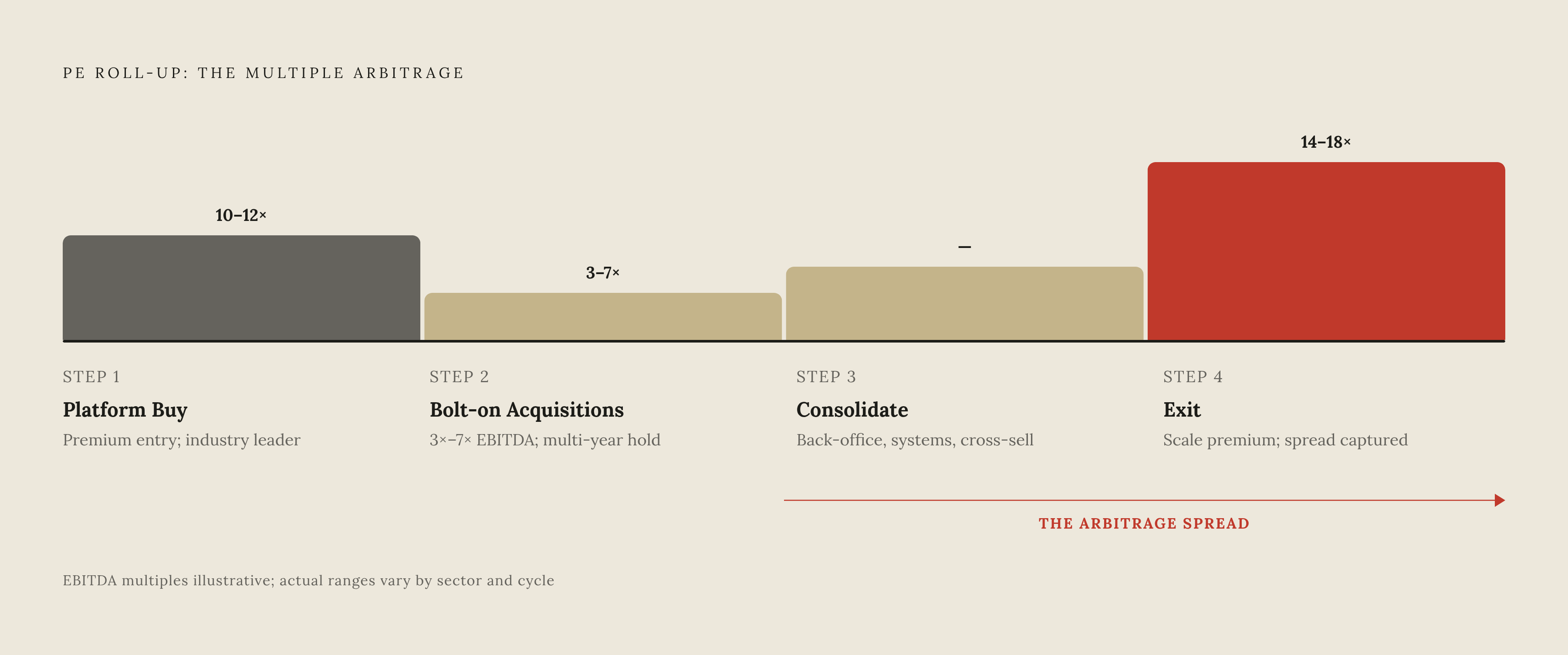
To understand why that capital keeps landing on smaller companies specifically, it helps to walk through the mechanics of what a roll-up actually is. The goal is growth engineered around something called multiple arbitrage. It's engineered around something called multiple arbitrage, and once you see the math, the whole strategy stops looking mysterious.
Per CT Acquisitions' guide, the process runs in a series of steps. First, the sponsor buys an established, industry-leading business at a premium multiple, essentially paying up for a company solid enough to anchor everything that follows. From there, in step two, the platform starts acquiring smaller, complementary businesses at 3x to 7x EBITDA, typically over a multi-year hold, with a cadence that ranges from a handful of add-ons to dozens. Step three is where the unglamorous work happens: consolidating accounting, HR, IT, and procurement into shared back-office functions, standardizing operating systems across every acquired business, and cross-selling into the combined customer base. Step four captures the payoff, geographic density, real leverage with suppliers, a stronger customer franchise, and a brand that means something at scale.
The economics land on a simple idea: buy small companies cheap, and exit the combined platform expensive.
But multiple arbitrage alone doesn't explain which roll-ups actually perform. Bain's 2024 analysis of buy-and-build deals from 2010 through 2019 found that platforms built around real organic growth or margin improvement delivered meaningfully higher returns than those leaning on multiple arbitrage alone. In other words, the sponsors capturing the biggest returns aren't just financial engineers stacking cheap acquisitions into an expensive wrapper, they're actually building better businesses that produce those returns. That distinction resurfaces later in this piece, because it's the single most useful lens a founder has for judging whether a buyer's offer is backed by substance.
There's also an academic case for all this, not just a practitioner one. A McKinsey study spanning two decades, cited via DealRoom, found that programmatic smaller-deal M&A, the steady drumbeat of add-ons rather than occasional giant transactions, generates more value over time than large one-off deals. The theory and the practice point the same direction, which is part of why roll-ups have become the default rather than the exception. A roll-up (buy-and-build) is defined as a strategy that acquires a "platform" company, then bolts on 10–50+ smaller targets to create scale and capture multiple arbitrage at exit.
Which industries are being consolidated and at what pace
None of this is theoretical for founders operating in the right sectors. If a business sits in one of these categories, the odds that a sponsor has already mapped the local competitive landscape, including that specific business, are higher than most owners assume.
Why these industries specifically? It's not arbitrary. They tend to share a few structural traits: ownership is fragmented across thousands of small, independently run shops, revenue is often recurring or contract-based, and there's real upside in bringing professional management to businesses that have historically been run by a single owner-operator. Those are the exact conditions that make multiple arbitrage work, since fragmentation means bolt-ons are cheap and plentiful, and recurring revenue means the combined platform is easier to underwrite.
Healthcare deserves its own mention here, separate from the broader services list. CT Acquisitions' research brief highlights PE consolidation specifically in physician practices, specialty clinics, and healthcare technology providers, an area that runs on its own regulatory and reimbursement logic but follows the same underlying roll-up mechanics.
What might be most striking to a founder evaluating offers is the depth of competition on the buy side. Each of these active roll-up industries has multiple PE platforms running simultaneously, not one dominant buyer cornering the market. That means a qualifying seller in HVAC or veterinary services isn't negotiating with a single suitor, they're sitting in the middle of a genuinely competitive buyer pool.
The scale some of these platforms have reached illustrates just how far the strategy can run. Service Logic, backed by Bain Capital and Mubadala as of late 2025, now operates more than 140 commercial HVAC locations. And in veterinary care, IVC Evidensia now runs more than 2,500 locations across 20 countries, acquiring as many as 300 independent clinics a year, and in one stretch, as many as 56 in a single month, across 12 geographic regions. Wrench Group encompasses approximately 25 brands with $3B+ in revenue across HVAC and home services. Sila Services, following a Morgan Stanley Capital Partners exit worth approximately $1.5B, comprises 30+ brands.
Some sponsors have moved past the traditional multi-year cadence entirely. CT Acquisitions' research brief describes an accelerated sub-strategy where certain PE firms acquire 30 to 50 businesses within a single calendar year. The pace of consolidation, in the industries where it's happening, is no longer measured in quarters. It's closer to a monthly rhythm. Named platform examples, per CT Acquisitions / research brief, illustrate the scale the strategy can reach. Apex Service Partners, backed by Alpine Investors, comprises 107 brands with $1.3B in revenue and anchored a $3.4B continuation vehicle in 2023 as a home services anchor.
Platform vs. bolt-on: the classification that sets your price
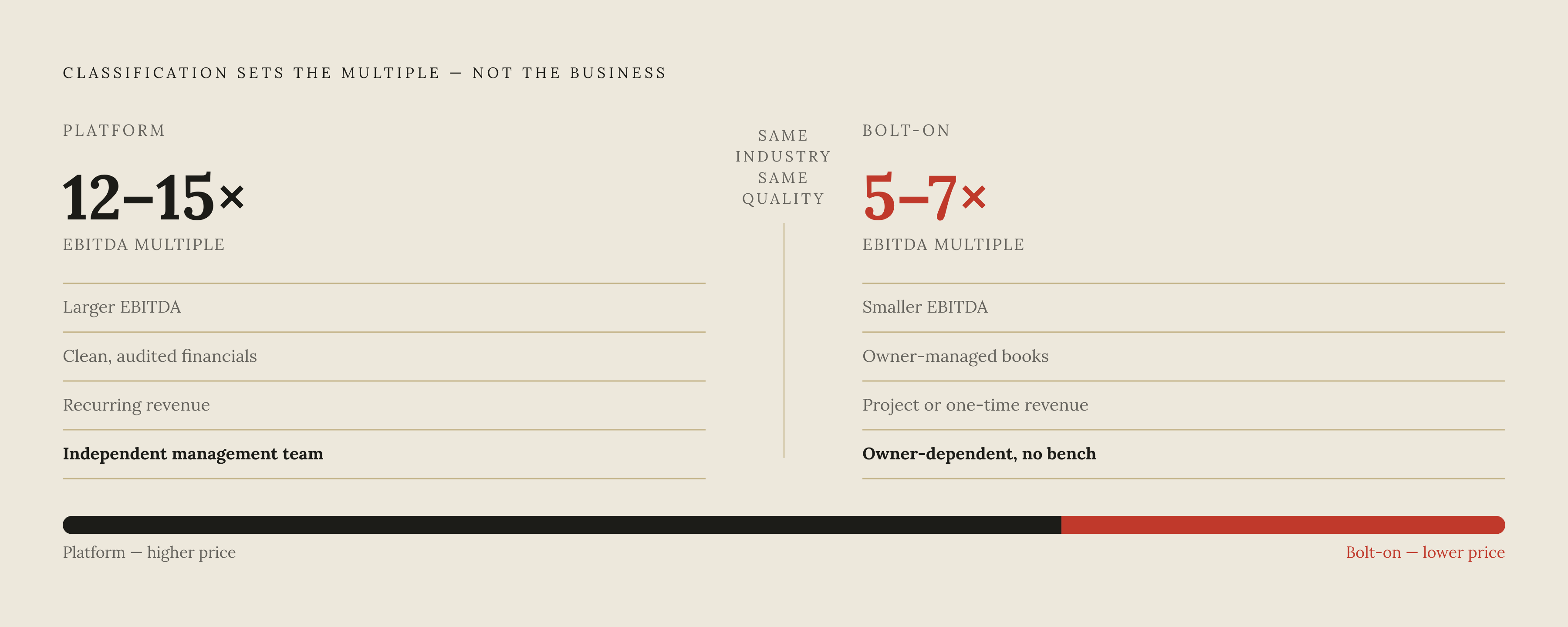
The picture gets personal for any founder actually weighing a sale. The price difference isn't about quality. The sponsor slots a given business into its consolidation thesis, and understanding that placement matters before any letter of intent lands on the table.
What earns platform status? A larger EBITDA base, financials clean enough to survive institutional due diligence, meaningful recurring revenue, and, critically, a management team capable of running the business without the founder in the room. Sponsors pay up for platforms because a platform isn't just a business, it's the base everything else gets built on top of. A bolt-on, by contrast, tends to run smaller, lean heavily on the owner for day-to-day decisions, and lack the management bench a sponsor needs to hand it real operating responsibility. Bolt-ons get bought to add revenue and customer relationships into an existing platform, not to lead one.
One might ask why this classification should change how a founder negotiates. It changes everything about it. Knowing which side of that line a business falls on determines whether accepting the first letter of intent makes sense, or whether running a competitive process to surface multiple bidders is worth the extra months it takes. The gap between platform and bolt-on pricing isn't a rounding error, it's often the difference between a good outcome and a great one.
What makes this section more than a warning is that classification isn't fixed. Founders can move themselves toward platform status well before a sale process starts, by building out management depth, growing the share of revenue that's contractual or recurring, tightening up financial reporting to institutional standards, and simply growing EBITDA to a size that can anchor a platform on its own. None of that happens overnight. But a founder with two or three years of runway before a sale has real ability to change which multiple applies to them. The fundamental split is that the platform pays sellers a higher multiple while the bolt-on pays sellers a lower multiple (same industry, same business quality, different price based on where the PE firm slots the seller into its consolidation thesis).
What the return data says about which roll-ups win
So do roll-ups actually deliver the returns the thesis promises? The data says mostly yes, with an important asterisk. That's a strong headline number, and it's the reason so much capital keeps flowing into the strategy.
But Bain's 2024 analysis, referenced earlier in the mechanics section, complicates that headline in a useful way. Deals built around organic growth or real margin improvement produced considerably higher multiples on invested capital than deals relying purely on multiple arbitrage. Returns, in other words, depend heavily on whether the sponsor is actually improving the businesses it buys, not just shuffling them into a bigger box and hoping the market pays more for the box.
A 2025 analysis from Gain.pro adds a growth dimension: platforms that completed more than five add-ons showed strong median five-year revenue compound annual growth rates. The compounding effect the whole strategy is named for, buy-and-build, turns out to be real when the integration work behind it actually gets done.
For a founder evaluating a specific sponsor's offer, this isn't academic. A PE firm that can articulate an actual operating thesis, how it plans to grow the combined business, not just how it plans to arbitrage the entry and exit multiples, is a fundamentally more credible buyer. And that credibility matters most for any founder taking rollover equity as part of the deal, because rollover in a well-run platform is worth materially more than rollover in one that's just stacking cheap acquisitions and hoping the math works out. A BCG/HHL study of deals exited 1998–2012 found that buy-and-build investments generated a substantially higher average deal IRR versus standalone buyouts, a meaningful spread in favor of the strategy.
Roll-up failure modes and their effects on sellers
That asterisk from the return data deserves its own section, because failure in this strategy is common enough that founders need to plan around it, not just hope to avoid it. CT Acquisitions notes that a meaningful share of PE roll-ups underperform their initial expectations, and Andy Silverman of Parkway Capital, drawing on a large volume of independent sponsor deals reviewed annually, estimates that the majority of roll-ups fail to hit their projected synergies within the first two years. That is a sobering number for a strategy that dominates as much deal volume as this one does.
CT Acquisitions outlines specific patterns behind that failure rate. One is under-built management infrastructure: platforms try to scale acquisition volume without hiring a platform CEO who actually has roll-up experience, a strong CFO, or regional operations leaders to run day-to-day execution. The org chart, in other words, matters just as much as the pace of acquisitions, and sponsors who skip that step tend to find out the hard way. Another is back-office duplication: rather than centralizing finance, HR, IT, marketing, and procurement across the businesses they've bought, failed platforms let each acquisition keep running its own systems in parallel, which quietly kills the entire synergy thesis the deal was built on.
What does this mean concretely for a founder who's taken rollover equity in one of these platforms? If the sponsor underperforms, that rollover equity returns far less than modeled, and the risk isn't distributed evenly. Preferred securities held by the sponsor and its investors typically rank above common rollover equity in the capital structure, so the founder absorbs downside before the institutional capital does.
Before signing anything, a founder should ask certain questions because of that risk. A founder can reasonably request a sponsor's integration playbook, a track record of how past add-ons actually performed, detail on management team depth, and the platform's overall leverage levels. These are simply the necessary questions. They're the exact questions that separate a platform likely to compound value from one likely to become a cautionary statistic.
The mechanics of rollover equity and what founders give up in the exchange
All of this failure-mode discussion matters most because of how common rollover equity has become in these deals. Rollover equity is the arrangement where a founder doesn't take full cash liquidity at close, but instead accepts a portion of the sale proceeds as an equity stake in the newly combined company, a structure that's standard in PE acquisitions of both corporations and LLCs. Per GF Data's middle-market outlook, rollover appeared in the majority of middle-market PE deals in 2024, averaging a modest share of total purchase price. Founders entering a sale process should expect this to be part of the conversation, not treat it as an unusual ask.
Why do sponsors want it so badly? Alignment is part of the answer: a founder who still holds equity after close has real incentive to help the integration succeed rather than just cash out and walk away. Financing is the more practical reason sponsors want it. Rollover reduces how much capital the sponsor needs to put up front, which has mattered more since 2022, when higher debt costs compressed how much leverage sponsors could responsibly use. There's also a signaling effect for the sponsor's own investors: a founder willing to roll a meaningful stake reads, to limited partners, as a founder who believes in where the business is headed.
The upside case is genuinely attractive. If the platform executes well and exits at a high multiple, and the founder's rollover was priced at a low entry multiple to begin with, that second stake can produce a liquidity event that rivals or even exceeds the original sale. That's the "second bite of the apple" pitch sponsors make, and for founders in well-run platforms, it can be real.
The downside case matters to internalize before signing. If the platform underperforms, the rollover barely breaks even, and given where common rollover typically ranks in the capital structure relative to preferred securities, the "alignment" argument sponsors make tends to run in one direction. Founders should understand, specifically, where their rollover sits relative to preferred claims, whether those preferred securities carry a return preference ahead of common equity, how future add-on acquisitions will be financed and what that means for dilution, what information and preemptive rights they actually hold, and the drag-along, tag-along, repurchase, good-leaver, and bad-leaver provisions buried in the shareholder agreement.
There's a practical, day-to-day consequence too, one that rarely gets mentioned in the term sheet. Founders who roll equity often keep running their old business much as they always did, but now also find themselves pulled into deal sourcing, diligence on the sponsor's other acquisition targets, and legal discussions that may be entirely outside anything they've handled before. The rollover is an ongoing job with new responsibilities attached. It's an ongoing job with new responsibilities attached.
Earnouts, headline price, and founder take-home
Everything above points toward a single, uncomfortable truth: the number on the letter of intent is almost never the number that lands in a founder's account. Cash versus stock, earnouts, rollover percentages, escrow holdbacks, working capital adjustments, and liquidation preferences all fall between the headline price and the actual wire transfer, and per data from SRS Acquiom, cited via Mondaq and referenced by WaveUp, that gap is a structural feature of these deals, not an exception.
Every mechanism discussed in this piece, platform versus bolt-on pricing, rollover equity terms, the sponsor's actual operating track record, feeds into that gap one way or another. A founder who understands the playbook well enough to know whether they're being priced as a platform or a bolt-on, well enough to interrogate a sponsor's integration history before accepting rollover terms, and well enough to read a capital structure before signing it, is a founder positioned to negotiate from real leverage rather than from the passive hope that the first offer on the table is the best one available.