Individual Buyer and Searcher Acquisition Behavior in the Lower Middle Market
Search funds and individual buyers now claim nearly half of lower middle market deals.

A seller has spent years picturing the buyer as a private equity fund, imagining a team of associates, a partner who flies in for the final walkthrough, and an investment committee somewhere behind the scenes. Demand is heavily concentrated in the lower EBITDA bands across all non-PE buyer types, with nearly all active buyers including that range in their criteria and demand tapering off meaningfully at the upper end. That picture is now wrong more often than it's right. Private equity funds and independent sponsors together accounted for a declining share of closed deals in 2025, a real drop from their dominant position in 2021, even as search funds reached a record share of closings and individual investors held their ground. New buyer registrations hit an all-time high in 2025, up roughly a third year over year, and nearly all of that growth came from categories outside traditional private equity: search funds, holding companies, family offices, individual investors. Separately, a quarterly survey of hundreds of business brokers and M&A advisors found that individual buyers, split between first-timers and repeat entrepreneurs, closed roughly 44% of lower middle market acquisitions.
The headline is not simply that more buyers showed up. A different category of buyer has taken real market share, and that buyer operates on different decision logic, different financing, and a different diligence process than the PE funds sellers have been advised to expect for years. Sellers who understand that distinction going in are negotiating from a position of knowledge; those who don't are pitching the wrong audience with the wrong materials. So who exactly are these buyers, and what do they actually want?
The three archetypes of non-institutional buyer that now dominate sub-$5M EBITDA deals
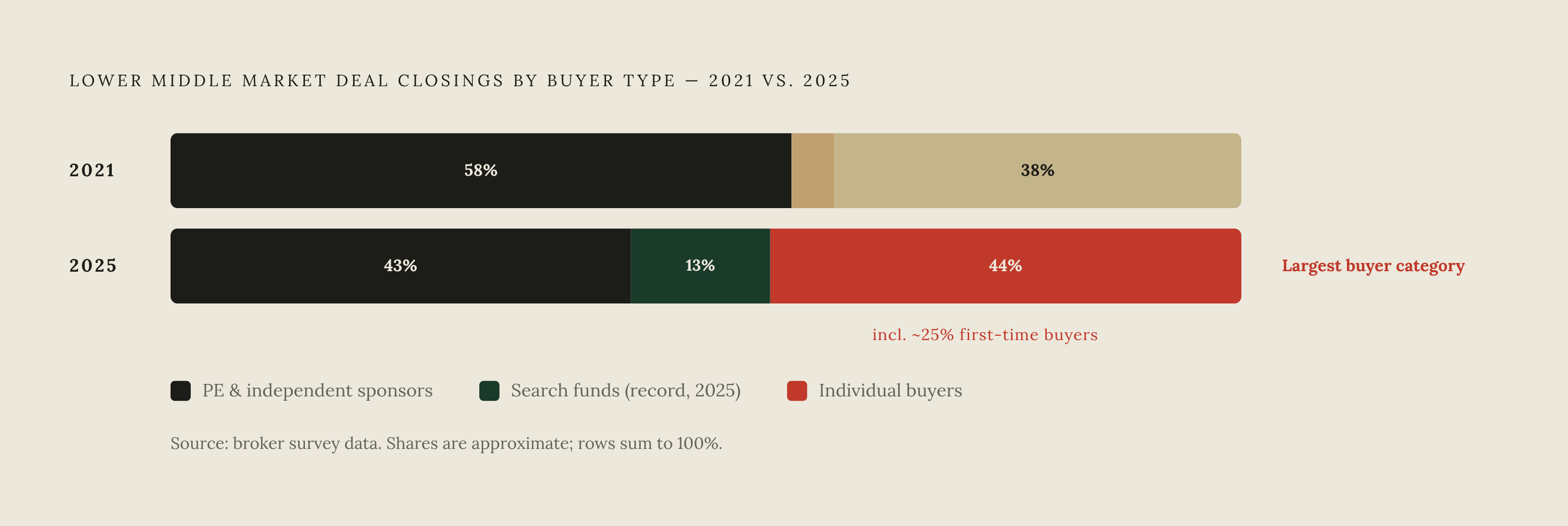
Lumping every non-PE acquirer into one bucket called "individual buyer" obscures more than it reveals. Three distinct archetypes make up this category, each with its own capital source, timeline, and appetite, and treating them as interchangeable leads sellers to misjudge exactly who is sitting across the table.
The self-funded individual investor buys a business to run it personally, day to day, typically financing the purchase with an SBA 7(a) loan layered under personal equity. Tres McVean of RCM Legacy Capital is a clean illustration of how fast this archetype can move: he activated his membership on a buyer platform on October 10, 2024, began pursuing the Maintenance Chef deal that same day, signed a letter of intent on November 4, 2024, and closed on April 28, 2025. Barely three weeks from first login to signed LOI, and under seven months to close. First-time buyers alone, a subset of this archetype, accounted for roughly a quarter of all lower middle market acquisitions in 2025.
The search funder is a different animal entirely: typically an MBA graduate, professionally trained in the search process, backed by a syndicate of investors who fund the search itself and commit equity for the eventual acquisition. The model is graduating a historically large cohort of searchers, with new fund launches peaking in 2023 and staying near record levels through 2025, and that pipeline shows up directly in the closing data: search funds reached a record share of closed deals in 2025. Searchers are moving up-market, and only a small fraction of their closed deals fell below a modest purchase price threshold, signaling a growing mismatch between the search fund model and the smallest businesses it was once associated with. Why the drift upmarket? Aggregate search fund returns, strong on both IRR and equity multiple, have attracted more institutional backing, and more capital chasing the same search fund structure naturally pushes searchers toward larger, better-capitalized targets.
The independent sponsor, sometimes called a fundless sponsor, sources and structures a deal without a committed fund behind it, then raises equity deal by deal from family offices and institutional limited partners once a letter of intent is signed. This model closed roughly 340 platform deals in 2025, drawing equity mostly from family-office LPs, and the ranks of independent sponsor firms have roughly doubled since 2019. A study of 846 independent sponsor transactions found a median gross IRR meaningfully above matched traditional buyouts, with loss rates statistically indistinguishable from those buyouts, a performance profile that explains why the model keeps expanding rather than fading as a stopgap. Deal sizes in this category swing hard year to year: average total enterprise value peaked in 2024 before falling back sharply in both 2022 and 2025, a pattern that tracks lender appetite more than buyer intent. And the boundaries between these three types are already getting blurry. A cross-sectional study of 76 active acquirers identified five as search/independent hybrids, confirming that the categories described above function more as points on a spectrum than as fixed boxes.
Why so many buyers have entered the market at once
Two forces, moving independently but reinforcing each other, explain why this shift looks durable rather than cyclical. One is demographic and largely outside anyone's control. The other is institutional, and it's accelerating.
Start with supply. A wave of boomer-owned businesses is reaching transition age, and the businesses coming to market skew smaller: the bulk of projected exits fall among micro and emerging middle-market companies, a size band that sits below what institutional private equity typically underwrites but fits the self-funded individual and the search funder almost perfectly. That mismatch between deal size and traditional buyer appetite is precisely the gap non-institutional buyers have moved to fill.
Demand has caught up to meet it. The independent sponsor model now commands substantial dedicated capital, Stanford's search fund data shows a steady year-over-year rise in graduating searchers, and SBA 7(a) lending funded tens of billions of dollars across tens of thousands of loans in FY2025, with acquisition financing climbing to more than a quarter of total loan count. An analysis of the U.S. lower middle market buyer pool from 2018 through mid-2026 estimates a meaningful multiplier in buyer numbers over that period, even correcting for the same buyer appearing in multiple cohorts, which points to a supply-demand balance that has tightened materially in favor of sellers who know how to reach this pool.
There's also a social dimension that rarely makes it into deal-flow statistics. The "Entrepreneurship through Acquisition" frame is also expanding the social base of individual buyers: it is increasingly pursued by Black professionals, displaced public-sector workers, experienced corporate employees, and returning caregivers, groups with transferable management skills who see acquisition as a path unavailable through traditional employment. These are people with real, transferable management experience who see buying a business as an opportunity that a traditional corporate ladder never offered them. That expansion of who searches, and why, feeds directly into the buyer pool growth described above, and it's one more reason to expect this shift to hold rather than reverse.
How individual buyers and searchers define the buy-box in practice
Once a seller accepts that the buyer pool has changed, the next question is practical: what does this new buyer actually want? Individual buyers and searchers tend to work from an explicit, often written set of acquisition criteria, commonly called a buy-box, and a business that doesn't fit it on paper rarely gets a serious look, regardless of how well it's actually run.
EBITDA is the first filter. Demand across non-PE buyer types clusters heavily in the lower EBITDA bands, with nearly every active buyer across categories including that range somewhere in their criteria, and interest tapers off noticeably as EBITDA climbs higher.
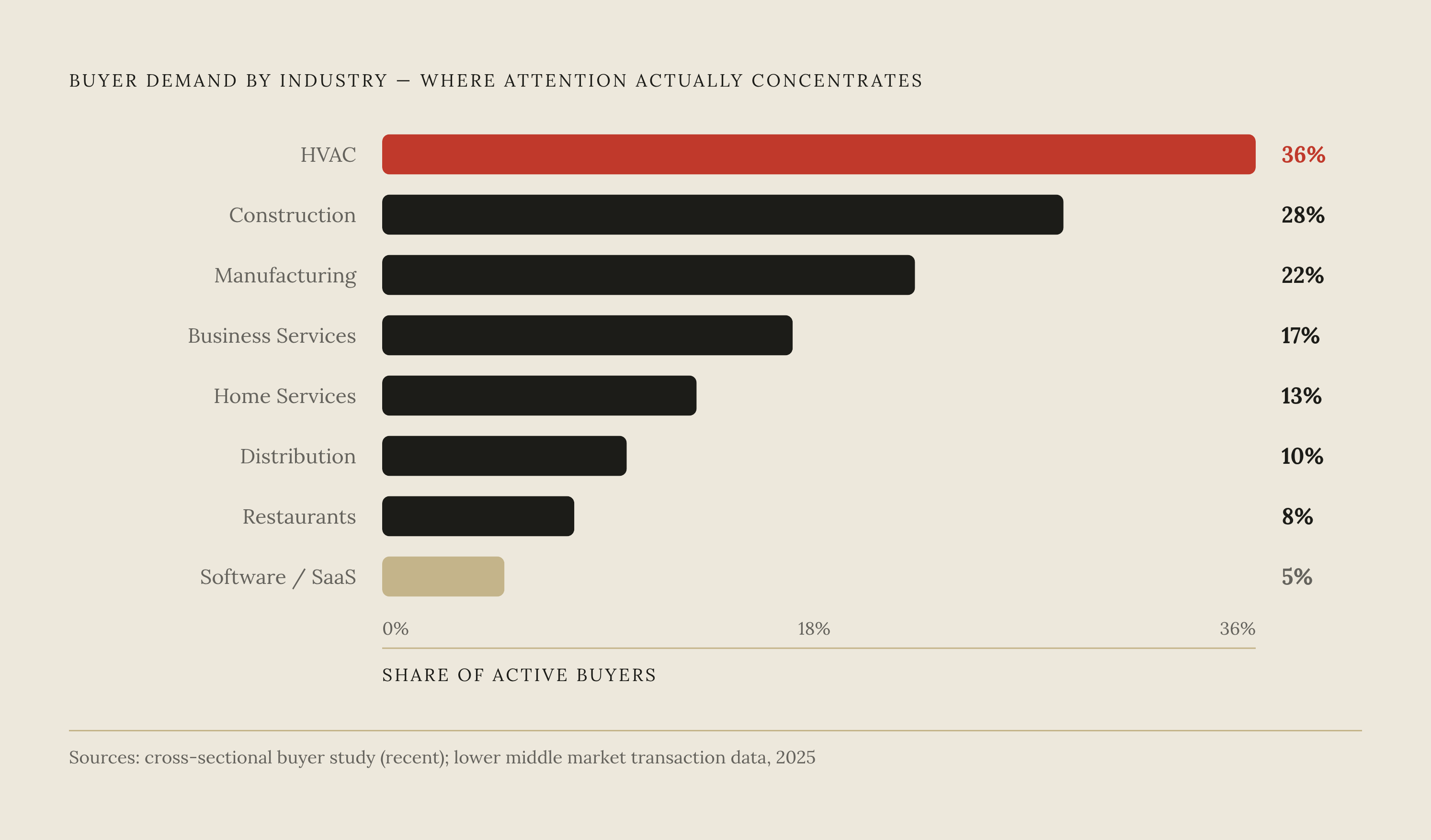
Industry matters just as much as size, and the pattern here cuts against a lot of popular assumption. Buyer demand concentrates in services and manufacturing verticals, with manufacturing, electrical contracting, HVAC, distribution, and home services forming the deepest buyer pools, while software and SaaS combined draw a much smaller share of active buyers. That's a meaningful correction to the assumption that software commands the most buyer attention. Broker data backs this up from a different angle: construction ranked first in lower middle market transaction activity in 2025, with business services and manufacturing close behind, and personal services and restaurants rounding out the top five across the broader market.
Control is close to non-negotiable. The large majority of buyers in this category require control of the business outright, and only a small fraction will entertain a minority recapitalization. A seller hoping to sell a partial stake while staying at the helm is fishing in a very narrow pond. Continuity preferences differ by archetype: search funders and individual investors generally want the seller to transition out over six to twenty-four months, while independent sponsors tend to be more flexible on this point because they often install a new management team or partner with the existing one. Geography rounds out the picture: regional relationships and local intermediary networks shape a substantial amount of deal flow, and many buyers build geographic concentration directly into their acquisition criteria.
How individual buyers source deals through proprietary flow
Knowing what a buyer wants only matters if the seller understands how that buyer actually finds deals. Individual buyers operate under real financial constraints: every hour spent diligencing a deal that ultimately falls through is an hour, and often real capital, that can't be recovered. That pressure pushes them toward relationship-driven sourcing over open marketplace listings wherever possible.
Four channels dominate. Business-for-sale marketplaces offer high volume but heavy competition, often producing multiple offers on the same listing. Broker and M&A advisor relationships serve as the primary channel for brokered lower middle market deals, with advisors filtering and pre-qualifying buyers on the seller's behalf before an introduction ever happens. Direct outreach to owners who haven't listed their business for sale offers the least competition but demands the most patience: a searcher may spend the better part of two years working this channel before reaching a data room. Referrals from accountants, lawyers, and wealth advisors round out the picture, often producing the warmest leads of all because the referrer already holds the owner's trust.
The gap between sourcing channels appears in timeline data. Working with an experienced buy-side advisor compresses acquisition timelines from an 18-to-36-month range for do-it-yourself sourcing down to 6 to 12 months, and it surfaces off-market deals that never appear on broker listings. The Tres McVean/Maintenance Chef case illustrates the speed possible when a buyer enters a curated marketplace with clear criteria: LOI within weeks of joining, close within six months.
There's an uneven distribution of buyer demand by sector, too, and it should change how sellers in certain industries think about timing. Buyer interest in construction, HVAC, and manufacturing substantially outpaces the number of listed deals in those categories, with HVAC alone drawing 36% of buyers in one recent cross-sectional study. A seller in one of those sectors who surfaces through any channel, marketplace, broker, or referral, should expect competitive interest almost immediately. Waiting passively to be discovered on a listing site makes little sense in a market this active; a seller working with an advisor connected to the right buyer archetypes reaches people who would never run a marketplace search.
How individual buyers finance acquisitions differently from PE
Private equity funds write equity checks from committed capital and layer debt on top through a familiar playbook. Individual buyers don't have that luxury, and their financing stack is layered differently, leaning more heavily on the seller's willingness to participate in the deal itself. That difference in financing mechanics is where individual buyer transactions are actually won or lost, more so than on headline price.
Below a certain enterprise value threshold, SBA 7(a) loans function as the primary debt vehicle: government-guaranteed, available up to a statutory cap, and central to how the self-funded individual buyer finances a purchase. The program funded tens of billions of dollars in FY2025 across tens of thousands of loans, with acquisition financing climbing to more than a quarter of total loan count. For transactions that sit above that range, regional and community banks step in with senior credit facilities, typically underwritten at moderate multiples of EBITDA.
What does this mean for what the seller actually walks away with? D|Sellers averaged a high share of cash at close in the fourth quarter of 2025, with most sellers in individual buyer transactions still receiving the bulk of deal value upfront rather than deferred. But seller financing remains a common bridging tool, usually structured as a subordinated note running five to seven years, or as an earnout tied to customer retention, though broker data shows earnouts and retained equity used sparingly compared to seller notes. Earnouts and representation and warranty insurance are becoming increasingly standard tools in the lower middle market, useful for bridging valuation gaps between what a buyer will pay today and what a seller believes the business is worth, and for delivering a cleaner exit once the deal closes; sellers should go into negotiations expecting these terms to come up.
One might argue a seller note is just a financing mechanism, a way to bridge a gap in the capital stack. Buyers read it as something more: a seller's willingness to carry a meaningful note signals genuine confidence in the business's forward earnings, and a flat refusal to carry any note at all can raise questions about risk the seller isn't disclosing. There's also a valuation reality smaller sellers need to reckon with directly. Businesses positioned as add-ons rather than platforms face a structural discount of 30% to 40% on the multiple, relative to platform investments of similar quality. A seller of a smaller business faces a real valuation haircut unless the business can be credibly positioned as a platform in its own right.
How individual buyers conduct diligence around cultural fit
Diligence with a private equity buyer runs through an investment committee: financial models get stress-tested, quality-of-earnings reports get dissected line by line, and the deal team reports upward to partners who weren't in the room for a single management meeting. Diligence with an individual buyer or searcher runs through a person who is about to become the owner, and often the operator, of the business. That distinction changes what gets scrutinized and how.
A self-funded buyer financing the deal with an SBA loan and personal equity is underwriting their own working life. The questions that matter to that buyer center on the business running without the current owner's specific relationships and habits, the employees staying once ownership changes, and the buyer personally having the operating chops to step into the seller's shoes. A search funder, backed by investors who expect a real return, still has to answer those same questions before an investment committee of their own, but the committee is smaller and the relationship between funder and target company is far more personal than anything in a typical PE deal.
This is why the transition period matters so much more here than it does in an institutional sale. Search funders and individual investors generally want the outgoing owner to stay involved for six to twenty-four months, and that stretch of time functions as its own extended diligence process: can the new owner actually run this business, learn the customer relationships, and keep the team intact, with the seller coaching from the sidelines rather than running day-to-day operations? Independent sponsors, who often install their own management team or partner with existing leadership, face less of this pressure, which is part of why their diligence tends to look more conventional, closer to what a private equity fund would run.
None of this means individual buyers skip financial diligence. Quality of earnings still gets checked, customer concentration still gets scrutinized, and the numbers still have to hold up under a lender's underwriting standards for the SBA or bank facility financing the deal. But an individual buyer or searcher tends to close, rather than walk away deep into a process, when the buyer can picture themselves running the business alongside its existing employees and customers. Financial engineering closes PE deals. For the individual buyer, the diligence period is really an extended audition, for the buyer and the business both, and a seller who understands that going in is far better positioned to make it through to closing.
Sources
- Buyer-Side Demand in the U.S. Lower Middle Market: A Cross-Sectional Analysis of 76 Active Acquirers (Q4 2025–Q2 2026) | Zenodo
- Who’s Buying in the Lower Middle Market in 2026? Key Buyer Trends From Axial Data
- Why Search Funds are Becoming an Increasingly Important Buyer | IBBAinsights: Winter 2025
- The IBBA® and M&A Source® Announce the Market Pulse Q4 2025 Survey Results
- The 2026 Lower Middle Market Buyer Mandate Report
- THE INDEPENDENT sponsor model is an emerging force in middle-market M&A,