Post-Pandemic Normalization in Small Business M&A Volumes
Mega-deals rebounded while small business M&A stayed flat, reshaping who can sell and how.
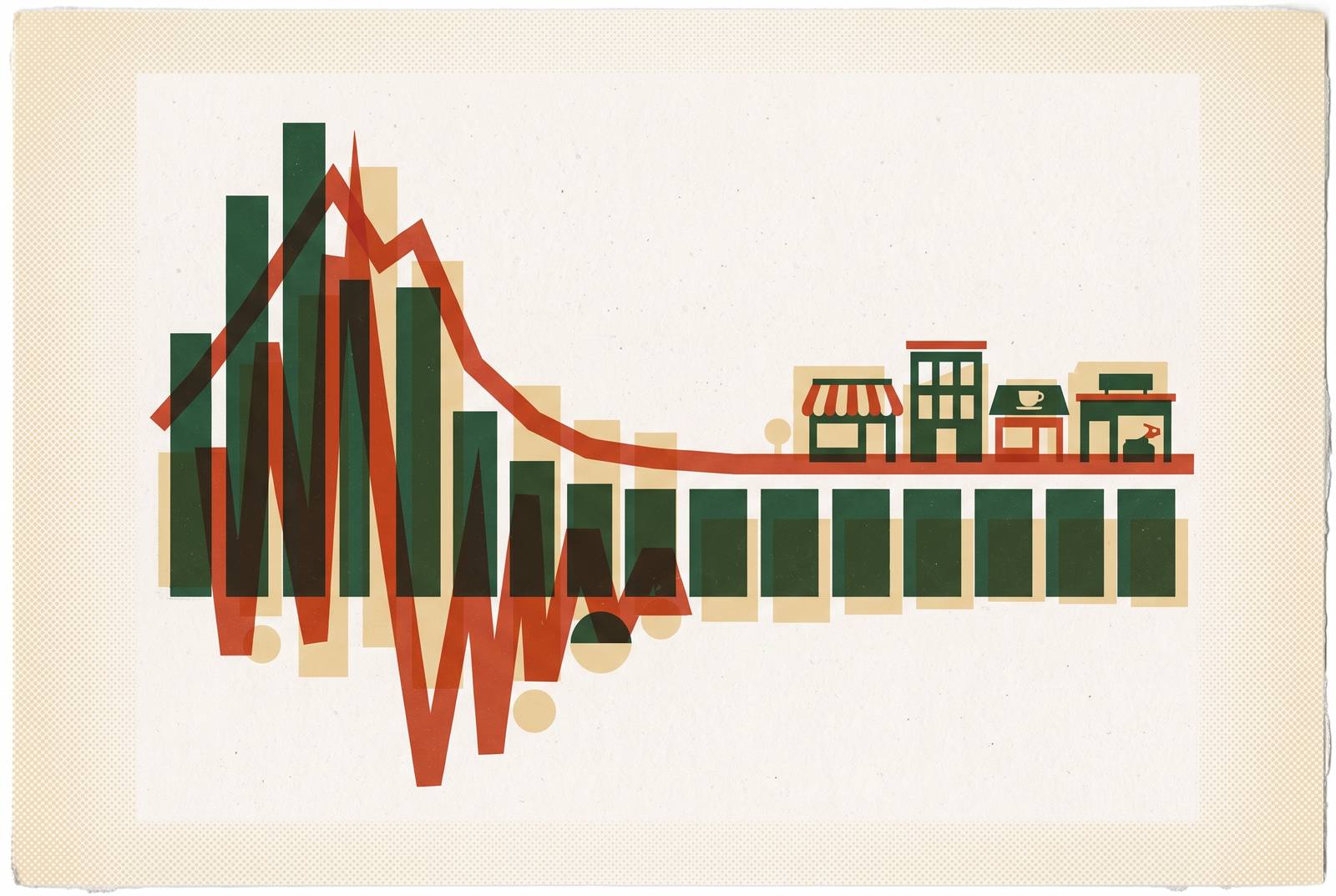
Deal volumes were distorted by the pandemic in both directions (collapse, then sugar rush, then correction), and small business M&A is now settling into a new baseline shaped by demographic pressure, financing conditions, and strategic buyer behaviour that owners need to understand before they plan an exit.
How the pandemic bent the M&A curve for small businesses
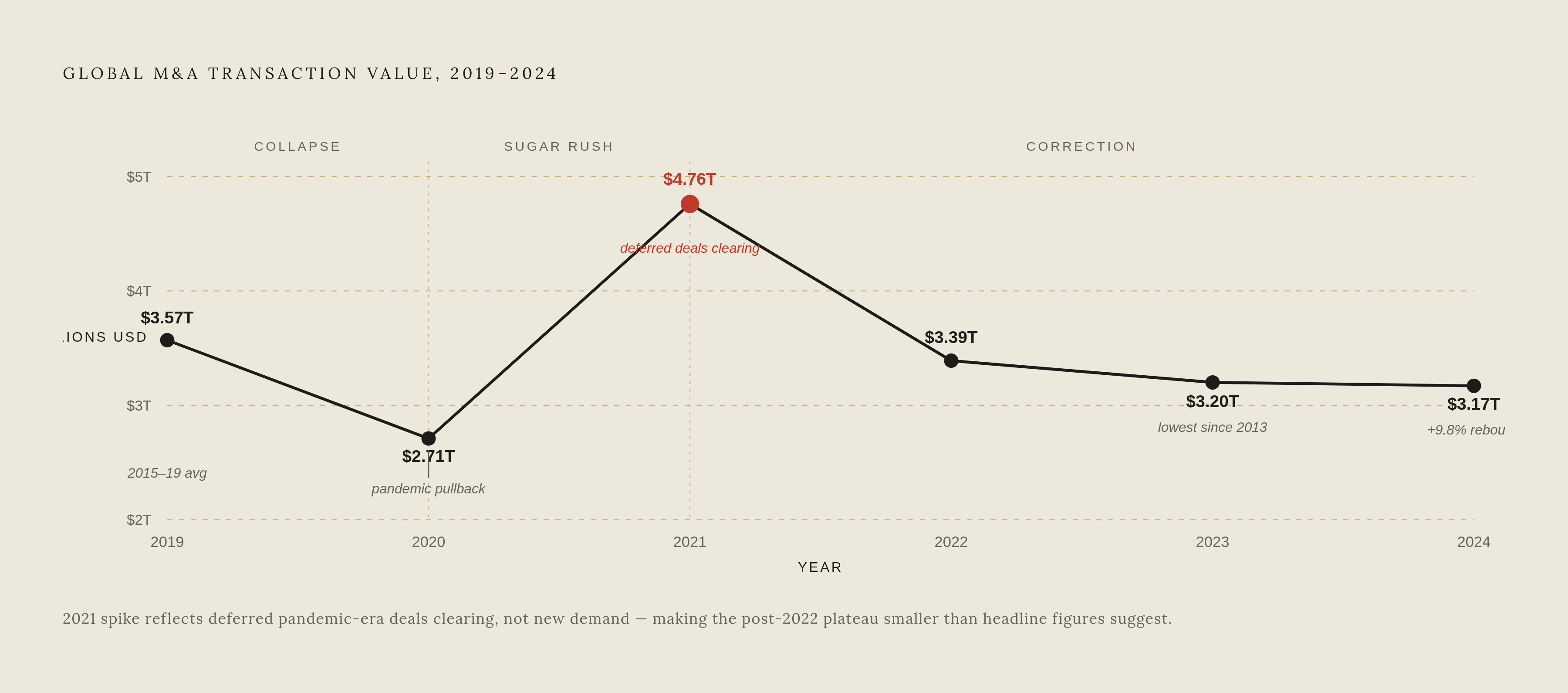
Small business M&A is not rebounding the way the headlines suggest. U.S. M&A transaction values averaged around $3.57 trillion a year between 2015 and 2019, a period that now reads as the last "normal" stretch before everything got weird M&A Outlook for 2025 and Beyond | Eisner Amper. Then 2020 hit, and deal values fell to $2.71 trillion as buyers and sellers alike pulled term sheets off the table and waited to see what was going to happen to the economy M&A Outlook for 2025 and Beyond | Eisner Amper bizbuysell.com. What followed wasn't recovery so much as a backlog clearing itself: values jumped to $4.76 trillion in 2021 and held at $3.39 trillion in 2022, numbers that looked like growth but were really just deferred deals finally closing M&A Outlook for 2025 and Beyond | Eisner Amper. By 2023, the market corrected hard: global M&A fell to $3.2 trillion, down roughly 15% year over year and the lowest since 2013, with North America seeing a 19% drop in deal volume neobusinessadvisors.com BizBuySell Insight Report 2024 bizbuysell.com bizbuysell.com. Global deal volume climbed back to $3.17 trillion in 2024, a 9.8% increase, though regulatory friction around large transactions kept a lid on how far that rebound could go corpgov.law.harvard.edu bizbuysell.com.
Those headline figures are dominated by mega-deals and financial sponsors, transactions that make headlines but are a poor proxy for what is happening on Main Street. What the data actually shows is a market finding a new equilibrium at lower energy, not a return to the frenzy of 2021.
Why the broader M&A rebound did not reach small business deals
The split between big and small got sharper in 2024, not softer neobusinessadvisors.com BizBuySell Insight Report 2024 bizbuysell.com bizbuysell.com. Mega-deals over $1 billion rose meaningfully that year, but the volume of small and mid-sized deals actually dropped by roughly 18%, according to Vistage and Forvis Mazars data bizbuysell.com.
Why did this happen? Private equity, which in a different rate environment might have stepped in as a demand-side driver for smaller acquisitions, pulled back instead. U.S. middle-market PE buyouts declined sharply year over year as borrowing costs made leveraged deals more expensive to underwrite and due diligence got more intensive on every file. With fewer financial buyers bidding, seller processes leaned harder on strategic buyers, a thinner and more selective pool than the one sellers got used to during the boom years. Deal timelines stretched out, more processes got pulled before signing, and closure rates slipped because the capital conditions that fueled 2021's frenzy had simply evaporated.
That gap matters enormously for anyone reading financial press coverage of "M&A recovery" and assuming it applies to them. It doesn't. The rebound reported in headline figures is a different market, dominated by mega-deals and financial sponsors, and understanding that distinction is the first real step toward planning a realistic exit. Midsize deals, between $1 billion and $10 billion, accounted for the largest share of global activity in 2024, per McKinsey (a concentration of deal energy well above Main Street).
What the small business transaction data shows, 2024 through mid-2026
Start with the concrete numbers. BizBuySell tracked 9,546 closed transactions in 2024, totaling $7.59 billion in enterprise value, a modest 5% increase over 2023 that read more like stabilization than surge BizBuySell Insight Report 2024 bizbuysell.com bizbuysell.com. Quarter by quarter, volume grew 10% in Q1 and 5% in both Q2 and Q3, then leveled off in Q4, with Federal Reserve rate cuts having limited impact on deal flow because election-related uncertainty overshadowed it instead BizBuySell Insight Report 2024 bizbuysell.com bizbuysell.com bizbuysell.com.
Full-year 2025 came in essentially flat: 9,586 closed transactions, up just 0.4% year over year, though total enterprise value rose 3% to $7.95 billion bizbuysell.com bizbuysell.com. The fundamentals actually looked healthy despite that flatness. Median cash flow rose 3% to $158,950, median revenue climbed 3% to $703,000, median sale price rose 2% to $350,000, and businesses kept closing at 94% of asking price bizbuysell.com bizbuysell.com bizbuysell.com. So volume stalled, but the businesses that did sell were bigger and better-performing than the year before.
2025 wasn't a smooth flat line, though M&A Outlook for 2025 and Beyond | Eisner Amper. It was choppy. Transactions declined 1% in Q1 and 4% in Q2 as inflation anxiety weighed on buyers, then Q3 surged to 2,599 closed deals, up 8% year over year and 11% quarter over quarter, with enterprise value hitting $2.13 billion, a 12% quarterly jump bizbuysell.com bizbuysell.com bizbuysell.com bizbuysell.com.
What does a market that is simultaneously producing fewer deals and higher multiples actually tell you? It suggests quality is concentrating. Fewer businesses are closing, but the ones that do close tend to be the stronger ones, and the Q2 2026 dip reads less like a stall and more like buyers becoming more deliberate about what they'll say yes to. That interpretation lines up with the DFin Solutions 2026 outlook, which found smaller deals under $1 billion hold up better against macro volatility than large ones, face less regulatory exposure, and are easier to finance without piling on external leverage. Into 2026, the market turned more selective: Q2 2026 saw 2,117 businesses change hands, down 10% both quarter-over-quarter and year-over-year, per BizBuySell's Insight Report, while the average cash flow multiple ticked up 2% year-over-year to 2.7 and the median sale price slipped just 1% to $349,250 bizbuysell.com bizbuysell.com bizbuysell.com.
The demographic pressure that will define small business M&A supply for the next decade
None of the volume or pricing data above means much without understanding who is actually selling, and why the selling isn't going to stop anytime soon. Roughly 41% of U.S. small businesses are owned by Baby Boomers, and with an estimated 34 million small-to-mid-size businesses in the country per the SBA's Office of Advocacy, that works out to more than 12 million businesses in Boomer hands right now hunton.com bizbuysell.com bizbuysell.com. The SBA projects that around 10 million of those businesses will change hands between 2019 and 2029, a supply wave that is still mid-crest, not cresting and receding. About 41% of small businesses are run by owners over 55, and roughly 10,000 Boomers retire every single day hunton.com bizbuysell.com bizbuysell.com.
One might argue this is just background noise, a slow demographic drift visible only in footnotes. It isn't. Estimates put the value of business assets changing hands over the next 10 to 15 years at roughly $10 trillion, a figure large enough to qualify as the defining supply story of a generation. The 2024 through 2026 transaction data reviewed above is the wave, already arriving, with the pressure only set to build as more of the generation crosses the retirement threshold. Boomers make up roughly 59% of sellers in the small business market, mostly selling for retirement, per IBBA data cited by ericimendelsohn.com. Canada's demographic profile mirrors the U.S. pattern closely, and the same succession gap and retirement timeline applies to the profitable $500K–$50M businesses the company serves.
How Boomer sellers are adjusting deal structures to get transactions done
So how are sellers actually getting deals closed in a tighter financing environment? A lot of it comes down to what they're optimizing for. Many Boomer sellers are prioritizing legacy continuity and a clean handoff over squeezing out the last dollar of a lump-sum price, and that shift in motivation changes the negotiating table in ways buyers have started to notice. Roughly 60% of Boomer business owners say they're open to some form of seller financing, according to reporting in Entrepreneur, which functions as a kind of lubricant for deals that would otherwise stall on bank underwriting alone.
Sellers without a viable succession plan in place, most of them, are increasingly willing to carry a meaningful chunk of the purchase price as a seller note. That's a signal of seller confidence, but it's also a practical bridge over the financing gap left by tighter bank lending. It isn't a how-to on structuring these deals so much as evidence that the market found its own workaround to a capital constraint that had been stalling transactions for a couple of years. That said, seller financing only functions when both sides are roughly aligned on valuation to begin with, and the readiness gap, an owner with no plan facing a retirement deadline they didn't see coming, tends to produce inflated price expectations that these structures have to bridge rather than avoid.
Who is buying small businesses
The buyer pool has changed shape almost as much as the seller pool. A Forrester study cited by Fox Business found that younger generations, born 1980 or later, now make up roughly 64% of small business buyers globally, a genuine generational handoff on both sides of the transaction bizbuysell.com. BizBuySell's own buyer data backs this up from a different angle: over 56% of current buyers have never owned a business before, and nearly 42% describe themselves as corporate refugees, professionals leaving salaried careers in search of independence bizbuysell.com bizbuysell.com. Serial entrepreneurs make up another 15% or so of the buyer pool, joined by recently unemployed workers, recent retirees, and freshly minted MBA graduates, a genuinely varied group united mostly by wanting to own something rather than work for someone else neobusinessadvisors.com BizBuySell Insight Report 2024 bizbuysell.com bizbuysell.com.
Sentiment among both sides is strong, but conditional. Roughly 90% of small business owners and 95% of buyers expressed optimism about 2025, and more than 91% of buyers said it was a good time to buy, pointing to improving business conditions, a wider variety of listings, and pricing they considered favorable BizBuySell Insight Report 2024 bizbuysell.com bizbuysell.com bizbuysell.com. But optimism doesn't mean buyers are relaxing their standards. Roughly 86% said they're specifically looking for recession-resistant businesses, and about 64% want businesses that are already thriving, not fixer-uppers with upside potential attached to a story bizbuysell.com. Buyers pay more, not less, for the businesses that clear their bar, which is visible directly in price: the average cash flow multiple in Q2 2026 rose to 2.7x, up 2% year over year bizbuysell.com bizbuysell.com. The compression happening in this market is in deal count. It is not in price for the assets buyers actually want.
Which characteristics move the multiple at the Main Street level
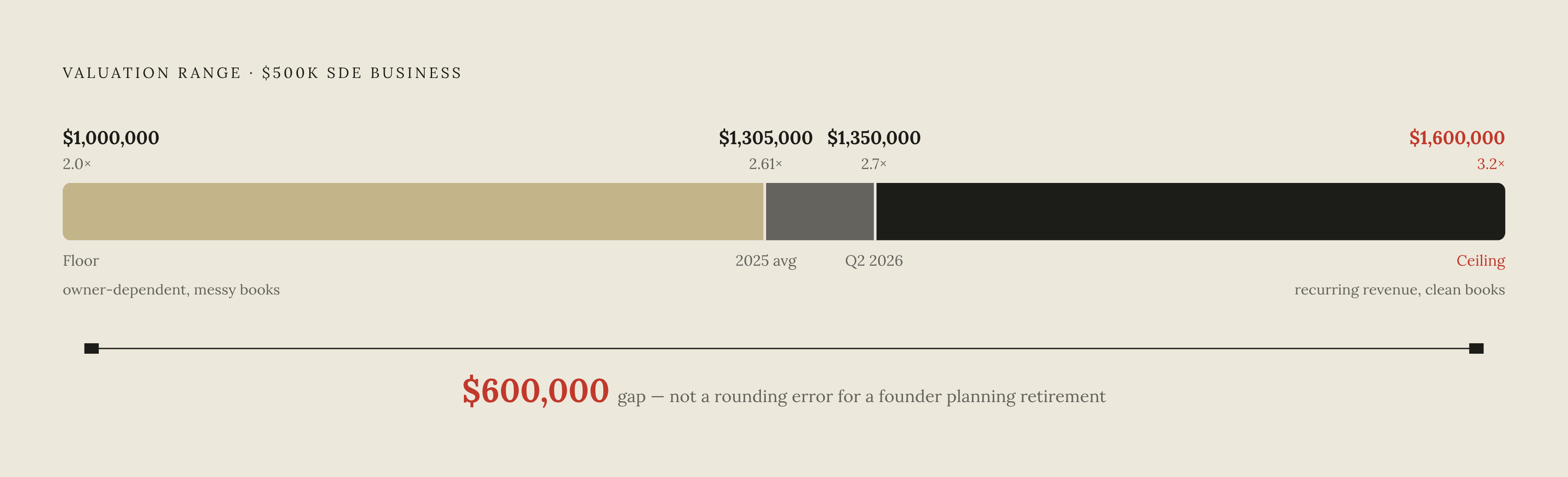
Across the 9,586 transactions BizBuySell closed in 2025, the average small business sale was at a 2.61x cash flow multiple, based on seller's discretionary earnings, with revenue multiples in the low-to-mid single digits bizbuysell.com. Zoom out and the broader range runs from about 2.0x to 3.2x SDE across most Main Street categories, with revenue multiples averaging around 0.66x industry-wide. These numbers moved around a fair amount over the past few years: multiples climbed through 2022 on tight supply and pandemic-era economics, got reined in through 2023 as interest rates rose, then resumed growth across most industries from 2024 into 2026. Private-company valuation data through 2025 tells a similarly jumpy story, with median selling price relative to net sales moving from roughly 0.60x in Q1 down to about 0.53x by Q3, then back up to around 0.62x by Q4, a pattern that looks less like a trend and more like a market still finding its footing.
What separates a business that is at 3.2x from one that limps in at 2.0x or below? Recurring revenue, margins that hold up under scrutiny, operations that don't depend entirely on the owner showing up every day, and earnings that read as durable rather than lucky. Buyers reward those traits at the top of the range, and businesses without them cluster at the bottom or, worse, fail to close at all bizbuysell.com. That 2.7x average multiple quoted for Q2 2026 conceals enormous dispersion, produced by differences in business quality that separate clean, well-documented businesses from lifestyle businesses with owner-dependent income, as the surrounding figures show bizbuysell.com bizbuysell.com. A clean, well-documented business with recurring revenue can command well above that average, while a lifestyle business with owner-dependent income and messy books is at the floor or below it bizbuysell.com. Do the math on what that actually means in dollars: the gap between a 2.0x and a 3.2x multiple on $500,000 of SDE comes out to $600,000. That is not a rounding error for a founder planning retirement.
The financing conditions that will continue to shape deal flow in 2026 and beyond
Rate cuts were real in 2024 and 2025, but their effect on small business deal flow was muted at best bizbuysell.com bizbuysell.com. The Fed cut rates three times in late 2024, yet BizBuySell's data shows deal volume slowing in Q4 anyway, overshadowed by election-related uncertainty that mattered more to buyers than the cost of capital did. Lower rates are supposed to loosen up financing and speed deals along, but when buyers are nervous about the broader economic picture, cheaper debt doesn't do much to change their calculus.
What matters more heading into 2026, according to the DFin Solutions outlook, is that smaller deals (under $1 billion) are more resilient to macro volatility, less exposed to regulatory friction, and more financeable without external leverage. Buyers who don't need third-party financing can move faster, absorb more uncertainty, and negotiate from a position of strength that financed buyers simply don't have. Private equity dry powder remains enormous, somewhere between $880 billion and $1.1 trillion in the U.S. alone and near $1.3 trillion globally, capital that needs to get deployed eventually, but middle-market PE remains choosy, concentrating on sectors with clear roll-up logic rather than spreading bets broadly. The 2026 market, per DFin, is defined by stricter underwriting, deeper scrutiny of financials, and a heavier emphasis on earnings durability, conditions that reward sellers who've done the work of getting their books in order well before a buyer ever sees them.
None of this happens in a vacuum free of macro noise. Tariff uncertainty, downward-revised GDP forecasts, and inflationary cost pressure were all cited by Vistage as factors that dented SMB deal confidence through 2025, and those pressures haven't fully cleared as 2026 gets underway. Still, the more accurate read of the current market is discrimination, in the literal sense: buyers are pickier, and that distinction changes what it actually takes to win as a seller. For sellers watching interest rate policy from north of the border, the mechanism is the same even if the central bank differs. Financing conditions govern deal flow, and sellers who can reduce a buyer's dependence on third-party debt, whether through seller notes, clean balance sheets, or normalized working capital, hold a real advantage regardless of which way the Bank of Canada or the Fed moves next.
What the new normal means for a founder planning an exit in the next one to five years
Put the pieces together and a fairly clear picture appears. Deal volume at the small business level isn't racing back to 2021 highs, and it probably won't for a while M&A Outlook for 2025 and Beyond | Eisner Amper. Instead, it's holding at a lower, steadier altitude, propped up by an enormous and still-growing wave of Boomer retirements that will keep supplying the market with sellers for years to come hunton.com bizbuysell.com bizbuysell.com. Buyers, meanwhile, have gotten choosier about what they'll pay full price for, rewarding businesses with clean financials, recurring revenue, and operations that don't hinge entirely on one person's daily involvement.
SDE multiples generally fall between roughly 2.0x and 3.2x across Main Street businesses. It comes down to preparation: the books are clean, revenue looks durable rather than lumpy, and the business can survive without its founder on site every day. The financing environment isn't going to hand sellers an easy tailwind the way ultra-low rates did a few years back, which means the businesses that win now are the ones built to look financeable on their own, with or without a bank standing behind the buyer.