Auction Process Mechanics in Large vs. Lower Middle Market Deals
Deal size reshapes every stage of an auction, from preparation through close.

A headline announcing a multi-billion-dollar acquisition and a notice that a regional manufacturer has sold to a private equity fund describe the same basic mechanism: a sell-side auction, run through preparation, marketing, bidding, diligence, and close. What changes between them is not the sequence of stages but the shape of everything inside each one, and deal size is the variable that does the reshaping. Four process designs sit available to any seller contemplating a sale: a broad auction, a limited auction, a targeted auction, or an exclusive negotiation with a single buyer. Each one trades off maximizing price through competition against protecting confidentiality, and that trade-off does not resolve the same way at the top of the market as it does further down.
At the top of the market, the buyer universe capable of writing a check is small and known in advance, documentation standards are institutional on both sides of the table, and regulatory scrutiny shapes timing even when deal volume favors sellers. Further down, in the lower middle market, the theoretical buyer universe is larger, drawing in regional private equity funds, independent sponsors, and strategic acquirers, but the pool of buyers actually qualified to close a deal on a given business is thinner than the raw count suggests. Most sellers at this level are owner-operators selling a company for the first time, often without the internal infrastructure that large corporate sellers take for granted. The sections that follow trace how this single variable, deal size, works its way through preparation, the buyer pool, marketing mechanics, bid dynamics, and diligence, stage by stage.
Preparation and Documentation Depth
Preparation sets the ceiling on everything that follows, because a buyer can only price what it can verify, and it discounts whatever it cannot. After preparation, every stage releases that verified information in a controlled way, timed to keep multiple buyers competing until the final responsible moment. That makes the preparation stage the place where the large-deal and lower middle market processes begin to diverge in ways that persist all the way to closing.
A large-deal seller typically arrives with audited financials, an institutional-grade quality of earnings report, a dedicated internal transaction team, and legal counsel who got engaged months before the process launched. The resources exist because the deal size justifies the cost of assembling them, and because the buyers on the other side of the table expect nothing less. Lower middle market sellers often cannot make the same claim. Many LMM companies do not have audited financials, have not tracked EBITDA consistently over time, and operate on cash-basis accounting that may not reflect the business's actual performance. The virtual data room, rather than being built by a dedicated transaction team, is typically assembled by a CFO or controller doing the work alongside their regular job, with no internal staff devoted solely to the sale. So VDR quality varies more in the lower middle market than anywhere else in the deal spectrum.
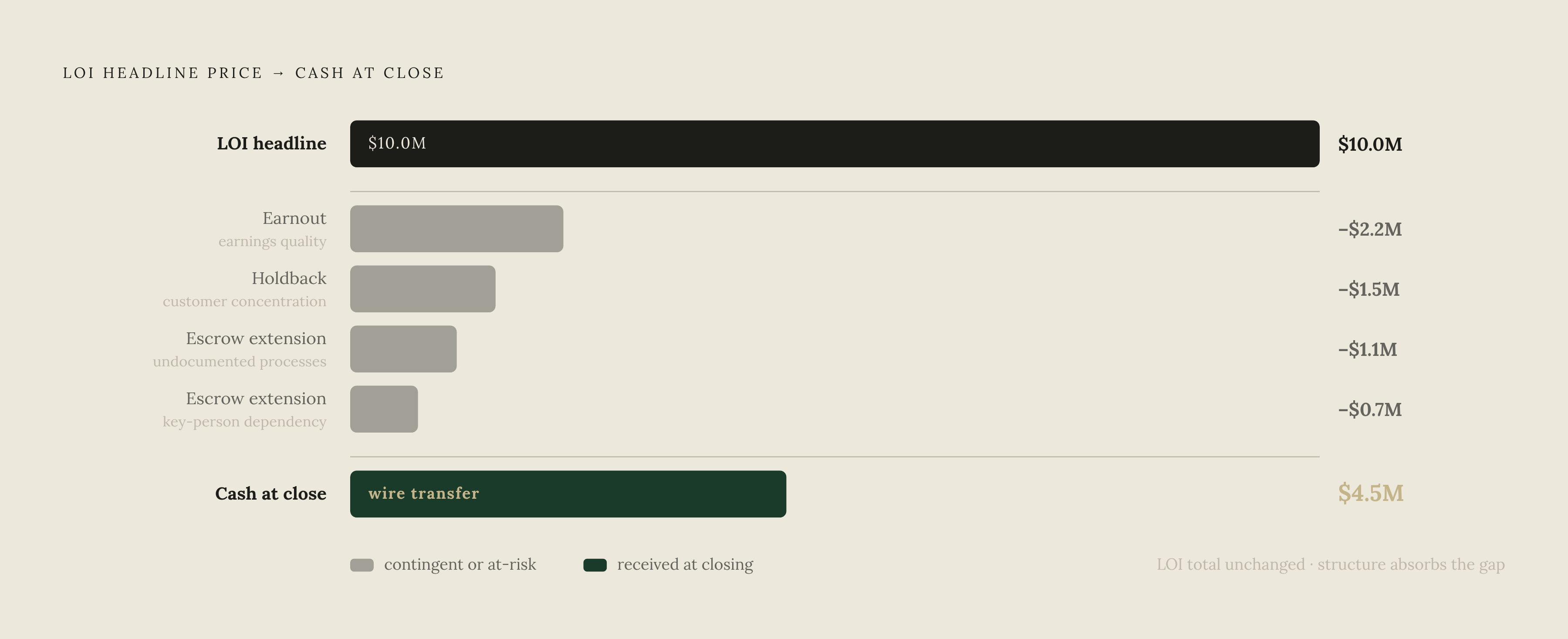
Salt Creek Advisory's outlook describes buyers basing offers on financial performance and proposed sale structure, and notes that earnings quality and growth prospects, particularly where customer concentration is low and management is strong, remain the primary way buyers distinguish among competing companies. What happens when a seller cannot supply that clarity? When this happens, buyers in the lower middle market rarely cut the headline multiple. Instead, unresolved questions about the financials get converted into deal terms: longer escrow survival periods, larger holdbacks, and earnout structures that push a meaningful share of the purchase price into contingent consideration. Call this the structure discount. The number on the letter of intent may look the same as it would for a cleaner business, but the portion of that number collected at the closing table shrinks. Founder-led businesses running on cash-basis accounting, without audited statements, face exactly this kind of documentation asymmetry, and AI-driven business valuation tools that surface earnings quality early can help sellers understand what buyers will eventually discount anyway, before that discount gets written into a term sheet rather than caught in advance.
How the buyer pool narrows at the top and fragments at the bottom
Deal size does not just change how many buyers show up to a process. It changes who they are, what motivates them, and how a seller should sequence outreach to them. At the top of the market, the buyer pool shrinks to a small set of large strategic acquirers and institutional private equity sponsors with the balance sheet to write a check at scale. In the ACV Auctions process, J.P. Morgan, acting for the seller, contacted three parties total, identified as Party A, Copart, and Party B, on July 14, 2026, and by August 6, 2026, had requested formal proposals from all three. That is the entire outreach list for a targeted auction at that scale. No broader canvass, no long tail of secondary buyers brought in to pad the competitive field. Three names, one letter, one deadline.
Regulatory scrutiny at this level runs higher than at the bottom of the market, and confidentiality requirements rise to match it, because a leak naming a specific counterpart like Copart can move markets or draw regulatory attention before a deal is signed. Antitrust clearance timing, rather than outright prohibition, is the practical risk even in a friendlier FTC/DOJ environment, a point Bravaldo's analysis makes clear about the current environment. Financing conditions also shaped who showed up at the top of the market in mid-2026: strategic buyers dominated large-deal activity as leveraged buyouts became harder to finance following a major central bank's June rate hike, leaving private equity largely a spectator at the top of the market during that stretch.
Move down to the lower middle market, where the buyer universe looks broader on paper, including regional private equity funds, independent sponsors, strategic acquirers, family offices, and search fund operators or individual operators, all theoretically in the market for the right business. But qualified demand concentrates on companies that fit clear investment mandates, and that concentration is where the apparent breadth of the pool fragments into something much narrower in practice. Salt Creek Advisory notes that available private equity dry powder and a backlog of funds nearing their exit windows can support real buyer competition, if the lower middle market company is strong. Dry powder sitting on the sidelines does not translate into multiple attractive offers for every seller, because buyers still concentrate on companies that match their criteria and can support the acquisition debt the deal requires. Buyers move aggressively toward businesses with durable earnings, low customer concentration, and capable management, creating a bifurcated demand curve as they walk away quickly from businesses carrying operational, customer, or earnings uncertainty. High-quality companies find real competitive tension in this market, while structurally weaker ones struggle to gain any traction.
Platforms that match founder-led businesses with vetted buyers are one example, and they show what this fragmentation means for process design at the lower middle market level. The buyer universe is theoretically broad, but qualified demand is thinner and more specialized than the raw count of potential buyers suggests, so a process built around broad outreach risks wasting a seller's confidentiality on parties who were never going to transact.
The proprietary deal is an alternative far more available to lower middle market buyers than to buyers operating at the top of the market. Buyers increasingly bypass bank-led, competitive processes in favor of direct outreach to owners, aiming for a one-to-one conversation where they are the only party at the table. A proprietary deal closed at a lower multiple can still be worth more to a buyer than winning a competitive auction at a higher price, because the buyer avoids the transaction costs, the information disclosed to competitors, and the risk of losing after investing diligence time. Sellers should weigh that proprietary deals can still deliver certainty of close and strong operational fit, so the idea that auctions always produce a higher multiple oversimplifies the choice. But a seller who accepts a proprietary approach gives up the competitive tension a structured process is built to create, and that tension is often what separates a good price from the best available one.
Marketing Pacing and Document Depth by Deal Size
When you market a large deal, you release information in a tightly sequenced, deadline-driven way to a small number of pre-screened parties. When you market a lower middle market deal, it spreads across a broader, often longer timeline, less standardized in its mechanics, and pacing follows the seller's documentation readiness as much as any deliberate strategy.
The large-deal sequence runs through a recognizable set of stages: teaser, then NDA, then confidential information memorandum, then management presentation, then data room access, then bid deadline. Each stage carries a hard deadline, engineered specifically to maintain competitive tension among a small, already-identified pool of buyers. The CIM at this level is institutional in depth. Legal NDAs are negotiated documents, not click-through agreements. Management presentations are rehearsed and tailored to each specific deal; they are not delivered from a generic script. The ACV Auctions process again supplies the concrete marker: NDA execution on June 9, followed by a letter to all three contacted parties requesting proposals by August 6, 2026. Less than two months separate the confidentiality agreement from the bid deadline, so you can see how compressed and formal large-deal outreach is even before serious negotiation begins.
Lower middle market marketing follows a looser pattern. The CIM is often less standardized in format and depth, NDA processes are lighter, and while the number of parties contacted is frequently higher than in a large-deal targeted auction, the conversion rate from initial contact to a serious bid runs lower. The timeline stretches out in practice, partly because sellers are often assembling materials in real time rather than arriving with a finished package, and partly because lower middle market buyers need more time to assess businesses that lack institutional-grade financials, running their own informal diligence earlier in the process than a large strategic buyer would need to.
Confidentiality risk also takes a different shape at each level. In a large deal, the risk is acute and market-facing: a named strategic counterpart like Copart appearing in a sale process can trigger market speculation or prompt competitive responses from other industry players, and the entire process architecture is designed around containing that exposure. In the lower middle market, the risk hits operations rather than the market. Employees, customers, and suppliers learning about a pending sale before it closes can damage the value of the business itself, by prompting departures, canceled contracts, or supplier renegotiations. Here, the remedy is tighter initial targeting rather than the structural secrecy a large deal requires. Because buyer mandates in this segment fragment across industry, revenue profile, and growth trajectory, matching a business to the right buyer segment before marketing begins becomes a primary decision shaping the entire process, not a detail to sort out after outreach has already started.
How bid dynamics and finalist selection work differently when the buyer pool is shallow
At the top of the market, competitive tension among a handful of sophisticated bidders is maintained through process discipline, deadlines, structured information releases, and clear rules of engagement. In the lower middle market, keeping any competitive tension alive at all becomes the central challenge of the bid stage, and when buyer certainty is harder to judge, the finalist comparison leans more heavily on factors other than price.
Both segments weigh a similar set of considerations when comparing finalists: the price on offer, the buyer's certainty of closing, the quality of the proposed structure (how much is cash at close versus rollover equity versus an earnout), cultural fit, the management retention plan, and the founder's intended role after the deal closes. What differs is how much weight each factor carries. In a large deal, the highest bid does not automatically win, but price tends to dominate the comparison, because sophisticated buyers can credibly commit to closing and the deal structure is relatively predictable across competing bids. The ACV Auctions process shows how specific diligence concerns can still thin a bidder field even among sophisticated large-deal parties: the same dynamic that narrows a lower middle market field for different reasons narrows a large-deal field too, just driven by different concerns.
In the lower middle market, earnouts carry disproportionate weight in the bid comparison. Salt Creek Advisory notes that buyers increasingly move risk into earnouts and rollover equity rather than paying cash at closing, so the headline price on a letter of intent and the economic reality behind it can diverge substantially. Rollover equity appears far more often in this segment than at the top of the market, meaning sellers retain a partial equity stake after close with real frequency rather than as an exception. Negotiating the rollover percentage, the valuation attached to it, and the governance rights that come with it is a nuanced exercise that shapes the entire deal structure.
Bravaldo's analysis adds that sellers in the lower middle market are not capitulating on price broadly, but buyers are transacting more selectively, which places a specific burden on sellers at the bid stage. Before accepting a finalist, a seller has to distinguish between an offer that is genuinely firm and one that is contingent on terms not yet fully disclosed. The handshake number and the wire transfer describe two different conversations in this market. A seller who evaluates competing bids on headline price alone, without accounting for how much of that price sits behind an earnout, a holdback, or a rollover requirement, misreads the actual economics of the comparison being made.
Due Diligence Intensity and Claims Exposure by Segment
Diligence in the lower middle market runs just as intensive as diligence in a large deal. It runs intensive in different places, probing areas that institutional processes handle through standardized documentation and professional advisors on both sides of the table. What changes is the seller's capacity to support that scrutiny. A large-deal seller typically has professional advisors in place who can respond to an institutional buyer's dedicated diligence team in kind and match resource for resource. At the top of the market, regulatory diligence runs as its own distinct workstream, covering antitrust review and sector-specific approvals, and in the current environment the practical risk is clearance timing, not outright prohibition.
A lower middle market seller facing the same intensity of inquiry, directed at customer concentration, revenue recognition practices, undocumented internal processes, or key-person dependency, often lacks the equivalent bench of advisors and the audited history to answer quickly and with confidence. That gap is why unresolved diligence findings at this stage get converted into contract language, just as the structure discount did earlier in preparation and in the bid stage: extended escrow periods, larger holdbacks, and earnout conditions tied to the resolution of exactly the questions the seller could not fully answer going in. Because the seller is less equipped to support the scrutiny, the exposure to post-closing claims runs proportionally higher in this segment, not lower, even though the deal itself is smaller. Preparation, in the end, is where that exposure either gets addressed in advance or gets left for a buyer's lawyers to find and price into the final terms.