Evaluating M&A Advisor Track Records for Lower Middle Market Deals
How to spot which M&A advisor will actually deliver the valuation promised.

The lower middle market is the busiest corner of U.S. M&A by deal count, and it is also where the gap between a good advisor and a bad one does the most damage to the seller. That gap exists because the segment sits in an awkward middle ground that most advisor categories are not built to serve. A company with a substantial but mid-sized revenue base has outgrown the local business broker who sells pizza shops and dry cleaners, but it is still too small to get real senior attention from a bulge-bracket bank, where a smaller deal might get staffed with a second-year analyst and a phone number. Specialized boutique investment banks built specifically for this band exist to close that gap, and Salt Creek Advisory, among others, has described its own practice as filling exactly this space.
A repeat buyer, whether a private equity fund or a strategic acquirer, has closed a dozen deals in the past two years, and that gap in experience is the deeper, informational problem underlying the asymmetry. The typical founder-seller, by contrast, has closed zero deals. An experienced LMM advisor exists to close that gap: running a competitive process with multiple bidders, controlling what information reaches buyers and when, and preventing the seller from negotiating alone against someone who has far more practice at the table.
That asymmetry is why advisor selection in this market carries more weight than it would in a transaction between two sophisticated institutional parties. The seller gets one shot. The advisor, win or lose, moves on to the next mandate. When the advisor is weak, the consequences do not land evenly. Every evaluation criterion that follows in this piece exists to answer one question: how does a seller know, in advance, whether the advisor sitting across the table is actually capable of closing that gap, or whether they are just another name on a pitch deck?
Deal Count and Credentials Are the Wrong Starting Point for Evaluating an LMM Advisor
Faced with that asymmetry, most sellers reach for the signals that are easiest to see: league table rankings, total deal counts, industry awards, and the weight of a recognizable firm name. These are, in practice, the least predictive signals available for judging LMM execution quality, and relying on them often means skipping the diligence that actually matters.
Start with league tables. Most of the remaining firms in those rankings simply report their own deal activity directly to the data vendor. A league table position says a firm knows how to fill out a submission form. It says very little about whether the deals that submission counted actually closed at the value the seller expected.
Deal counts carry a similar problem. Teams turn over. Specializations shift. A firm that built its reputation advising manufacturing roll-ups in an earlier decade may now be running a much thinner, less focused practice.
The same skepticism applies to the valuation range an advisor pitches in the first meeting. That number is a sales tactic, and a fairly obvious one: the firm that promises the highest multiple in the pitch meeting is often the one most eager to win the mandate, not the one most likely to deliver. The multiple a deal actually closes at depends on the auction the advisor runs, the buyers they bring to the table, and how well they manage the process from LOI to close, none of which a first-meeting projection can show. Clearing these proxies away is the first step. What's left is a narrower, harder, and far more useful question: what can an advisor actually prove about how their past deals performed?
The five track record signals that predict whether an LMM deal closes at the expected value
A sound evaluation of an LMM advisor rests on five checkable dimensions: recent closed deal experience in your specific sector and size band, how much senior banker time is actually committed to your deal, the depth of the advisor's buyer list, how the fee structure is built, and what actual sell-side clients say when asked directly.
Recent closed deal experience in your sector and size band matters because buyer pools, valuation norms, and diligence traps differ meaningfully from one industry to the next. An advisor who has not worked your specific sector recently will not know which buyers in that space are real and which are just collecting information. Verify this against independent acquisition announcements that name the advisor directly, and treat any "transactions" page on a firm's website as a claim to check, not a fact to accept.
Senior banker time commitment is a measurable variable, not a soft preference about who seems more attentive. Salt Creek Advisory describes its own process as targeted, curated outreach run personally by both principals. Whatever firm a seller is evaluating, that level of specificity, naming the actual people and their actual role, is the standard to hold every competing proposal to.
Buyer list depth is the mechanism by which a competitive process actually gets built. An advisor who cannot describe a credible, pre-existing buyer network in your sector is not running an auction. They are running a single conversation and hoping it works out. Ask the advisor to walk through the last three buyer processes they ran in your sector: how many letters of intent did each process generate, and how many of those buyers came from the advisor's own outreach versus inbound interest the seller would likely have found anyway?
Fee structure alignment deserves more scrutiny than it usually gets. A fee weighted the other way, a high retainer against a thin success fee, removes some of that urgency and can leave a process coasting. Ask what share of the total fee is contingent on closing, and ask what the retainer is meant to cover.
References from actual sell-side principals round out the five. Any advisor unwilling to connect a prospective client with two previous sell-side clients, the actual owners or founders who sold rather than members of the management team or buy-side contacts, is a harder pass than one who simply lacks deep experience in your exact sector. And would that seller hire the advisor again?
Close rate and post-LOI retrade frequency as the two most telling numbers to request
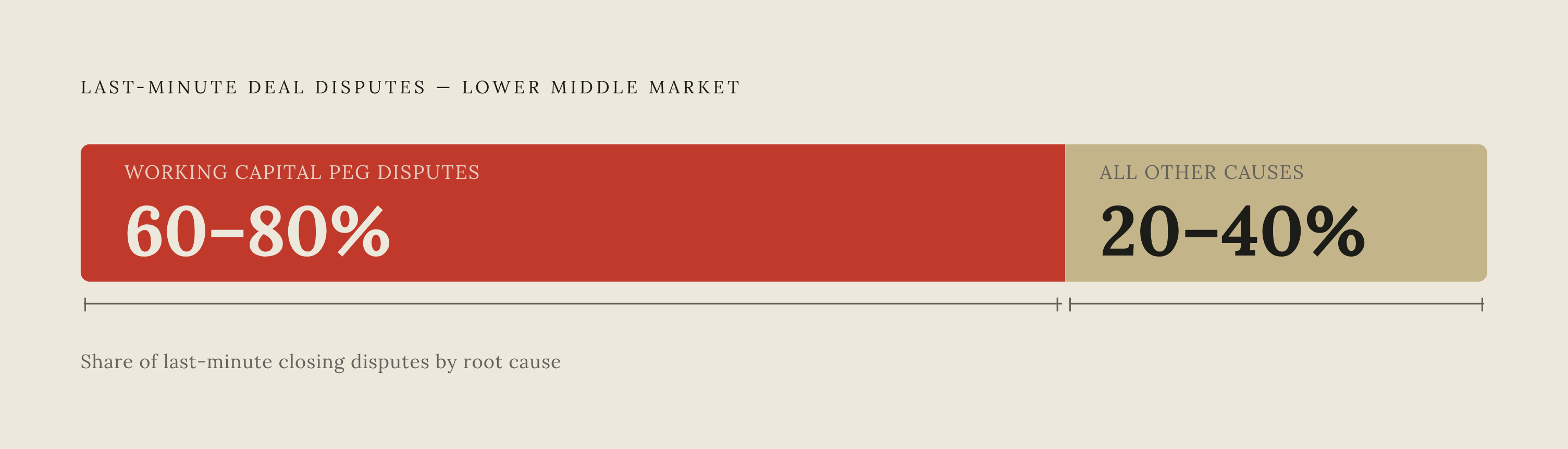
Of the five signals above, two numbers carry more diagnostic weight than the rest combined: how often the advisor's deals actually close, and how often the price at closing differs from the price in the letter of intent. Both numbers matter because they are outputs of how well the advisor runs a process, not inputs the advisor can shape with a good pitch beforehand.
Post-LOI retrade frequency deserves particular attention because of where disputes actually originate. The working capital peg, the target level of net working capital a business is expected to deliver at closing, is where 60 to 80 percent of last-minute deal disputes happen in LMM transactions, based on an informal survey of transactional lawyers. An advisor who has not built a disciplined process around setting and defending that peg will see closing prices drift below the LOI figure repeatedly, because the advisor never locked down the mechanism that prevents that drift.
The question to put to a reference is direct: did the final closing price match the number in the letter of intent, and if not, what caused the gap? An advisor who shrugs off that question, or whose references describe repeated last-minute price cuts, is not managing diligence. That advisor is reacting to it after the fact, which is a different skill and a much weaker one. Close rate and retrade frequency together tell a seller something the first five signals, taken individually, cannot: not just whether the advisor looks capable on paper, but whether their actual deals land where they said they would.
How macroeconomic and sector conditions in 2026 change what "good execution" looks like
None of these five signals should be applied as a fixed checklist, because the market an advisor is navigating has shifted in ways that change what good execution actually requires. The deal environment heading into 2026 rewards advisors with real sector depth and process resilience more than it did a few years earlier, because valuation gaps and diligence timelines have both stretched in ways that punish a generalist practice.
Capstone Partners' Middle Market M&A Valuations Index, published in April 2026, documents how the tariff disruption that began in early 2025 forced many transactions in that year's second quarter to be re-priced, restructured, or abandoned. Notably, a handful of sectors, Aerospace, Defense, Government & Security; Business Services; Energy; and Technology, Media & Telecom, posted year-over-year improvements in average purchase multiples through that same disruption. That outcome was not an accident of sector luck alone. Advisors working those sectors largely kept buyer competition alive even as generalist processes elsewhere stalled out.
By the third quarter of 2025, conditions had begun improving, and Capstone Partners describes the middle market as positioned for steady re-acceleration through 2026. The phrase to hold onto there is "quality assets," since that re-acceleration applies unevenly. For a seller evaluating an advisor today, the practical move is to ask what happened to that advisor's in-flight deals during the 2024 to 2025 disruption specifically: which ones survived, which fell apart, and what the advisor did differently to keep the survivors moving. That answer reveals process discipline under real pressure, which a calm-market track record cannot show.
Technology adoption as a process-quality signal, not a marketing differentiator
How an advisor uses technology has become a legitimate way to judge process quality, separate from whatever claims appear in a pitch deck. Firms still running buyer outreach the old way, built entirely on a partner's personal Rolodex, are increasingly outmatched by buyers who show up to diligence already running sophisticated tools of their own.
AI-driven buyer matching, the ability to surface qualified buyers from a large, structured dataset rather than relying solely on who a partner happens to know, represents a real difference in capability, not a marketing flourish. An advisor who can explain specifically how they find buyers beyond their existing contact list starts a competitive process with a structural advantage over one who cannot. A large share of finance leaders now use AI tools during M&A due diligence. Buyers are moving faster and digging deeper than they were just a few years ago. An advisor whose own process has not kept pace will watch diligence timelines compress against the seller's interests, simply because the buyer's side is better equipped to find problems fast.
Asking a prospective advisor whether they use AI invites a yes that means nothing. The better question is how their technology improves buyer coverage, diligence preparation, and process speed for a seller in your specific sector and at your specific size. Founder-owned businesses of modest scale now have access to advisors who combine that kind of buyer matching with traditional investment banking advisory, and a vague answer to that question is itself a signal worth treating seriously.
Building a Verification Protocol That Survives an Advisor's Marketing
Most of what an LMM advisor claims about their own track record cannot be confirmed through public sources alone. The seller bears the burden of building independent checks to verify the pitch deck's claims.
Start with the transactions themselves. Search for acquisition announcements that name the advisor directly in a press release or in independent news coverage, and compare that list against whatever "transactions" page the firm publishes on its own site. The gap between those two lists says something on its own. Only a small share of LMM deals name a sell-side advisor in a verifiable public announcement, so this check will not confirm every deal a firm claims. It will confirm the ones that matter most, and it will flag advisors whose entire track record rests on self-reporting with nothing behind it.
Run the reference check with discipline. References need to be actual sell-side principals, the owners or founders who sold their business, not members of the management team and not buy-side contacts who have their own reasons to speak well of the advisor. The same four questions from the framework section apply here: more than one credible LOI, a closing price that matched or missed the LOI, engagement through diligence rather than a handoff, and whether that seller would hire the advisor again. Ask for references from deals that did not go well alongside the success stories. How an advisor handles a process that falls apart says as much about their judgment as how they handle one that closes cleanly.
Test the senior commitment claim before anything gets signed. Request that the specific banker who will run the day-to-day process be named in the engagement letter, then ask to meet that person directly rather than relying on the rainmaker who ran the pitch meeting. Ask how many active mandates that banker is currently carrying, since a senior person spread across a dozen live deals cannot give any one of them the attention a seller is paying for.
Finally, ask about the 2024 to 2025 disruption by name. Any advisor active through the tariff-driven diligence slowdown of 2025 has a real, stress-tested track record to describe in specific terms: which in-flight deals survived, what changed in how they managed them, and why. An advisor who cannot answer that question with specifics was likely not running many processes during that period. Put together, these four checks give a seller a protocol that holds up regardless of how polished the pitch deck looks, because none of it depends on taking the advisor's word for anything that can be checked another way.