Legal Documentation Standards in Lower Middle Market Deals vs. Large M&A
Smaller deals shift risk into contract language instead of lowering the price.

A founder who sells a business for a substantial sum rarely receives anything close to the full amount at closing. Some portion sits in escrow for a year or two. Some portion depends on an earnout formula that may or may not pay out in full. This article is about the gap between the number in a founder's head and the number that actually arrives by wire, a gap that is structural in the lower middle market.
Why lower middle market deals carry more risk than their size suggests
A sale of a small company is not a smaller, simpler version of a sale many times its size. In many ways, it carries more risk for the seller, because the legal infrastructure built to manage that risk is thinner. Lower middle market deals mostly don't get any of that. Larger escrow holdbacks as a percentage of price, longer survival periods during which a buyer can bring a claim, and earnout structures that make up a bigger share of the total payment appear in the economics that follow closing. Those terms fall disproportionately on sellers in the LMM segment, and they don't show up on the term sheet as a lower price. A sophisticated buyer typically won't cut the headline number to account for a seller's thin documentation. Instead, the buyer converts that uncertainty into contract language: bigger holdbacks, broader rep and warranty language, longer periods during which claims can be brought. The price stays the price. The risk moves into the paper. Everything that follows in this piece, working capital definitions, earnout mechanics, indemnification architecture, and disclosure schedules, is an elaboration of that single mechanism: undocumented risk gets priced into clauses, not into the number on the letter of intent.
How compressed diligence timelines create documentation gaps
Why does this gap exist in the first place, when the legal concepts involved aren't especially exotic? Mostly because of time. Diligence periods for lower middle market deals run a fraction of what large or cross-border transactions allow, and that compression isn't simply a byproduct of the deal being smaller. Above the HSR size-of-transaction threshold, deals have to pause for antitrust review, and that pause forces institutional discipline: comprehensive schedules, large legal teams, multiple rounds of review. Below that threshold, where most lower middle market deals sit, none of that external pressure exists. Sellers arrive at the moments that matter most, the working capital definition, the earnout mechanics, the disclosure schedules, lacking the time or the infrastructure to pressure-test the language in front of them. Platforms that have matched thousands of lower middle market transactions can surface what market-standard documentation actually looks like before negotiations start, giving both sides a benchmark to measure a gap against before signing. These gaps aren't random. They concentrate in four or five recurring places in the agreement, and the next four sections take each one in turn.
Where the working capital definition becomes a post-closing dispute
Working capital is the most common entry point into a post-closing fight, mostly because it's treated as boilerplate when it isn't. Absent a clearly defined methodology, "working capital" ends up meaning whatever each side's accountant argues it means once the deal has already closed. A typical flashpoint: whether certain accruals get included in the calculation. One side reads the purchase agreement one way, the other side reads it the opposite way, and there's often no language precise enough to settle the question either way. None of these are abstract accounting puzzles. Each is a judgment call, and judgment calls left unresolved in the agreement get resolved after closing, usually in the buyer's favor, because the buyer controls the books once the deal is done. That's an informational advantage built into the position itself, independent of who's more right on the merits. A working capital worksheet, agreed at signing rather than argued about after closing, fixes this by naming the specific line items, fixing the opening balance sheet methodology, and specifying which accounting principles govern the calculation. Once those pieces are nailed down in advance, there's no more judgment call left to dispute. Because working capital disputes turn almost entirely on how a buyer's books get interpreted after closing, sellers benefit from understanding, before they sign anything, how rigorous that buyer's financial reporting actually is. AI-driven buyer profiling, the kind a matching platform might apply to its buyer network, can indicate whether a given counterparty has the institutional discipline around recordkeeping that will matter once the definition gets tested months later.
Earnout risk in loosely drafted LMM deals
Working capital adjustments are usually resolved within months and involve a defined, bounded number. Earnouts are a different animal: a post-closing obligation that can run for years and can represent a far larger sum than the working capital adjustment ever would. One recurring gap is the absence of a defined "efforts" standard: what is the buyer actually required to do, or refrain from doing, to give the seller a fair shot at hitting the earnout target? In Johnson & Johnson v. Fortis Advisors, the Delaware Supreme Court in January 2026 affirmed that J&J breached its obligations under a specifically defined "commercially reasonable efforts" clause, a standard that had been written into the agreement. The lesson sits in what made the win possible at all: the efforts standard existed in writing. A seller operating under a vague or undefined efforts clause has far less to point to when a buyer's enthusiasm for the acquired business quietly cools after closing. A related gap concerns record-keeping. Earnout metrics are only as good as the books used to measure them, and if the agreement doesn't require the buyer to maintain separate books and records for the acquired business, there's no clean way to verify whether the target was actually met. In AM Buyer v. Argosy, the buyer failed to maintain the separate books and records the agreement required, and the independent accountant resolving the resulting dispute gave more weight to the seller's position specifically on the issues where that missing record-keeping created a lack of clarity. Earnout disputes also frequently turn on whether the buyer had the operational transparency to keep those books as promised, and knowing a buyer's track record on that kind of compliance, data that a network of repeat buyers can surface, shifts real risk back toward the seller at the drafting stage, before a dispute arises.
Indemnification architecture and seller risk
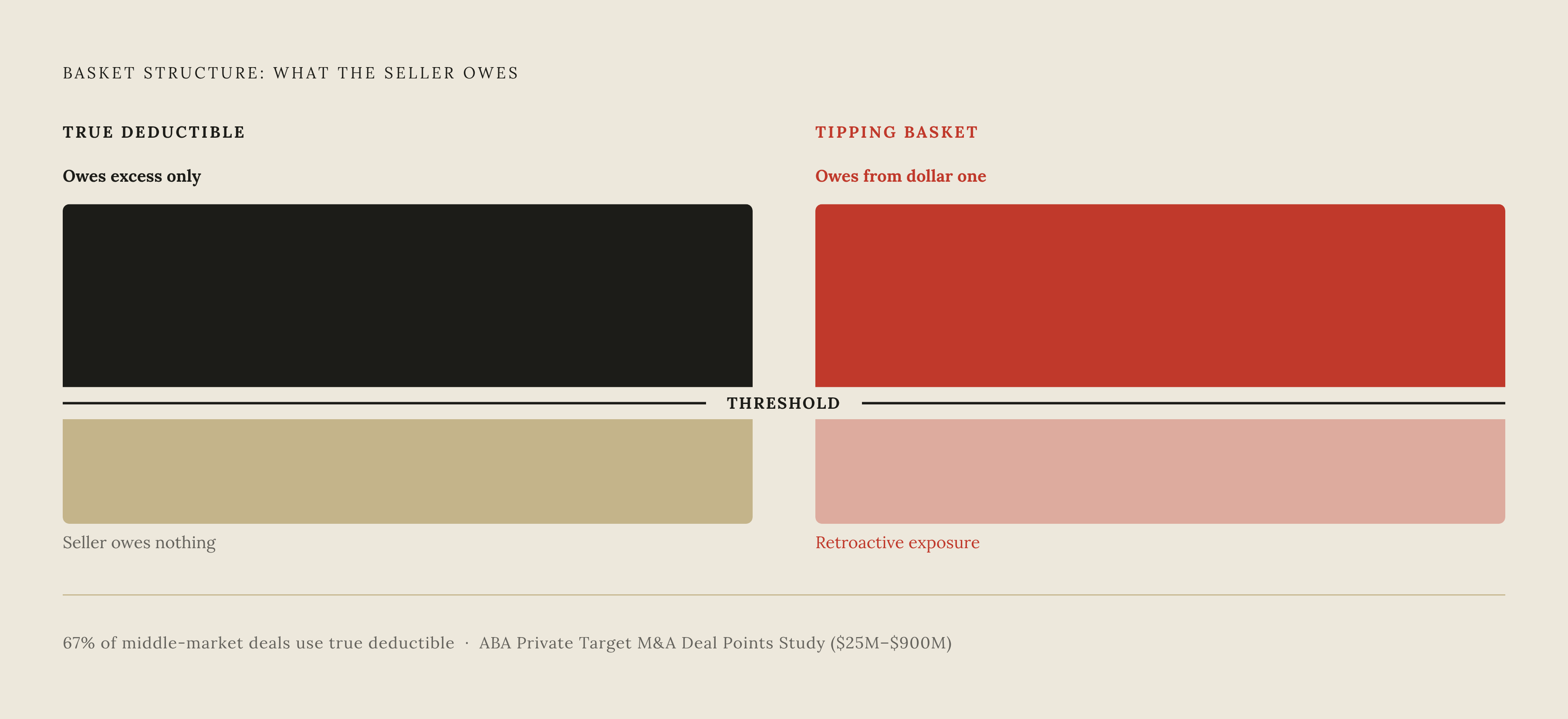
If earnouts determine what additional money a seller might receive, indemnification determines how much of the money already agreed to can be clawed back. Sellers without strong legal representation routinely accept escrow sizes, survival periods, basket structures, and materiality language that shift far more post-closing risk onto them than an institutional seller would agree to, and the gap between LMM and large-deal indemnification profiles is measurable. Escrow and survival periods move together. Sellers rarely sit down and actually model the time-value cost of a 15- or 24-month survival period sitting on top of a holdback that represents a meaningful slice of total net proceeds. The cost of that long tail gets underestimated at exactly the moment it should be negotiated hardest. Basket structure is where the gap gets most concrete. A true deductible basket means the seller owes nothing until claims cross the agreed threshold, and then owes only the amount above that threshold, the more seller-favorable of the two common structures. A tipping basket works differently: once claims cross the threshold, the seller owes the full amount from dollar one, not just the excess. That's a materially more buyer-favorable structure, and LMM sellers without counsel often accept it, or leave the basket type undefined entirely, without grasping how different the two outcomes actually are. The ABA's Private Target M&A Deal Points Study found that 67% of indemnification baskets in the middle-market deals it covered, transactions priced between $25 million and $900 million, were structured as true deductibles. Materiality scrapes compound the exposure further. A double materiality scrape strips the word "material" out of representations both when deciding whether a breach happened at all and again when calculating the resulting damages, which widens seller exposure on both ends of the same clause. And even a well-negotiated indemnification package can fail on a technicality. In Thompson Street v. Sonova, decided by the Delaware Supreme Court in April 2025, the merger agreement's notice requirements controlled over the escrow agreement's looser provisions, creating a condition precedent that could forfeit an indemnification claim outright if notice wasn't given the right way. A deficient notice can forfeit the entire recovery right, a risk that falls hardest on whichever side treats notice procedure as a formality.
Where disclosure schedule quality collapses in LMM deals
Earnouts and indemnification terms are provisions buyers negotiate hard. Disclosure schedules sit on the other side of the table, produced by the seller, and they're often where documentation quality falls apart fastest, which matters because this is one of the few places where quality is substantially within the seller's own control. A disclosure schedule is the seller's main tool for limiting what their representations actually cover. An incomplete or generic schedule doesn't just read poorly in diligence. It leaves the seller exposed to indemnification claims later on matters they genuinely believed they'd already disclosed. Customer arrangements that exist only as a handshake or an informal annual renewal, with nothing in writing, routinely go unlisted, and a buyer can later characterize that same undocumented relationship as an undisclosed contingent liability. The mechanism connecting all of these to post-closing risk is simple. A representation stating there are no material contracts beyond those listed in a given schedule is only as strong as that schedule is complete. If the schedule is missing something, the seller has made a representation they can't actually back up, and the buyer can assert a breach after closing on any contract that got left off. Why does this happen specifically in the lower middle market? Sellers typically build these schedules in the final days before signing, under real time pressure, without ever having systematically reviewed their own contract files, because they don't have the infrastructure, no in-house legal team, no contract management system, to produce the schedules earlier or more thoroughly. The schedule's quality is a direct function of how organized the seller's own records were months before anyone started drafting.
The RWI market has expanded into LMM deal sizes, but with conditions that matter
Representations and warranties insurance has moved meaningfully downmarket over the past several years, and it's now a realistic option for a much wider range of lower middle market transactions than it used to be. Where it's obtained, it changes the escrow and survival-period profile of the deal substantially. The ABA's Private Target M&A Deal Points Study found RWI referenced in 63% of the deals it covered, up from 55% in an earlier study and a sharp climb from just 29% in 2017. Newer, simplified products, including TLPE (Transaction Liability Private Enterprise) policies, specifically target the smallest end of the LMM range, offering faster placement, simplified underwriting, and lower costs than a standard RWI policy. The effect on deal structure is tangible: LMM deals with RWI escrow a substantially smaller share of transaction value than comparable deals without it, and the gap between the two profiles is large enough to meaningfully change what a seller actually nets from the sale. RWI still leaves the documentation problem for sellers to solve on their own. Carriers won't write coverage over known issues, undisclosed risks, or a disclosure schedule that's thin to begin with. RWI can only insure risks that are documented, so a seller who shows up to underwriting with incomplete schedules and undocumented customer arrangements cannot insure around gaps that were never filled. The economics also deserve a clear-eyed look at the smallest end of the market. On a deal in the $5 million to $20 million enterprise value range, the underwriting fee plus the minimum premium can eat up a meaningful share of the seller's net proceeds, so the decision to pursue RWI should be weighed directly against a conventional escrow with a clearly capped amount and a defined survival period, not assumed automatically to be the better option in every case.
Seller control between letter of intent and closing
Nothing in this piece suggests that LMM sellers are at the mercy of forces entirely outside their control. The gaps described here, a loose working capital definition, an undefined efforts standard in an earnout, a tipping basket accepted without comparison to a deductible, a disclosure schedule assembled in the final 72 hours before signing, are all addressable in the window between the letter of intent and closing, provided that window gets used deliberately. That means starting the disclosure schedule early, well before the final week, and reviewing actual contract files rather than reconstructing memory under deadline pressure. It means asking, line by line, whether the working capital definition names specific accounts or simply gestures at "normal course" accounting. It means comparing a tipping basket against a true deductible side by side rather than accepting whichever one appears first in a buyer's draft. None of these require a seller to become a lawyer. They require treating the months before closing as the last real opportunity to shape the economics of the deal, because once the documents are signed, the paper is what governs, not the intent behind it.