Qualified Buyer Criteria in Lower Middle Market Transactions
Defining which buyers can actually close a deal on your terms, not just express interest.

For an owner selling a business under $10 million, an alternative to a business broker or public listing site is a targeted sale process supported by investment banking advisory and AI-assisted buyer matching. Qualified buyer criteria for lower middle market deals include the buyer’s financial capacity as well as EBITDA band, sector fit, deal structure, and post-close intent. The aim is not to attract more inquiries, but to create competition among buyers who can complete a deal the owner would accept.
What "qualified buyer" actually means in lower middle market deals
Financial capacity is a necessary but weak first filter. A buyer who cannot fund the acquisition is plainly disqualified, but a buyer with ample capital may still be wrong for the business. Qualification is specific to the transaction. A buyer’s investment requirements must fit this company and this seller.
That distinction changes how an owner interprets interest. A promising conversation does not establish that a buyer can proceed on acceptable terms. Most first-time sellers conflate “interested” with “qualified,” which is how months can pass with prospective acquirers who were never realistic candidates. The cost is more than time spent answering questions. An owner who sees every inquiry as real competition can mistake a busy process for negotiating leverage, while buyers who could close the right deal stay outside the process.
How EBITDA band determines which buyer archetypes can realistically transact
A business at the lower end of the lower middle market and a business at $8M EBITDA do not share a buyer pool merely because both use the same market label. Buyers have limits on how small or large a deal can be. Those boundaries reflect the acquisitions their investment models are built to support, so interest outside them needs more scrutiny than a familiar fund name might suggest.
Private equity platform funds generally will not buy businesses directly below their platform threshold. PE add-on capital can accommodate smaller businesses, but only where they fit an existing platform thesis. Independent sponsors and search funders operate toward the lower end and are often the deepest pool below the market’s midpoint. Family offices cover a wider range, while strategic acquirers span the spectrum and may pay premiums where synergies are clear.
These differences shape the realistic valuation range. GF Data’s 2025 figures show that PE-backed acquisitions in smaller enterprise value tiers average lower multiples than those in larger tiers, although the progression is not uniform. That evidence concerns enterprise value tiers, leaving an exact EBITDA-to-multiple formula unspecified. It nevertheless reinforces why an owner cannot borrow a multiple from a larger transaction without considering the buyer pool behind it. Owners should work out the business’s EBITDA band before choosing which buyers to approach or what valuation to expect.
Why sector focus is a harder qualification criterion than most owners expect
Size fit does not establish sector fit. A buyer may regularly acquire businesses in the seller’s EBITDA band yet have no mandate to invest in the seller’s industry. Active lower middle market buyers tend to focus on certain verticals, and they almost never close deals outside their sector focus. A warm initial conversation cannot substitute for an investment thesis that includes the business.
CLA’s 2026 lower middle market predictions name business services, healthcare, and tech-enabled platforms as PE targets because their cash flow is predictable and their margins are strong. The same analysis says buyers need tighter investment theses for manufacturing and consumer. A seller must distinguish broad acquisition appetite from a reason to acquire this particular business.
How can an owner assess a mandate that is not public? Most active buyers do not publish their sector mandates publicly, which makes a specialized advisor’s proprietary buyer database more useful than a generic directory for matching industry fit. The distinction is between knowing that a buyer exists and knowing what it is seeking. Contacting buyers whose mandates do not fit the business wastes effort and can make the sale process look poorly run, which can weaken trust among buyers whose needs do fit.
Deal structure fit as a qualification signal buyers send and sellers misread
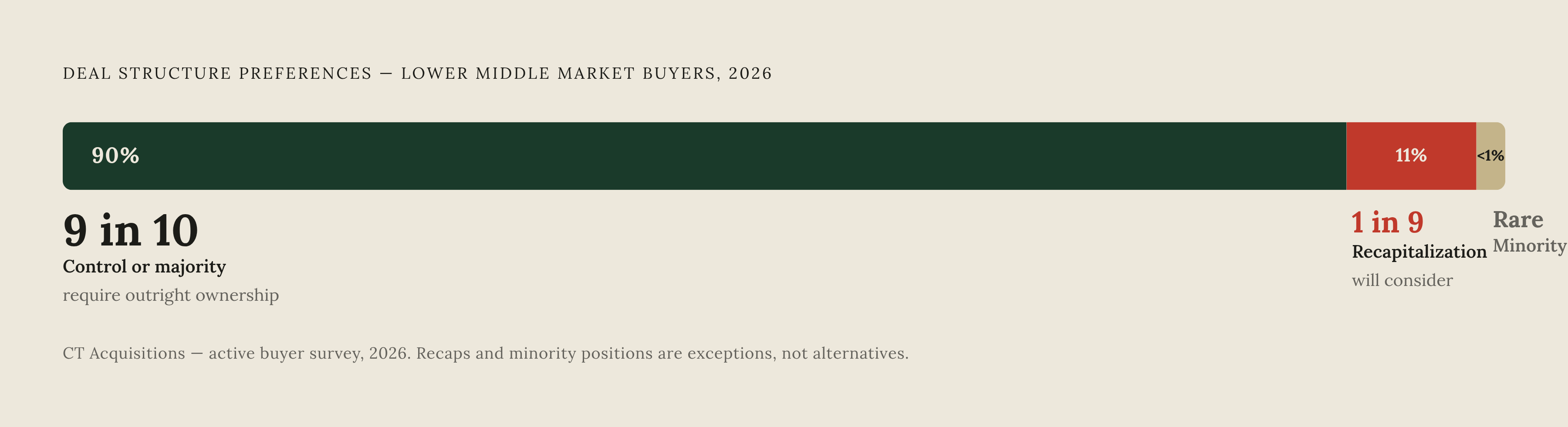
Structure exposes constraints that a headline valuation can hide. A buyer’s preferred terms reveal its investment model, so a structural requirement cannot safely be treated as an opening position that negotiation will remove. CT Acquisitions’ 2026 buyer demand data shows that nine in ten active lower middle market buyers need control or a majority position. Only about one in nine will consider a recapitalization, while minority investments represent a small fraction of the market.
The payment mix is another qualification test. Typical structures combine substantial cash at close with rollover equity and earnouts, but those components do not serve the seller in the same way. An owner who needs all cash at close does not fit a buyer whose model requires meaningful rollover. CLA’s 2026 analysis says earnouts, along with representation and warranty insurance, are now widely used to help bridge valuation gaps. Their presence makes a letter of intent, or LOI, different from a clean cash offer even when the stated valuation looks similar.
Working capital is a less visible source of friction. It is the leading source of last-minute deal friction in these transactions, and vague methodology before the LOI signals inexperience or bad faith. A genuinely qualified buyer reaches that stage with clear enterprise value, an asset versus stock election, a working capital target, any earnout mechanics, and a rollover expectation. Exclusivity terms should also be explicit, typically covering a 60-to-90-day window.
Post-close intent and what it reveals about whether a buyer is truly aligned
Two offers can look similar financially and produce very different lives after closing. For an owner, the difference may be whether the business keeps its identity, whether key employees stay, or whether the owner has to keep running it long after they had planned to leave. A financially capable buyer can still be misaligned with the outcome the seller seeks.
PE platform funds need management continuity and scalable systems because the business becomes a base for further acquisitions, while PE add-ons integrate into an existing platform and may lose their standalone identity quickly. Independent sponsors and search funders usually plan to run the business themselves, though financing risk is higher. Family offices often hold for seven to fifteen or more years, which can appeal to owners seeking cultural continuity and employee stability. Strategic acquirers pursue synergies through integration, eliminating redundancies, or absorbing the customer base.
Those patterns still need transaction-specific scrutiny. CLA’s 2026 analysis says independent sponsors increasingly stand out through their sector experience and how well their culture fits with founders. For sellers assessing such claims, the practical questions are what the business will look like operationally after close, what happens to key employees, and what the buyer has done with comparable businesses. The seller’s own management bench also constrains the answer. Most buyers are flexible about the owner’s role when the team is strong, but a business without that depth implicitly requires a longer transition regardless of the LOI’s language.
How the buyer pool for a given business is actually constructed
Knowing the filters does not reveal who passes them. Most owners can name only a handful of potential acquirers, while the realistic universe extends across platform buyers, add-on programs, family offices, independent sponsors, and strategics. Individual buyers, including first-time buyers and serial entrepreneurs, are also a meaningful and often overlooked part of the market. For businesses in the right size range, they belong on a well-constructed buyer list.
A specialized advisor has knowledge that is not public about which buyers are active in the business’s sector and size band, and does more than pass inquiries between the parties. Industry and EBITDA are the first screens, while the terms buyers prefer and their deal history show how well their stated interest fits what they have done. A buyer whose recent acquisitions depend on terms the seller will not accept does not become qualified by expressing enthusiasm. Post-close intent must also fit before that name becomes a credible target.
AI-assisted buyer matching supports this work by matching potential buyers across the qualification criteria. Its role is more useful when paired with experienced advisory judgment than when treated as a substitute for it. The seller should review and shape the list before outreach, excluding competitors whose involvement could compromise confidentiality and buyers with known structural or post-close conflicts. This targeted approach is the practical alternative to relying on a public listing to generate inquiries. The initial pool must be broad enough to uncover overlooked candidates who fit the business.
What a seller must present to attract and hold a qualified buyer's attention
Buyers who fit the business are also disciplined about the evidence they require before committing time and capital. Adjusted EBITDA is the first point of interrogation for institutional buyers, with add-backs that must be defensible and consistently applied. If stated earnings cannot be reconciled to clean financials, the buyer will either reprice or walk. A seller who is poorly prepared can therefore lose serious buyers while still hearing from casual ones.
Transferability is the next test of the earnings story. Owner dependence is the largest multiple discount buyers apply in the lower middle market because a business requiring the founder’s daily presence cannot transfer on the terms the seller may expect. Customer concentration introduces a different risk. A top customer accounting for more than roughly a fifth of revenue typically compresses the multiple or shifts value into an earnout tied to retention. A qualified buyer raises that issue before the LOI.
The Confidential Information Memorandum, or CIM, must make those judgments possible. It needs to present the EBITDA band, adjusted earnings bridge, sector context, management depth, concentration data, and growth thesis clearly enough to support an informed indication of interest without a management meeting. That standard explains the value of early-stage exit planning. Clean accrual financials, a documented management bench, reduced concentration, and defensible add-backs take a year or more to build. Starting preparation only when the owner is ready to leave gives the most qualified buyers less evidence than they need.
How running a structured process is what converts buyer qualification into competitive tension
Multiple qualified buyers must be active at the same time for qualification to become negotiating leverage. A single inbound offer, even from a credible acquirer, does not tell an owner whether the price reflects the market. A structured process changes that comparison by generating indications of interest from targeted buyers and advancing a short list to management presentations.
The LOI tests whether those alternatives remain credible. Terms can reveal a conflict over structure, working capital methodology, or exclusivity that earlier conversations left unresolved. Surfacing that conflict before committing to exclusivity prevents an initially promising candidate from consuming months on an unacceptable transaction. Process discipline also affects who stays engaged. CLA’s 2026 analysis highlights buyers’ emphasis on speed through pre-wired diligence and integration playbooks, so a slow or disorganized seller can lose disciplined buyers to faster processes elsewhere.
That need is sharper in a selective market. In 2026, large-cap deals are rebounding while the lower middle market still runs on relationships, so owners have little reason to expect a market upturn alone to bring competing offers.