AI Buyer Matching Platforms for Lower Middle Market Business Sales
Algorithm-built buyer pools surface acquisition candidates brokers' rolodexes would never reach.

A founder trying to sell a smaller business has, until recently, faced two bad options: list on a public marketplace and hope the right buyer happens to search that week, or hire a broker and hope their personal contact book happens to include someone who wants what's for sale. AI buyer matching platforms now offer a third path, built specifically to close the information gap that has made the lower middle market one of the hardest places in finance to complete a deal efficiently. This piece explains what that gap has always looked like, why it has gotten worse since 2021, and what an algorithm-built buyer pool changes for sellers compared to a Rolodex.
The lower middle market's transaction problem
Public markets have exchanges, tickers, and prices updating by the second. Large-cap M&A has investment banks running auctions with dozens of informed bidders. The lower middle market, generally the smaller end of businesses sold, has none of that. There is no centralized place where a buyer can see what's for sale, what it's worth, or who else is looking at it. Most companies in this range do not show up in any commercial database.
That absence isn't a glitch in the system; it's the system itself. A founder who has spent 20 years building a business rarely has the time, relationships, or process discipline to run a real competitive sale. A buyer looking to acquire, meanwhile, has no reliable way to know which businesses are actually open to a conversation versus which are just answering a cold email out of politeness. What fills the space between the two is luck: a broker who happens to know a buyer, a buyer who happens to drive past the right storefront, a seller who happens to get introduced at the right golf course. None of that is a process. It's chance wearing the clothes of a process, and it has defined how small businesses change hands for decades.
The post-2021 deal volume decline and the information gap
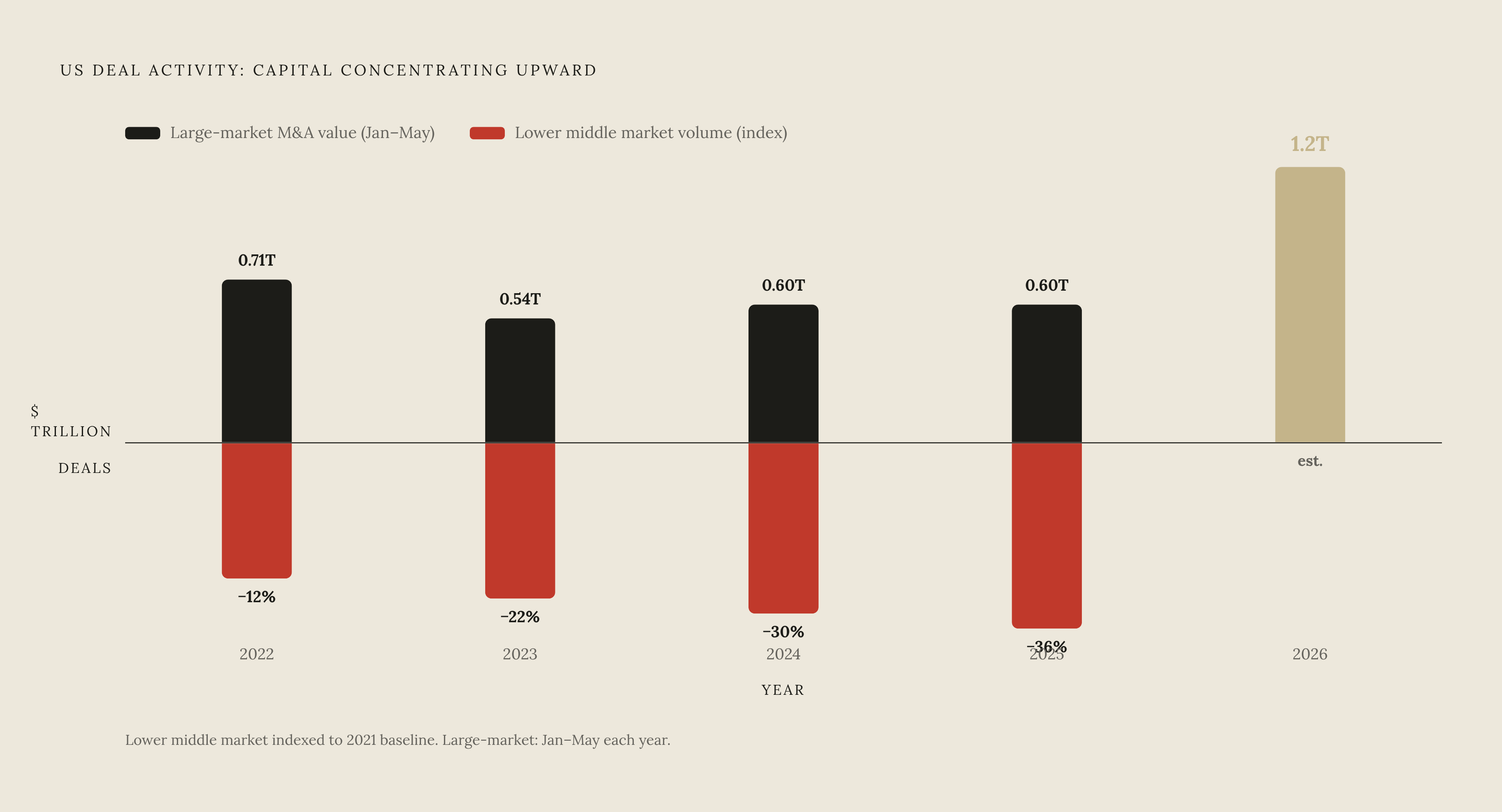
The gap described above didn't stay still. Deal volume in the lower middle market declined steadily from 2021 through 2025, and fewer transactions happening at once means the businesses that do transact face sharper competition for buyer attention. At the very same time, overall M&A deal value moved in the opposite direction: US M&A deal value reached $1.2 trillion in the first five months of 2026, nearly double the $603 billion recorded in the same period a year earlier. Capital is piling into larger transactions while the volume of small deals keeps shrinking.
That split has made buyers in the lower middle market far more selective than they used to be. A business with recurring revenue, clean financials, a management team that isn't just the founder, and limited owner dependence still draws real competitive interest. A business without those traits sits, waits, and watches offers fail to materialize. A founder whose company might have sold in a matter of months back in 2019, through nothing more sophisticated than a broker calling a few names, now competes in a market that has fewer total transactions and higher expectations attached to each one. This polarization cuts both ways, and it will matter again later in this piece: even the best buyer-matching technology cannot manufacture interest in a business that genuinely isn't ready for a competitive process, and it can't close the gap between what a founder believes the business is worth and what a buyer will actually pay. That valuation mismatch is the leading cause of failed deals so far in 2026.
AI buyer matching platforms versus a broker's contact list
AI buyer matching platforms attack the information gap from a different angle entirely than broker outreach ever could. A broker works from a list: people met at conferences, former clients, referrals built up over a career. An AI platform works from data: it scans company websites, financial signals, ownership structures, hiring patterns, and growth indicators across a huge universe of private businesses, looking for matches to a defined set of buyer criteria. The companies it surfaces don't need to be actively listed anywhere. Many of them aren't advertising that they're for sale. The platform finds them anyway, reading signals in the business itself before the owner raises a hand.
That's a real shift in how sourcing works. Traditional deal sourcing is reactive: a listing goes up, a broker circulates a teaser, and interested parties respond. AI-driven sourcing is proactive: a buyer defines what they're looking for, in concrete terms, and the platform goes out and finds candidates that fit, whether or not those candidates have done anything to announce their availability. Agentic AI pushes this one step further. Instead of a single search that returns a list of names, an AI agent can gather data on a company, compare it against a buyer's investment thesis, rank how well it fits, and flag what to do next, all as one continuous process rather than a one-time query a human has to re-run manually. For a founder on the seller's side, the practical consequence is that a well-run advisory process today can surface a structured, pre-qualified buyer pool, instead of depending entirely on whichever acquirers happen to already be in the advisor's address book.
Platforms used for LMM deal sourcing
Not every AI sourcing tool is solving the same problem, and choosing the wrong one means paying for enterprise outbound features while getting none of the confidentiality or deal-management support a single, high-stakes sale requires. Some platforms are built for large sales teams running high-volume outbound campaigns across industries. Tools like ZoomInfo serve exactly that market: verified contact data, intent signals, and conversation intelligence packaged for enterprise sales organizations tracking thousands of accounts at once. Apollo and similar self-serve platforms offer a lighter-weight version of the same idea, useful for a smaller team doing its own prospecting without an enterprise budget. These are capable products, but they were built to sell software and services, not to run confidential M&A processes for a founder who might sell exactly one company in a lifetime.
A smaller set of platforms focuses specifically on company-level sourcing for deal professionals, scanning private-company data to identify acquisition targets that match an investment thesis. That's a closer fit to what a lower middle market sale actually requires, but a pure sourcing tool still leaves a gap: identifying a buyer is not the same as representing a seller through a negotiation, protecting confidentiality during the process, or managing the dozen moving pieces a real transaction involves. For a founder weighing a public listing site against a pure data platform against something in between, the deciding question is whether the platform's design matches what a single, high-stakes, confidential sale actually demands.
What changes for sellers when a buyer pool is algorithm-built
For a founder actually going through a sale, the shift from broker-built to algorithm-built buyer pools changes more than the mechanics of outreach. It changes the ceiling on who can realistically find the business in the first place, raising that ceiling beyond what a broker's personal network could reach. A broker working from a personal network and a static contact database is capped by the size of that network, by geography, and by how recently those contacts were updated. An advisor using AI-native sourcing operates at a different order of magnitude, not a marginal improvement in reach.
A broader buyer pool built this way tends to arrive better prepared, too. Buyers using AI tools to source deals show up with a tighter sense of thesis fit already worked out. Less time is spent on conversations that were never going anywhere, and more time is spent with parties who were already a plausible match before the first call happened. Where a traditional broker's network is limited by personal relationships and geography, an AI-driven platform can surface qualified buyers across a national footprint, so a founder's exit stops being constrained by whether a local advisor happens to know the right acquirer and starts being constrained by something more useful: whether that buyer's thesis actually matches the business.
That reach cuts in both directions, though, and a founder should go in with eyes open about it. A business with clean financials, recurring revenue, and low dependence on the owner personally gains the most from broad algorithmic exposure, because more eyes on a genuinely strong business means more competitive tension and a better outcome. A business carrying real weaknesses benefits more from an advisor who frames the story carefully before it goes in front of dozens of potential buyers at once. AI tools increasingly support what's called dual-method modeling as well, helping advisors present the same business to both individual SBA buyers and institutional private equity acquirers, which widens the pool of plausible buyers for a single deal rather than forcing a founder to pick one type of buyer to pursue from the start. In a market where valuation misalignment remains the leading cause of failed deals, platforms that combine AI-driven valuation tools with buyer matching help sellers understand what the business is actually worth before stepping into a concentrated buyer pool, closing the expectation gap that has weighed on lower middle market transactions since 2021.
Where AI buyer matching fails
AI buyer matching solves a discovery problem. It does not solve a deal problem, and conflating the two is where founders get into trouble. The leading cause of failed deals through the first half of 2026 is a gap between what sellers expect their business is worth and what qualified buyers are actually willing to pay. An algorithm can surface that gap faster, by putting a seller in front of real market feedback sooner than a slow, broker-driven process would. It cannot close the gap itself. Closing it takes a hard conversation, grounded in comparable transaction data and an honest read of the business's financials, that no platform runs on its own.
Longer buyer lists carry their own risk, too, and it's a counterintuitive one. More names on a list is not automatically a better outcome. Practitioners in the space have pointed out that a tighter, carefully matched list of acquirers often outperforms a long algorithmically generated one, because a short list of genuinely interested parties produces real competitive tension, while a long list of lukewarm ones just produces wasted calls and diluted attention.
Data quality is a separate problem, and it bites hardest at the smaller end of the market. Private company financial estimates can be substantially off for smaller businesses, since so little of their financial information is reported publicly. An AI-matched buyer can arrive at the table with a confident-sounding but incorrect assumption about a target's revenue or margin, built on bad underlying data. And AI cuts against sellers in diligence just as easily as it helps them in sourcing: buyers now use the same category of tools to scrutinize deal documents, challenge add-backs, and build out diligence requests far faster than a human team working alone could. One in five strategic dealmakers walked away from a deal in the past year specifically because of the anticipated impact of AI on the target's business. A founder without an advisor who understands that dynamic from the buyer's side is negotiating at a real disadvantage, whatever the buyer pool looks like going in.
A complete exit process pairing AI matching with human advisory judgment
None of the limitations above argue against using AI matching. They argue against using it alone. The founder-led businesses getting the best outcomes from this technology are the ones whose advisor pairs algorithmic reach with the judgment to run a confidential, competitive, well-prepared process once that reach has done its job.
AI changes what's possible at the top of the funnel: a broader, more precisely matched set of potential buyers than any network-bound process could ever produce on its own. What happens after that initial match is still, and will likely remain, a human responsibility. Preparing the business's story so it holds up under real scrutiny, qualifying which buyers are serious and which are just browsing, managing confidentiality so employees and customers don't hear about a sale before it's final, running an actual competitive process among multiple bidders, and negotiating the final terms on the seller's behalf: these are steps that AI can support but cannot take over. For a founder weighing options in the lower middle market, the choice of advisor ends up mattering just as much as the choice of platform, and the real question to ask any advisor is a simple one: are they sourcing buyers with AI-native tools, or still working from a static list built years ago?
Timing matters as much as the tools themselves. The right moment to engage isn't necessarily the day a founder decides it's time to sell. Strategic preparation three or more years ahead of a planned exit gives a business time to get positioned for the buyers AI will eventually surface, rather than leaving a founder scrambling to explain away weaknesses after a strong match has already been made. An advisory model pairing AI-driven buyer matching with institutional investment banking advisory is built for exactly that founder: the one who needs real reach into a national buyer pool, but also needs someone representing their interests at every step from first contact through close. Certainty in an exit still comes down to preparation and the right partnership. What's changed is how much more powerful that partnership can be with AI doing the work a broker's Rolodex never could.