Management Team Depth as an Exit Value Driver
Buyers pay higher multiples for companies that can operate without their founder.

For business owners, exit planning should start 3–5 years before a target sale, and building management depth should be a priority because of its effect on the sale price. Management Team Depth as an Exit Value Driver explains why buyers pay more for earnings that can hold up after the founder leaves. Distributing authority, documenting critical processes, and addressing retention risk before going to market help the business support both a higher price and a cleaner exit.
Why buyers treat management depth as a valuation input, not a leadership preference
A buyer is purchasing future cash flow. The buyer must assess whether earnings will hold after the person who built the company leaves. If those earnings depend on that person’s judgment, relationships, or technical capability, the buyer inherits a transition risk. The multiple expresses how much the buyer will pay for earnings exposed to that risk. Management depth therefore belongs in the valuation discussion.
This distinction matters because much of a private company’s value rests in intangible assets, including its brand, customer relationships, systems, and human capital. Those assets must survive the transfer of ownership to retain their value for a buyer. A capable management team provides continuity, but only if its members actually exercise authority. The practical test reaches into ordinary work, including who handles payroll, resolves vendor disputes, and approves customer discounts. When the owner handles all of these tasks, each one carries the same concentration risk.
How buyers audit management depth during diligence
Buyers test this concentration by comparing the formal organization with how the business operates. They look at documented processes, organization charts that show who has authority, and evidence that people make decisions without the owner’s sign-off. A title alone does not establish independence. Management presentations then let buyers see how well the leadership team understands the business, how well it fits the culture, and whether they can trust it.
The vacation test gives this inquiry a concrete frame. Buyers consider what would happen operationally if the owner disappeared for an extended period. They look for clear accountability and consistent performance across sales, operations, finance, and people leadership. They also examine succession depth and the retention risk among managers and specialists. Moving every important decision from the founder to a single COO transfers dependency to that operator.
AI-assisted diligence makes this assessment sharper by cross-referencing CRM data, organization charts, and financial records, so claims of management depth that only look good on paper are easier to spot. This also creates an opportunity to identify weaknesses before formal diligence begins. Succession AI is one of the platforms that combine AI-powered buyer matching with investment banking advisory, and it can flag founder concentration during planning, before it hurts the price.
What owner dependency costs in multiple terms and deal structure
When that evidence is weak, the financial consequence extends beyond a lower headline multiple. Owner-dependent businesses sell at a meaningful EBITDA discount relative to management-run peers in the same industry tier. For a mid-sized business, that gap can represent millions of dollars in pre-tax proceeds. Key person discount is also a formal appraisal methodology, applied when one individual holds disproportionate institutional knowledge, customer relationships, or technical capability. It is not merely a label a buyer invents during negotiation.
Earn-outs bridge valuation gaps and can encourage the seller or key personnel to remain involved after closing. Holdbacks, seller financing, and longer transition periods also put risk back on the seller. In effect, the seller finances the buyer’s uncertainty by accepting delayed or contingent proceeds, or by continuing to supply the leadership the business lacks. Strong management depth can help sellers get more cash at closing, smaller holdbacks, and shorter transition periods.
Dependency can also reduce competition before terms are negotiated. Financial buyers without an operating partner to install need a company that can function without its founder. Individual acquirers who intend to run the business themselves also need operations that survive the handover. Where buyers using government-backed loans are relevant, high key-person risk can disqualify a business. Fewer qualified bidders weaken competitive tension, adding a buyer-pool penalty to the valuation discount.
The objection worth taking seriously: owner dependency does not always kill a deal
Many home services and trade businesses close transactions at lower-range multiples with extended transition roles for their sellers. An owner willing to remain involved may find a lower multiple plus an earn-out entirely acceptable. That outcome is not a failed exit merely because it is less clean.
The owner must weigh that outcome against the best available outcome for their goals. Management depth is a multiple driver for owners seeking maximum proceeds and less post-close responsibility. For those owners, accepting a discount and remaining contractually tied to the business for years are material costs.
What the supply-demand imbalance means for well-prepared sellers right now
The opportunity for prepared sellers follows from a distinction between businesses available for sale and businesses buyers are ready to acquire. Private equity firms have near-record amounts of uncommitted capital, while the Baby Boomer exit wave brings more companies to market. Yet the supply of prepared, quality businesses remains thin relative to the capital available. More potential sellers do not necessarily mean more attractive acquisition targets. Buyer selectivity is the filter between the two.
A seller who has completed the organizational work competes against businesses whose earnings still depend heavily on their founders. A business that can run without its founder can both avoid a discount and command a premium. It also opens the process to more kinds of buyers, including financial and strategic acquirers and, where applicable, acquirers using government-backed loans.
This is a structural opportunity for a company prepared for a sale. Available capital cannot substitute for evidence that a business will survive its transition. Responding usefully to the imbalance requires organizational preparation.
How early should a Canadian business owner start planning to sell
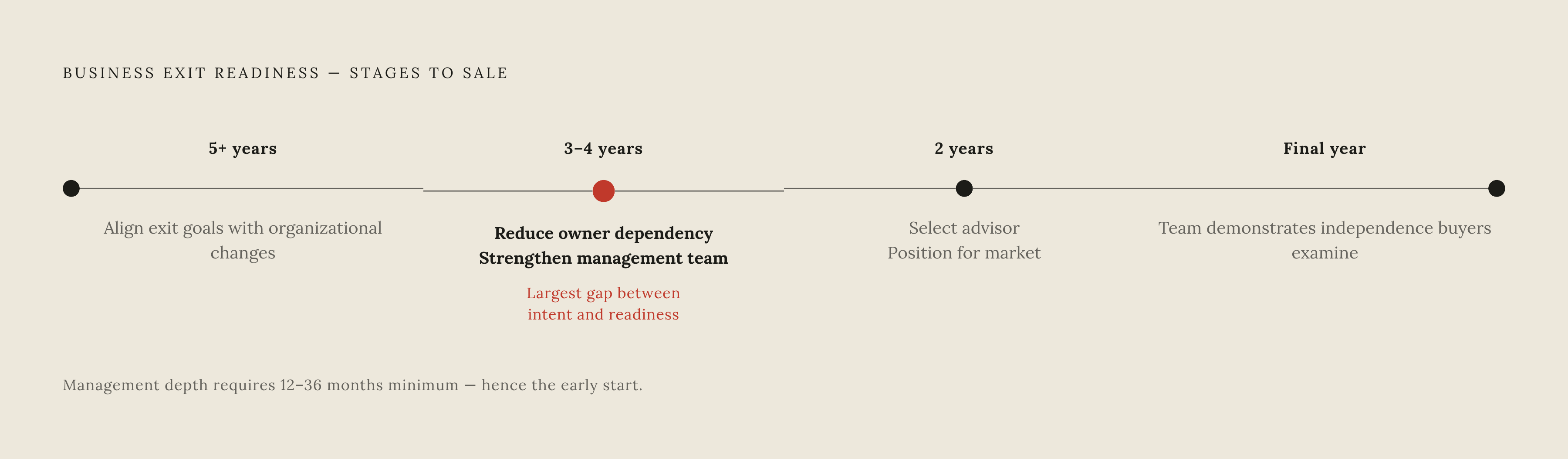
Meaningful improvement in management depth requires a minimum of 12 to 36 months. Hiring, developing internal talent, and restructuring authority take time to change how a business runs. For an owner targeting a sale in 3–5 years, that makes organizational work an early priority. A management team assembled just before launch has not had the same time to establish independent performance. The buyer needs to assess an operating business.
Owners can start planning for the exit as a whole 3 to 10 years before a target sale. At five or more years out, owners have room to connect their exit goals with the organizational changes needed to support them. At 3–4 years out, the priority is to reduce owner dependency and strengthen the management team. At two years out, the work turns toward selecting an advisor and positioning the business for market. By the final year before launch, the team should be demonstrating the independence buyers will examine.
For an owner three years from selling, this sequence makes the immediate task clear. Leadership gaps, unclear succession in key roles, and retention risk need attention before the business enters a transition. Waiting until diligence exposes them leaves little room for meaningful correction under scrutiny. Only a small fraction of owners report being fully prepared to transfer ownership, despite widespread intent to exit. The collision between the Boomer exit wave and the minimum preparation timeline means delay can leave a seller structurally disadvantaged when the intended sale date arrives.
What owners should actually build: the components buyers reward
Owners should honestly evaluate the leadership structure to identify which decisions, relationships, and capabilities still depend on them, then strengthen the roles that can assume those responsibilities. A second-in-command should have authority to run operations. That authority must extend to the work buyers will test. At the same time, succession beyond that leader matters, because replacing founder dependency with dependence on one manager leaves the underlying problem intact.
Documenting critical processes makes the operating model available beyond the founder’s judgment. Buyers look for evidence that decisions get made and problems get solved through a system. Documentation supports that evidence, but the actual use of delegated authority is what connects the written process to daily operations. The same principle applies to customer relationships. Moving those relationships systematically to account managers or sales leadership reduces the share of revenue tied personally to the owner.
Retention deserves separate attention because management depth has little value to a buyer if the people providing it leave during the transition. Retention agreements, equity participation, or compensation structures can align key managers with staying through and after the sale. Owners also need breadth across sales, operations, finance, and people leadership. A strong COO does not compensate for missing sales leadership or finance capability.
Together, these components create a practical standard for readiness. The business needs distributed authority, documented processes, talent that stays, and people who can cover enough roles to run it without the founder. Strengthening key roles over time is more credible than filling gaps only when a buyer asks about them. Valuation updates every 12–24 months during preparation allow owners to assess whether organizational improvements are translating into valuation progress.
How advisory support — human and AI-assisted — shapes what owners can actually achieve before going to market
Advisors entering only at the transaction stage cannot readily correct organizational gaps that require months or years to resolve. Starting work with an advisor 3–5 years before the target exit gives owners time to fix weaknesses found in a salability analysis. The relevant expertise is deep M&A experience, including valuation, buyer negotiations, and risk mitigation. Quality-of-earnings analysis and buyer identification before market entry also shape the eventual process.
Human advisory and AI-assisted matching serve different purposes within that work. Buyer matching can use a systematic search to find financial buyers, strategic buyers, and individual acquirers that are a good fit for a business with real management depth. Investment banking advisory translates that depth into the confidential information memorandum, prepares the leadership team for management presentations, and structures the process around qualified buyers. Neither activity creates the underlying independence. Their value is in connecting the organizational evidence to buyers who can recognize and price it.
Succession AI combines AI-driven buyer matching with investment banking advisory, so it is one option for owners who want to link their work before the sale with the sale itself. Experienced M&A advisors and AI-assisted platforms are useful only to the extent that their work addresses the company’s actual gaps and buyer requirements. For profitable lower middle market businesses, the combination can connect a stronger operating organization with a wider qualified buyer pool. The central distinction is between presenting management depth and having built it. Owners who begin early have time to do both, turning a company that depends on them into one a buyer can confidently own without them.