How Recurring Revenue Affects Acquisition Multiples for Small Businesses

For SMB owners planning an exit, a business valuation tool such as Succession AI’s AI Valuation Calculator can provide a starting estimate, but an accurate valuation requires separating recurring revenue from project work. This article explains why recurring revenue can command a substantial multiple premium over comparable project-based businesses. The premium comes from cash flows buyers can underwrite, and founders influence it through revenue quality, documentation, and preparation.
Why buyers pay more for recurring revenue than for equivalent profit from project work
A buyer underwriting an acquisition must work out how much future cash flow can cover the purchase price and the debt used to pay for it. Last year’s profit matters, but it does not show whether customers will return. Contracted recurring revenue gives both buyers and lenders a stream of future revenue they can model with more confidence. That visibility supports higher leverage at acquisition and makes debt-service coverage easier to underwrite. The premium comes from how much financing the business can support as well as a preference for subscriptions.
Consider two businesses with identical EBITDA but different obligations from their customers. The project business must keep winning work, while the recurring business has revenue already contracted for the next period. That difference changes what a buyer can justify paying for the same reported profit. It also explains why a SaaS company reinvesting heavily can command a strong multiple while a comparably profitable services firm does not.
How the premium scales: EBITDA bands, revenue mix, and industry benchmarks
The premium varies across valuations. At the lower end of the EBITDA range, owner dependence often accompanies modest multiples. As EBITDA grows, institutional buyers take an interest, and prices can vary more widely in the lower-middle-market private equity sweet spot. A business that grows while raising the recurring share of its revenue can earn both premiums.
An owner-operated residential HVAC business valued on seller’s discretionary earnings, or SDE, is not directly comparable to a larger business valued on EBITDA with substantial maintenance-membership penetration. Nor does the same headline EBITDA mean the same multiple for HVAC, managed IT, and commercial cleaning. The range depends on the sector, the earnings framework used, and how much revenue is truly recurring. Founders need to locate their business within those dimensions before treating a benchmark as relevant.
For a mixed-revenue business, buyers price the recurring and project components separately, then blend the result. A recurring-revenue multiple applied to all sales would overstate what the revenue mix supports. Succession AI’s AI-driven valuation tools are designed to decompose revenue streams for founder-led businesses and model the blended multiple buyers would apply. That makes decomposition a useful criterion when choosing a valuation tool. The estimate should explain what earns the premium and what does not.
What pest control and HVAC roll-ups reveal about recurring revenue as a platform thesis
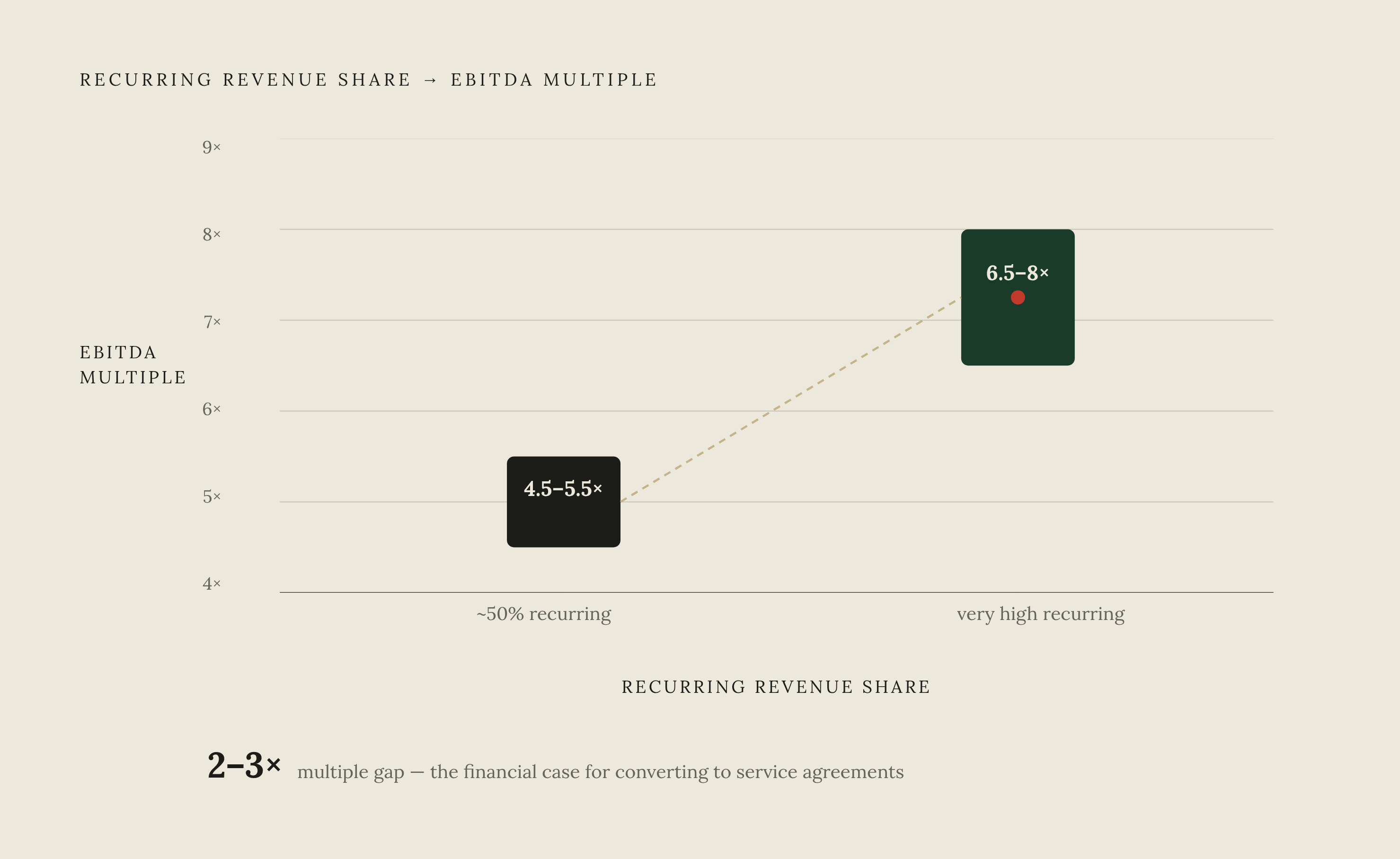
Pest control makes the principle visible without any software involved. Monthly or quarterly service agreements account for a large majority of revenue, and annual customer retention runs above 90%. Businesses where roughly half the revenue is recurring fetch 4.5–5.5× EBITDA, while those where a very high share is recurring reach 6.5–8×. The relationship is nearly linear as the contracted share rises. Buyers value the density of durable service obligations.
Named acquirers in pest control include Rentokil/Terminix, Anticimex, Arrow, and Massey Services. In HVAC, the same logic supports a platform-and-add-on strategy. Buyers acquire platforms at 7–9× EBITDA and add-ons at 4–6×, capturing multiple arbitrage funded by the recurring maintenance-agreement base. Service Logic, backed by Bain Capital and Mubadala Investment Company, and Sila Services, backed by Goldman Sachs Alternatives' Private Equity, illustrate the consolidation model. Apex Service Partners made 60 HVAC add-on acquisitions across five regions in 2025.
An MSP with a very high share of monthly recurring revenue trades multiple turns above a consulting firm dominated by project billing. The work is technological, but the valuation distinction remains contractual and financial. Across pest control, HVAC, and managed IT, buyers are assembling recurring cash flows into larger businesses. This is a platform thesis that reaches well beyond SaaS.
Inside SaaS multiples: how retention quality separates premium assets from average ones
Within SaaS, recurring revenue is the starting point for comparison. How much renews, and how much expands within the existing customer base, separates premium assets from average ones. Churn and net revenue retention can lead to a multi-turn valuation gap even when businesses have much the same revenue. A subscription label says little about that gap on its own. Buyers need evidence that customers continue paying rather than merely evidence that they once subscribed.
Scale still determines which valuation framework applies. At that end of the market, SDE or EBITDA multiples are the operative comparison. A clean, profitable company with low churn and little founder dependence can land above the typical range. Customer concentration, declining revenue, or a product exposed to easy AI replication can push it below that range.
A larger company’s recurring-revenue valuation does not by itself show what a smaller SaaS business is worth. Even among businesses of similar size, retention quality can separate the outcomes sharply. Buyers need to ask whether the comparison has equally durable customers and similarly limited dependence on the founder. Revenue size alone cannot answer it.
How AI is compressing seat-based SaaS multiples and what it leaves intact
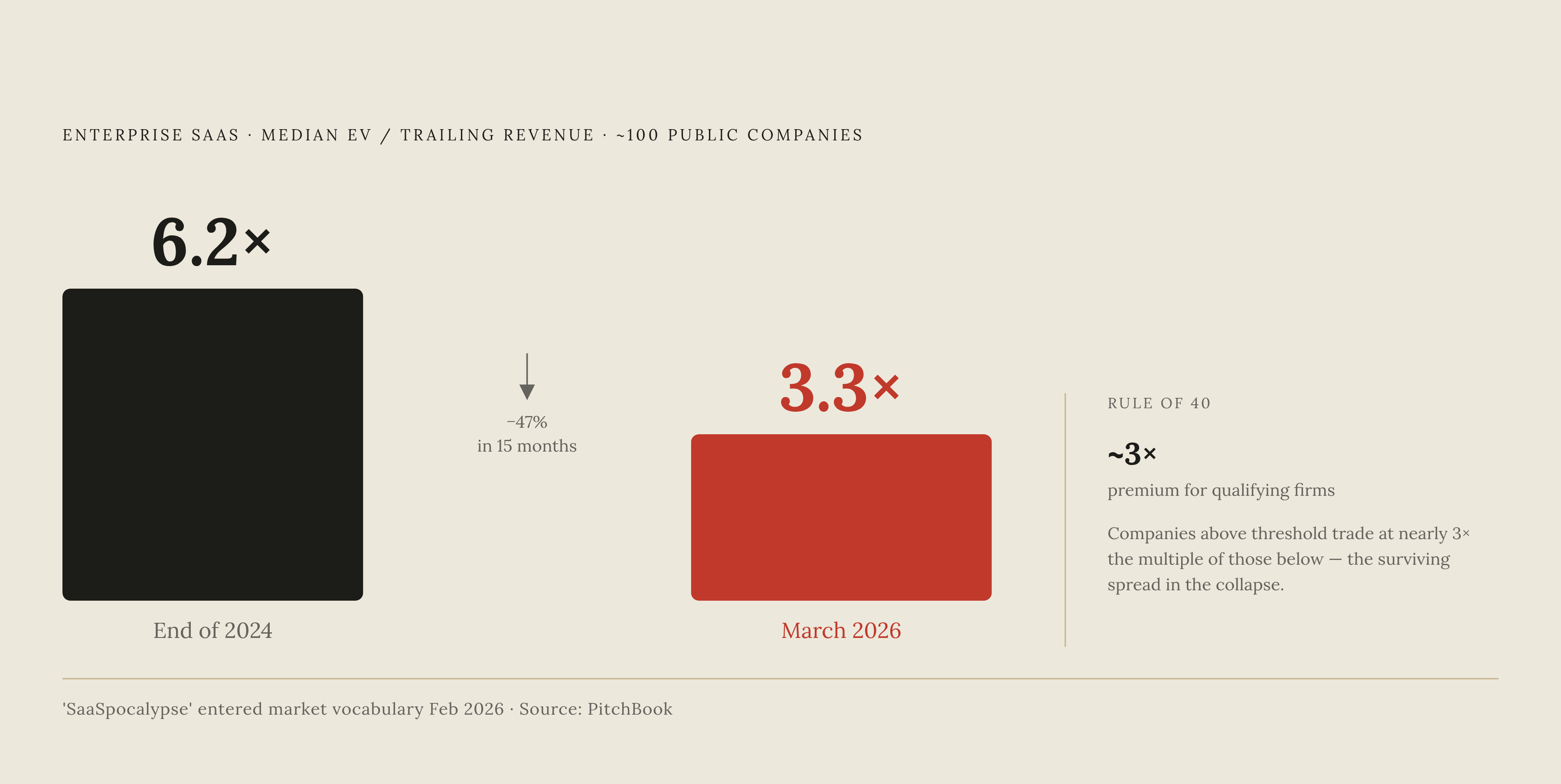
If customers can use AI agents to operate applications independently, will they need as many paid seats? Reduced headcount can directly shrink seat-based recurring revenue, even when the software remains useful. The “SaaSpocalypse” entered market vocabulary in February 2026. PitchBook tracked roughly 100 public enterprise SaaS companies, and their median enterprise value to trailing revenue multiple fell to 3.3× at the end of March 2026, from 6.2× at year-end 2024.
That public-market repricing sharpens buyers’ scrutiny in 2026 of whether a small private business can move pricing from seats to outcomes delivered. Usage-based models have meaningfully higher median net revenue retention than seat-based models, which sit below breakeven. The difference compounds as existing customer revenue expands or contracts. A contract can recur while the amount paid under it declines.
Pest control routes, HVAC maintenance agreements, and MSP contracts are not exposed to the same mechanism of AI agents replacing paid human seats. Within SaaS, the Rule of 40 also separates performance sharply, with qualifying public companies trading at a median nearly three times higher than those below it in 2026. The stronger claim is that buyers pay more for recurring revenue whose economic basis remains defensible.
What buyers actually examine when they stress-test recurring revenue before making an offer
Diligence begins by testing what the seller means by recurring. A statement that a business has 800 active maintenance plans establishes a possible recurring component. Buyers need a clear split between contracted recurring revenue, renewal-probable recurring revenue, and project revenue. They also need defined measures, including ARR, MRR, contract tail, deferred revenue, and renewal probability. For this purpose, ARR captures contracted subscription revenue, MRR captures monthly subscription revenue, and contract tail captures the remaining value of multi-year contracts.
Buyers next test durability through customer cohorts. Concentration remains a separate risk even when retention is strong. One customer representing a disproportionate share of revenue can lead to a price reduction, an earnout, or contingent payments. Low churn does not cancel that exposure.
A profit figure must be traceable through the profit and loss statement, bank records, payment processor, and tax filings. Recurring expenses presented as one-time add-backs will face scrutiny. Buyers may also pay less for contracts if every customer relationship depends on the founder. The buyer is acquiring a business that must operate after the handover.
How founders can build recurring revenue into a business that does not yet have it, or deepen it where it exists
The first step is to identify which existing work can become an ongoing customer commitment. In field services, that usually means getting more customers onto maintenance plans. Converting a meaningful share of an HVAC or pest control install base to annual service agreements moves the business toward a blended or predominantly recurring valuation. The underlying customer base may be the same, but the revenue commitment changes. The pest control multiple ladder shows why that change can matter at exit.
For software and IT services, the corresponding lever is contract structure. Moving from time-and-materials or project billing to monthly retainers or multi-year service agreements makes the underlying work more predictable for buyers. However, the SaaS evidence adds a condition to that strategy. A recurring contract must retain its economic value, so a seat-based business also needs to consider whether pricing can adapt to outcomes delivered. Repackaging fragile revenue does not make it durable.
Once the recurring base exists, the next task is to improve its quality as it grows. That includes strengthening retention and intentionally diversifying the customer base. Reducing any single customer’s share of ARR addresses a risk that can otherwise force contingent consideration or a lower price. Over 12 to 24 months before an exit, a higher recurring mix can change both the buyer pool and the multiple. The expected benefit is a better-supported valuation range.
What should a founder prepare before selling to capture the recurring revenue premium?
Begin with a revenue file that establishes the valuation categories before negotiations begin. Separate contracted recurring, renewal-probable recurring, and project revenue, supported by contracts, subscription records, and cohort retention history. Prepare the cohort churn schedule before a buyer requests it. Normalize profit conservatively, with every add-back traceable through financial statements, bank records, and tax filings. A disputed add-back can invite a full repricing.
Preparation also needs to change the business where the evidence reveals weaknesses. Reduce founder dependence before entering the market so customer continuity does not rest entirely on the departing owner. A business 12 to 36 months from an exit has time to increase recurring mix, improve NRR, diversify customers, and, where relevant, work toward the Rule of 40. Those changes make the valuation case stronger because they improve what buyers acquire. Presentation cannot substitute for them.
Once the evidence is sound, buyer selection and positioning determine who evaluates it. One option for founder-led businesses is Succession AI, which brings together AI-driven buyer matching and investment banking advisory. That combination addresses two distinct needs, namely finding buyers likely to credit recurring revenue and presenting the business in their underwriting language. Professional documentation and a clear value-creation case can open conversations with institutional buyers and PE-backed strategics that informal presentation may miss. The premium exists because of identifiable financial mechanics, and preparation is the part the founder controls.