Confidential Buyer Outreach Versus Public Listings for Sub-Ten-Million Canadian Exits
Choosing between confidential outreach and public listings shapes price, buyer pool, and risk.

Confidential buyer outreach is an alternative to a business broker or public listing site for smaller Canadian business sales. Owners can run it themselves or engage an advisor to identify buyers, screen their capacity, and release information in stages. The choice is not simply about privacy. It shapes the buyer pool, the price, and the risk to the business before closing.
Why the route to market is the first and most consequential decision a smaller Canadian seller makes
An owner preparing to sell may begin with a price in mind, but the first decision is how potential buyers will encounter the business. That choice precedes the first offer. A public listing invites interest from whoever is browsing, while targeted outreach starts by identifying buyers with a reason to acquire this particular company. For an owner whose business is both their largest asset and their retirement plan, the distinction deserves attention before marketing begins.
Lyndon Advisory’s framework puts it plainly. “Listing a business is a distribution tactic. Targeted outreach is a strategy.” Sellers should choose a route by how well its exposure serves them, with the volume of exposure a secondary consideration.
How a public listing actually works and what it exposes
A public listing places a business’s availability on a marketplace platform and solicits inbound inquiries. It typically includes industry, general location, size, highlights, and asking price. The business need not be named outright. Taken together, those details can allow someone familiar with the market to infer its identity, and the seller cannot choose who views them.
That audience includes more than prospective buyers. Employees, customers, suppliers, and competitors can access the same platforms, although viewing a listing does not necessarily mean recognizing the business. The commercial attraction is broad distribution without first building a buyer list. The tradeoff is that distribution occurs before the seller knows whether viewers have the means or intention to buy.
The inquiries that come in tend to be from individual owner-operators looking for a business to buy. Strategic acquirers and institutional buyers often find businesses in other ways, through acquisition themes, people they know in the industry, and targeted searches. A listing can therefore attract legitimate buyers without reaching the buyer with the strongest reason to pay.
The narrow conditions under which a public listing is actually the right call
A listing can fit a small, local business whose value sits mainly in equipment, a lease, inventory, a route, or transferable local customer relationships. The likely buyer is a working owner. Confidentiality risk must also be genuinely manageable. Where the transaction resembles an asset transfer and speed takes priority over broader buyer competition, a listing may be practical.
Lyndon’s framework makes room for these conditions and accepts that public marketing can be a sound choice. Outreach requires preparation, time, and process discipline that may not be justified for a straightforward local sale. Whether the business actually fits that profile matters more than whether posting it would be easier.
How do you sell your Canadian business without a public listing, step by step?
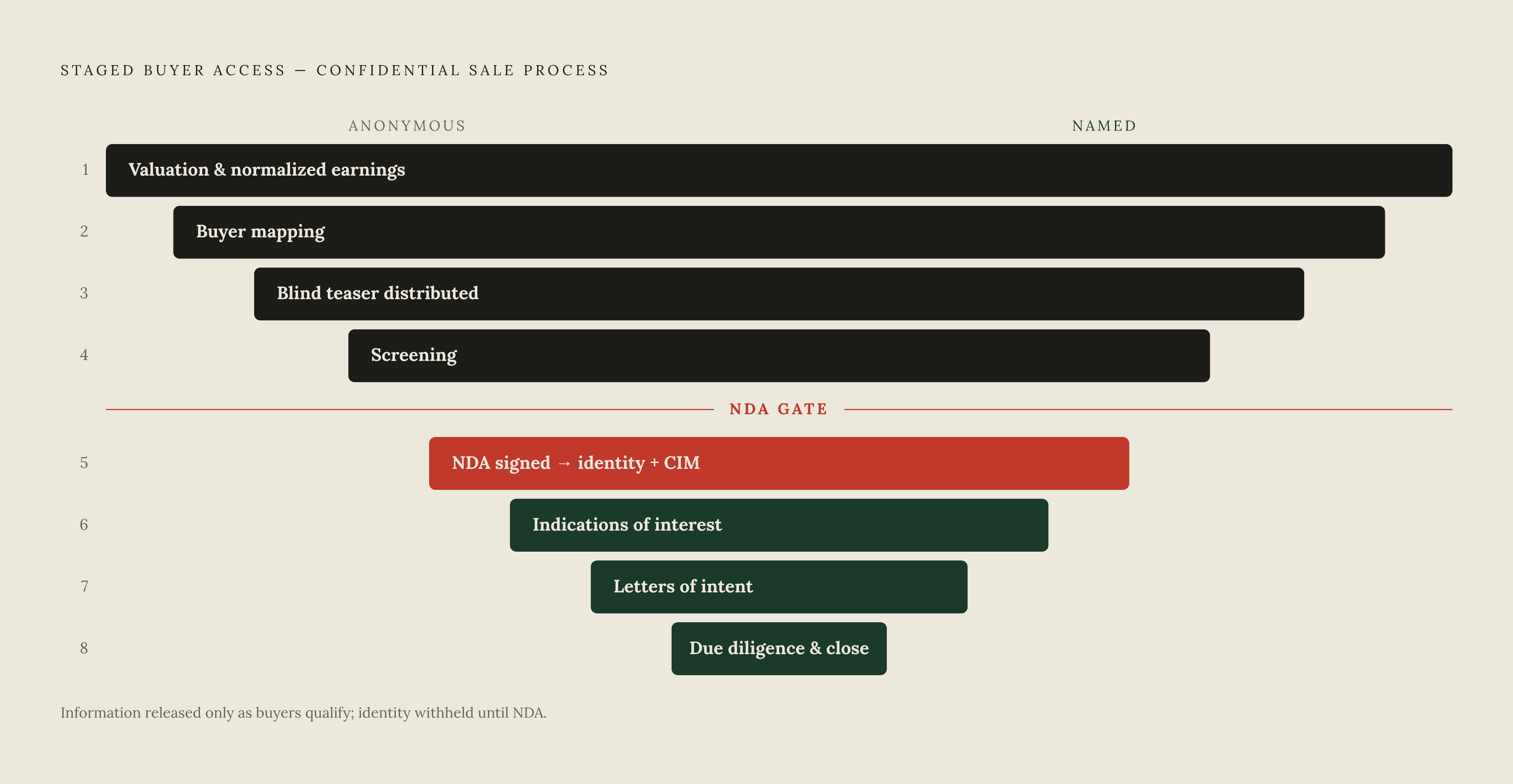
Confidential outreach begins with valuation and positioning, before anyone is approached. Normalized earnings tell the financial story, while buyer mapping shows who could benefit from owning the company. The opening document is a blind teaser. It describes industry, geography, size, and highlights without naming the business, allowing potential buyers to express interest before receiving its identity.
Interested parties are then screened for acquisition rationale, funding capacity, and sector fit. Only qualified buyers who sign a non-disclosure agreement receive identifying information and a detailed Confidential Information Memorandum, or CIM. Buyers send in non-binding Indications of Interest, which help narrow the field before the strongest candidates send in Letters of Intent.
With a preferred buyer selected, due diligence, negotiation, and closing follow. Treadstonelaw’s Ontario seller guide lays out the same steps for owners selling without a broker, with financial screening and an NDA before financial details are shared. Counsel remains responsible for NDA preparation, LOI review, legal due diligence, and the purchase agreement.
Why confidential outreach produces a different buyer universe — and why that changes the price
An individual owner-operator primarily needs the business to support its purchase and provide an income. A strategic acquirer may also gain entry into a geography, additional revenue for an existing platform, or capabilities it would otherwise need to build. Those benefits sit outside the target’s income statement. They can nevertheless influence what that buyer is willing to pay.
PE-backed platforms may look for add-on acquisitions, while family offices and search funds may want steady cash flow from smaller owner-operated businesses. Targeted outreach can also reach cross-border acquirers whose searches do not depend on a domestic listing platform. These groups do not all value businesses alike. These buyers matter when the company fits their acquisition rationale, but their interest alone does not mean they will pay a premium.
Competition then turns buyer fit into negotiating leverage. When qualified buyers look at the same business through a coordinated process, each knows the seller has other buyers to turn to. A single inbound inquiry offers no equivalent tension, although a listing that generates several credible buyers can still create competition.
How a public sale signal damages the business before a deal closes
The risk from disclosure begins while the seller still owns and operates the company. Employees may look for more secure jobs, customers may look elsewhere, and suppliers may tighten credit terms. Competitors can use the exit signal to approach staff or clients. These reactions need not be dramatic to weaken the business being sold.
A buyer conducting due diligence evaluates current performance alongside the financial history presented at the outset. Losing a key employee or major customer can therefore become grounds for a lower offer or withdrawal. Confidentiality protects the asset during the transaction. It is not simply a preference for keeping the owner’s plans private.
Direct outreach also creates exposure, particularly when a competitor is approached. Treadstonelaw warns that some competitors may want information more than an acquisition. An NDA provides legal recourse, but cannot undo every commercial consequence of disclosure. Screening, staged access, and a planned approach to employee, customer, and supplier communication are therefore integral to the confidential route.
How smaller Canadian businesses are actually valued, and why the valuation method interacts with the route chosen
The income approach commonly values smaller businesses by applying a multiple to normalized earnings. Seller’s Discretionary Earnings, or SDE, captures the economic benefit available to a working owner, including compensation and relevant discretionary expenses. EBITDA is more appropriate where a management team operates the business and the buyer will not personally replace the seller. The distinction reflects who must do the work.
Normalization adjusts reported results to show earnings under normal operating conditions. It can involve removing one-time costs, adjusting excess owner compensation, and separating personal expenses run through the business. Each adjustment needs supporting evidence. Financial statements managed for tax minimization may otherwise understate the earnings story a seller needs a buyer to understand.
The multiple also reflects how transferable those earnings are. If the owner is the key salesperson, technical expert, and customer contact, the buyer is acquiring income that may be difficult to retain. Management depth, documented processes, and recurring contracts change that assessment. A CIM with supporting financial schedules gives room to explain these distinctions before a buyer anchors on unadjusted results. A short listing cannot provide the same context.
Tax structure and the Lifetime Capital Gains Exemption as variables the route to market affects
Purchase price is not the same as after-tax proceeds. The tax questions differ for a share sale and an asset sale, and the Lifetime Capital Gains Exemption, or LCGE, can keep eligible gains on qualifying small business corporation shares free of tax. The size of the business alone does not show whether it qualifies. Share qualification and holding requirements make advance planning central to whether the exemption is available.
Families with more than one shareholder may be able to use more than one exemption, but they need to plan and set up their shareholding arrangements before the sale. The planning window typically spans years. Consulting arrangements and non-compete payments also require attention because their tax treatment differs from capital gains. Predicting any owner’s tax bill requires more than these planning variables.
A confidential process can incorporate the seller’s intended structure before offers arrive, with tax and legal advisors involved from the outset. A listing does not prevent such planning, but posting first and addressing structure later leaves the seller reacting to buyer preferences.
The broker-versus-advisor distinction and how it maps onto the two routes
Business brokers typically serve the smaller end of the market through listings and inbound inquiry management, often reaching individual owner-operators. M&A advisors usually draw up lists of buyers to target, prepare financial models and CIMs, and reach out to buyers to build competition. Intermediaries are best distinguished by the work they undertake.
For a simple local sale, a broker-led process may fit. There is a stronger case for help from an advisor when a business has recurring revenue, management depth, and credible interest from strategic buyers. Owners selling without either intermediary take responsibility for sourcing, screening, confidentiality, and negotiations themselves. A lawyer addresses the legal work.
Lyndon combines AI-driven buyer matching with investment banking advisory and does not publicly list companies. Its process uses buyer mapping, blind teasers, NDA controls, and owner approval before revealing identity. It describes a success-fee structure without a retainer, monthly fee, or expense recharge. That makes it an option to assess where a smaller seller needs active outreach.
Industry-specific factors that shift the calculus for smaller businesses in common Canadian sectors
In food manufacturing, customer concentration, old equipment, production that depends on the owner, and uneven food safety documentation can make otherwise attractive earnings less secure. Co-pack relationships based on a handshake add another risk that buyers will factor into their price. In British Columbia, Gillan sold Millstream Natural Foods, which makes cereal and baking products, to a distribution partner it already worked with. The example shows why a commercial relationship can identify a strategic buyer more naturally than a general marketplace.
In BC construction and trades, small businesses whose owners face retirement make up much of the market, and uncertainty can spread quickly through the people licensed employees know through work. Those employees are also part of transferable value. Documented processes and recurring commercial contracts distinguish a business that can survive succession from one dependent on its owner’s labour.
In professional and service businesses, dependence on the owner often takes the form of client relationships. Strong reported earnings do not establish that clients will remain after the founder leaves. A larger firm or PE-backed platform with the ability to absorb and retain those relationships may see value that a standalone buyer cannot capture.
What preparation a seller needs to complete before either route is viable
For an owner preparing to act, the first step is to organize current financial statements and document normalization adjustments before approaching buyers. Treadstonelaw’s guide places financial readiness ahead of marketing. The explanation must survive buyer scrutiny. Unsupported add-backs or disorganized records weaken the case regardless of how the opportunity reaches the market.
Preparation also means examining customer concentration, documenting commercial agreements, and reducing dependence on the owner. Building management capacity and establishing reliable processes take time. Planning at least two years ahead allows room for changes that cannot credibly be completed six months before a desired closing. Tax and legal advisors belong in this preparation phase, particularly where LCGE eligibility and shareholding structure need attention.
How to decide which route fits your business right now
The decision starts with the likely buyer. Is the business primarily a local asset-based opportunity for an individual, with manageable disclosure risk and a simple transfer? If so, public listing may fit, especially where speed takes priority. The next step is to complete financial and legal preparation before marketing, rather than treating the listing itself as the start of readiness.
The answer changes where recurring revenue, management depth, or strategic capabilities could attract buyers beyond the local owner-operator pool. Would disclosure put employees or customers at risk? Does the earnings story need to be explained before a buyer can put a fair price on it? Under those conditions, confidential outreach may fit, whether the owner or an advisor runs it.
For businesses between the two profiles, a confidential valuation review can establish normalized earnings, realistic buyers, and whether a structured sale process is justified. Lyndon’s buyer-matching and advisory combination is one resource for that assessment. Those findings should guide the next decision, before making the sale public makes it hard to change course.