Controlling Information Flow While Running a Competitive Buyer Process for a Profitable Canadian SMB

A profitable Canadian SMB can be sold without a public listing by approaching a curated, pre-screened buyer group with a blind teaser, then releasing information as buyers make commitments. A confidential business sale process depends on more than a vetted buyer network. Its central discipline is sequencing disclosure so that competition strengthens the seller’s position without exposing the business unnecessarily if negotiations fail.
Why the sequence of disclosure matters more than secrecy itself
How can an owner draw serious buyers without worrying employees or letting rivals learn who the customers are? Keeping everything hidden leaves buyers unable to judge the opportunity, while sharing everything early gives them information before they have to commit. Neither extreme protects the seller’s negotiating position. Staged disclosure resolves the dilemma by giving buyers enough evidence to advance, while reserving sensitive details for those who demonstrate intent.
Comparable deadlines and controlled access require buyers to commit resources, limiting their ability to wait for concessions. Confidentiality also protects the business itself, since an employee departure or customer concern can erode the value under negotiation.
What a competitive buyer process is designed to accomplish
A competitive process aims to bring in several indications of interest at roughly the same time. That overlap gives the seller meaningful alternatives. Before exclusivity, buyers have less room to anchor low, postpone difficult terms or widen their risk discount without consequence. The seller can compare proposals and test financing confidence while other discussions remain active.
However, competition is not always the appropriate design. A bilateral negotiation may suit a uniquely motivated buyer, constrained timing or exceptional confidentiality needs, trading price discovery and leverage for speed and simplicity. Once exclusivity begins, the seller has paused alternatives and invested management time, making a failed negotiation more disruptive. Process design therefore consists of engineered decisions about when to compare, advance and commit.
How valuation is established before the first buyer conversation
An internally established valuation gives the seller a walk-away price before a buyer introduces an anchor. It also informs the size and industry signals that the blind teaser can safely disclose. Preparation comes before negotiation. Without that baseline, the seller cannot reliably distinguish a credible indication of interest from an opportunistic bid.
For most Canadian private companies, the starting point is adjusted EBITDA benchmarked against industry-specific comparable transactions. The critical distinction is between EBITDA and seller’s discretionary earnings, or SDE, because applying one metric’s multiple to the other produces mispricing. Normalization accounts for owner compensation that is above or below market, personal expenses, one-time items and related-party transactions. These adjustments need documentation before outreach, since the figures underpin the Confidential Information Memorandum and later inconsistencies become grounds for price reductions.
Preparation that happens entirely before buyer contact
The financial baseline needs three years of clean statements prepared by an accountant, backed by contracts, employment agreements and intellectual property assignments that are in order. Missing paperwork can become a negotiating concession. A pre-market review gives the seller an opportunity to resolve defects before buyers discover them. Paperwork that is in order also helps institutional buyers judge how well the business behind the reported earnings is run.
The advisory team belongs in this quiet preparation phase. A business broker or M&A advisor manages screening and timing, legal counsel prepares confidentiality terms and reviews sale obligations, and a CPA handles financial preparation, tax planning and structure. Requests for routine records can be framed as planning updates rather than announcing a sale, and premature landlord disclosure should be avoided. With these foundations in place, the data room becomes evidence of readiness.
The three documents that control who learns what and when
The blind teaser comes first, before an NDA. It gives the industry, size band and broad area where the business operates, but leaves out the business name, any location that would identify it and customer names. Its job is to qualify interest. Buyers should be able to see how the business fits their plans without learning whose business is for sale.
The non-disclosure agreement, or NDA, then governs access to named and financial information. For competitor-buyers, its terms should address customer non-solicitation and the staged release of competitively sensitive material. Signing opens the next gate. It does not justify handing over everything the seller has assembled.
The Confidential Information Memorandum, or CIM, names the business and presents historical revenue and EBITDA, unnamed customer mix, management, market positioning and the investment thesis. It gives a buyer the basis for an indicative offer. The full data room serves a different purpose and belongs later in the sequence. The NDA creates obligations, but it cannot guarantee that disclosed information will cause no harm.
The staged disclosure ladder from indicative offer through closing
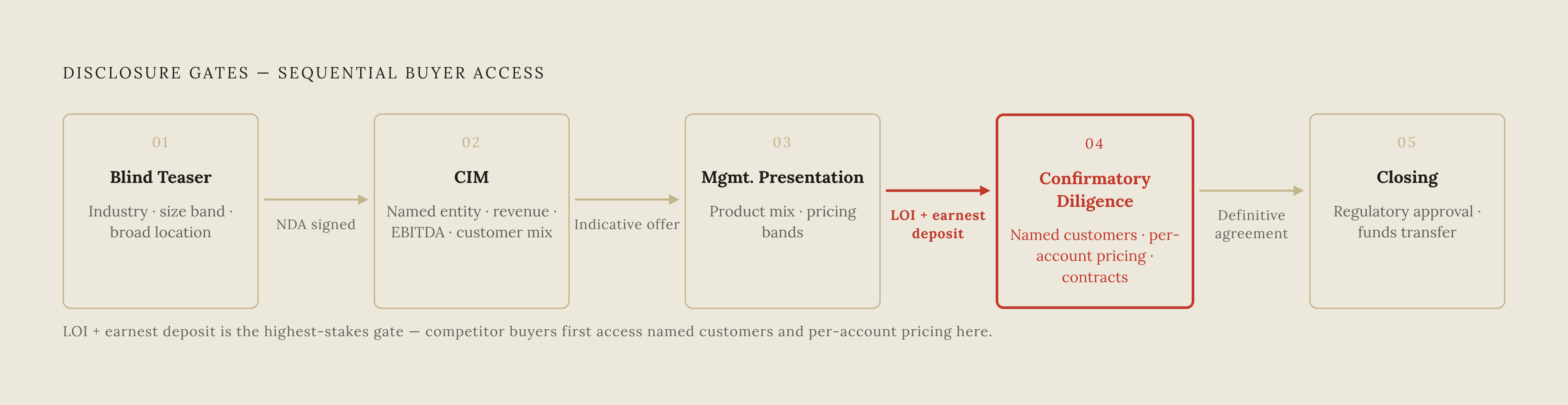
After the CIM, what should a buyer do to earn deeper access? The first threshold is an indicative offer within the seller’s valuation range. That commitment supports a management presentation and disclosure of product mix and pricing bands, with per-account prices withheld.
The next threshold is a negotiated letter of intent, or LOI. Before signing, the seller evaluates price, transaction structure, financing contingencies, earn-out provisions, post-close obligations and certainty of closing. These questions should not wait for exclusivity. An attractive headline price offers limited protection if the buyer can defer the terms that determine what the seller ultimately receives.
For competitor-buyers, access to named customer information and per-account pricing stays limited until the later diligence stage, after an LOI and earnest deposit. Confirmatory diligence then proceeds through controlled access to customers, contracts and supporting records, with management questions routed through the process. Closing follows the definitive purchase agreement and any required regulatory approvals. Each release has a purpose tied to an advancing commitment.
Deadlines make these thresholds credible by requiring buyers to allocate resources on a comparable timetable. Repeated extensions teach them that urgency is negotiable. Yet delaying exclusivity indefinitely can also drive away a serious buyer if the process appears unreliable. At the LOI, the seller can agree on major terms while other buyers are still in play, before exclusivity starts to give the buyer more leverage.
Running the virtual data room as an active competitive tool
The virtual data room, or VDR, enforces the disclosure sequence through role-based permissions. Buyers, advisors and legal teams see only the folders authorized for their stage, with restricted access to pricing, named contracts and employee compensation. Auxo recommends staged access, redacted customer information, restricted folders and delayed disclosure to direct competitors.
Tracking activity helps show how engaged a buyer is, though it cannot take the place of an offer. Repeated attention to the financial model and management presentation signals more engagement than an unopened CIM. Audit logs record what each buyer accessed and when, supporting later questions about disclosed risks or NDA compliance. Routing Q&A through the room also reduces inadvertent disclosure, keeps answers consistent and avoids preferential access that could undermine competition.
Managing competitor-buyers specifically: where the information risk concentrates
A strategic buyer may offer a higher headline price because synergies make the business worth more than it would be on its own. The same buyer can benefit from information without completing the acquisition. That is the central asymmetry. After a deal falls through, a rival can use margin data to attack prices, compensation details to target staff for recruiting, and customer concentration information to tailor counter-offers.
Excluding competitors removes those bidders but can also restrict price discovery and strengthen the negotiating position of those who remain. A mixed group of strategic and financial buyers offers an alternative to avoidance. The seller can retain competitive pressure while limiting what any rival learns before committing. The controls need to match the information’s potential use.
For owners including rivals, the response is to delay named customers and per-account pricing until the LOI and deposit threshold, use customer and employee non-solicitation provisions, and aggregate or time-delay sensitive data where possible. Trends can help buyers assess the business before they need details for the current period. Legal counsel should shape the safeguards around the diligence need. Where deeper competitor access is necessary, a clean team provides a further means of restricting sensitive review.
Canadian-specific constraints that shape every disclosure decision
Canadian privacy requirements constrain the sharing of customer and employee information, even when disclosure would help a buyer assess the business. A business transaction exemption to consent exists, but it requires a pre-diligence agreement before personal information is shared. An NDA alone is not permission for indiscriminate disclosure. Legal counsel should determine how the requirements apply, reinforcing the strategic case for withholding identifying details until needed.
Buyers usually favour an asset purchase for its cost-base treatment and protection from hidden liabilities, while sellers usually favour a share sale for capital gains treatment and the chance to use the Lifetime Capital Gains Exemption. The preferences can conflict. A CPA and legal advisor should establish the seller’s position before the CIM frames the transaction.
The exemption can shelter a large gain on shares that qualify, but an owner needs up-to-date professional advice on who qualifies and the exact limits. A family trust that is set up properly may spread benefits across family members, though planning for it must start years before the sale. The asset-versus-share decision belongs in LOI negotiations because it affects how competing offers should be compared.
What the process looks like from the seller's side across a full transaction timeline
Well before marketing, the owner’s attention is on exit readiness, financial normalization, quality-of-earnings review, legal and IP cleanup, and assembling advisors. The VDR is designed and populated during this phase. Nothing needs to reach buyers yet. Marketing opens only when the records and disclosure materials can support the claims being made.
During marketing, the teaser reaches a curated buyer list, signed NDAs permit CIM access, and a firm deadline brings indications of interest together. Buyers whose offers fall within the valuation range then move on to management presentations. Product mix and pricing bands deepen their understanding without exposing per-account economics.
The LOI phase compares economics, structure and closing risk before the preferred buyer receives exclusivity. Confirmatory diligence follows the agreed rules for access, including the earnest deposit before sensitive information is shared at a later stage. Closing then turns on the definitive agreement, any approvals required under the Investment Canada Act or Competition Act, and funds transfer. This is a sequence-dependent timeline because each phase relies on work and decisions completed in the preceding one.
Who helps owners run a private business sale in Canada, and what should they expect?
An owner needs more than introductions to prospective buyers. Qualified advisors screen buyers, prepare documents, enforce deadlines, control communications and run the VDR through a process that takes several months. Before hiring advisors, an owner should expect to know who will do that work and how offers will be judged on more than price. That review covers financing contingencies, earn-outs, working capital adjustments and what the seller must do after closing.
A pre-screened buyer network brings in buyers who can compete, while advisors’ management of the process can turn those buyers into credible alternatives. AI-driven matching combined with investment banking advisory can broaden qualified reach, but matching alone does not control disclosure or negotiate an LOI. Reach and process serve different functions. For the owner, the intended outcome is greater certainty, speed and value through a designed transaction process rather than reliance on one buyer’s goodwill or good luck.