Choosing a Business Valuation Tool as a Canadian SMB Owner Preparing to Exit
Start valuations early: online tools guide planning, but formal appraisals close deals.

For Canadian SMB owners preparing to exit, the right business valuation tool depends on timing, purpose, and who must rely on the result. Online calculators offer an early ballpark, informal CPA estimates support planning, and formal Chartered Business Valuator reports provide a documented basis for scrutiny by buyers, lenders, and the CRA. The best choice is a sequence of tools.
Why so many Canadian SMB owners are approaching exit without knowing what their business is worth
Canada’s generational ownership transition exposes a costly planning gap. Many owners approach a sale with an informal benchmark. A belief that similar companies sell for about 3× revenue can become the foundation of a retirement plan, even though it says little about sustainable earnings or buyer risk. Underestimating value can mean accepting too little, while overestimating it means planning around wealth a sale may not deliver.
That gap takes time to close properly. The CFIB’s Business Valuation resource recommends engaging a Chartered Business Valuator at least 24 months before selling. The lead time gives owners a chance to address what the valuation reveals. Owners therefore need to determine what kind of analysis they need now to assess what the business is worth.
What a business valuation actually does — and what it cannot do
A valuation estimates a defensible range under defined assumptions. Its purpose might be sale negotiation, estate planning, a partner buyout, a shareholder dispute, or CRA compliance, and those uses require different levels of support. A rough estimate suitable for personal planning is not necessarily a sound negotiating position.
The buyer also brings a separate test. The CFIB explains that buyers consider whether the business will pay for itself within a reasonable period and whether a lender will finance the acquisition. Even goodwill, including brand, recurring contracts, systems, and IP, needs documentation to be persuasive. Choosing a tool means matching its evidence and assumptions to the decision it must support.
The three valuation approaches Canadian CPAs and CBVs actually use
The income approach measures future earning capacity. For profitable operating businesses, it is commonly the primary approach, using capitalized earnings for stable performance or Discounted Cash Flow, or DCF, for a defined growth trajectory. Capitalized earnings divides expected earnings by a capitalization rate that reflects risk. Higher risk means a lower value. DCF estimates the present value of future cash flows, so its usefulness depends on solid financial data and realistic forecasts.
The market approach looks at what similar businesses sold for. Guideline company transactions and public company multiples provide reference points, making this approach persuasive in arm’s-length negotiations. But the comparison must withstand closer examination. Many Canadian small business sales are private, so useful data on those sales can be hard to find, though professional valuators use industry databases and broker reports. For most SMBs, market evidence cross-checks an income-based result.
The asset approach uses adjusted net book value or liquidation value to work out the fair market value of net assets. It establishes an asset-based floor after liabilities are paid. For asset-heavy businesses, including manufacturing, construction, and real estate holding companies, it can be the primary approach. Service businesses pose a different problem because much of their value resides in people and relationships. How these approaches fit together depends on the type of business and the sale being planned.
Why the earnings metric you choose — EBITDA or SDE — changes the number materially
Before applying a multiple, which earnings are being multiplied? EBITDA, meaning Earnings Before Interest, Tax, Depreciation, and Amortization, is the standard metric for mid-market Canadian businesses. Seller’s Discretionary Earnings, or SDE, adds back owner compensation and personal discretionary expenses to show what a working owner-operator can get from the business. The two measures answer different questions. Their multiples are not interchangeable, and SDE multiples for smaller owner-operated businesses are generally lower and fall within a tighter band.
An owner who pays themselves above-market compensation can depress reported EBITDA, while one who pays themselves too little can inflate it. For an EBITDA-based analysis, normalization uses a market-rate salary for a replacement manager in place of what the owner is actually paid. For an SDE-based analysis, the owner-operator’s compensation is treated differently because the buyer is also acquiring a working role.
Normalization also removes one-time items, including litigation settlements and pandemic-era anomalies, so historical noise does not stand in for sustainable earnings. What would remain under ordinary operating conditions? That is the question an advisor must resolve before selecting a multiple. A revenue multiplier cannot do that work, although the CFIB identifies it as useful in niche markets such as tech where buyers expect to scale revenue quickly.
The value drivers that move a multiple up or down — and that owners can actually control
An industry multiple is not a fixed entitlement. Customer concentration can reduce it because a large share of revenue depends on one relationship, and high concentration may also deter lenders. Recurring revenue from subscriptions, retainers, or long-term contracts carries less risk for a buyer than project work does. For owners preparing to sell, the practical response is to address concentration and strengthen recurring revenue where the business allows it.
If customer relationships, specialized knowledge, and operating decisions all depend on the founder, a buyer is acquiring a business that may struggle after the handover. Reducing that dependency means documenting operating procedures, employee handbooks, and customer onboarding workflows. The CFIB notes that realizing goodwill may also require the seller to remain for a mentorship period so the successor can take over relationships, processes, and training systems.
Buyers expect normalized working capital, and a deficit can reduce the offer or become a source of post-close disputes. Real estate that the corporation holds is usually valued on its own at fair market value and handled differently in the deal structure. Owners should work on the business’s transferability, working capital, and asset structure two to three years before going to market, when there is still time for changes to affect the sale.
What online valuation calculators actually give you — and where their output breaks down
A well-built tool can compare EBITDA, SDE, and revenue multiples with a basic DCF calculation, revealing where methods produce different results. That spread can be useful. It helps an owner see which method fits the business and which assumptions an advisor should check.
The limitation begins with the earnings entered. A calculator cannot reliably judge whether compensation is reasonable, an expense is truly non-recurring, or an add-back would hold up to a close review. It also applies multiples mechanically rather than weighing customer concentration, owner dependency, and contract quality as a valuator would. Calculator output is therefore unsuitable for sale negotiations, CRA positions, estate freezes, or a sophisticated buyer’s due diligence.
For an owner three or more years from exit, those limits need not make the tool unhelpful. The CFIB cautions against considerable spending on a formal valuation at that horizon because market conditions can change dramatically. The useful next step is a CPA review of normalized earnings and the assumptions behind the range.
When an informal CPA valuation or internal estimate becomes the right tool
A CPA familiar with the business can replace mechanical inputs with informed judgment about compensation, related-party transactions, and one-time items. That makes an informal estimate more useful than a calculator for tracking progress one to three years before exit. Because it costs less than a full CBV engagement, it can be a good fit for yearly financial plans and choices about whether to retain earnings or make distributions.
The same analysis can help an owner look into a partner buyout, weigh whether an estate freeze makes sense, or check when they might qualify for the Lifetime Capital Gains Exemption. Exploring a transaction is different from supporting its execution. An internal estimate is usually not enough for formal talks with a sophisticated buyer, a CRA challenge to share transfer pricing, a shareholder dispute, or a Quality of Earnings review that a lender asks for. The dividing line is who must accept the number and how strongly they may challenge it.
What a formal Chartered Business Valuator report provides that nothing else does
A formal Chartered Business Valuator, or CBV, report sets out how the estimate was reached and gives it backing that institutions can trust. The valuator considers the income, market, and asset approaches, selects the appropriate primary method, and cross-checks the result. The output is still a range. What changes is the support behind it, including the reasoning that connects financial evidence, business-specific risks, and assumptions to the conclusion.
Buyers’ lawyers, lenders, and CRA auditors need a basis they can examine, rather than an unexplained calculator result or an internal planning estimate. Among these tools, the formal report provides that foundation. It does not guarantee that every buyer will agree with the price or that every challenge disappears.
When the findings arrive affects whether there is still time to fix the problems they reveal. A CBV engagement can expose undocumented goodwill, owner dependency, or excess passive assets that threaten tax eligibility. The CFIB also notes that engaging a CBV after completing a formal succession plan can help an owner negotiate a better valuation.
How Canadian tax structure — share vs. asset sale and LCGE eligibility should shape the valuation tool you use
A headline valuation does not tell an owner what remains after tax. Deal structure can change that outcome substantially. The CFIB explains that sellers usually prefer share sales for their tax advantages, while buyers often prefer asset sales to cut risk and write off the assets they buy over time. Because the financial, tax, and legal implications differ, the proposed sale structure helps determine the valuation method.
The Lifetime Capital Gains Exemption, or LCGE, makes that distinction especially consequential. It is a personal exemption that applies only to a qualifying share sale and excludes gains realized inside the corporation. Eligibility requires Canadian-Controlled Private Corporation status, an active asset test at sale, and a separate active asset requirement during the 24-month holding period. The shares must also meet a 24-month holding requirement. Excess cash or passive investments can jeopardize qualification.
What information does the valuation tool need to address that risk? A calculator needs to know the corporate structure and the mix of assets to reliably model eligibility, and a CPA or CBV needs to see the full balance sheet. The business may need to distribute excess passive assets before sale, and a family trust may let more than one eligible beneficiary use their exemptions, but both steps need to be planned ahead. The implication is to have a CBV and a tax-aware advisor work together on value and after-tax proceeds, rather than leaving tax structure until a price is agreed.
How to sequence valuation tools as your exit approaches
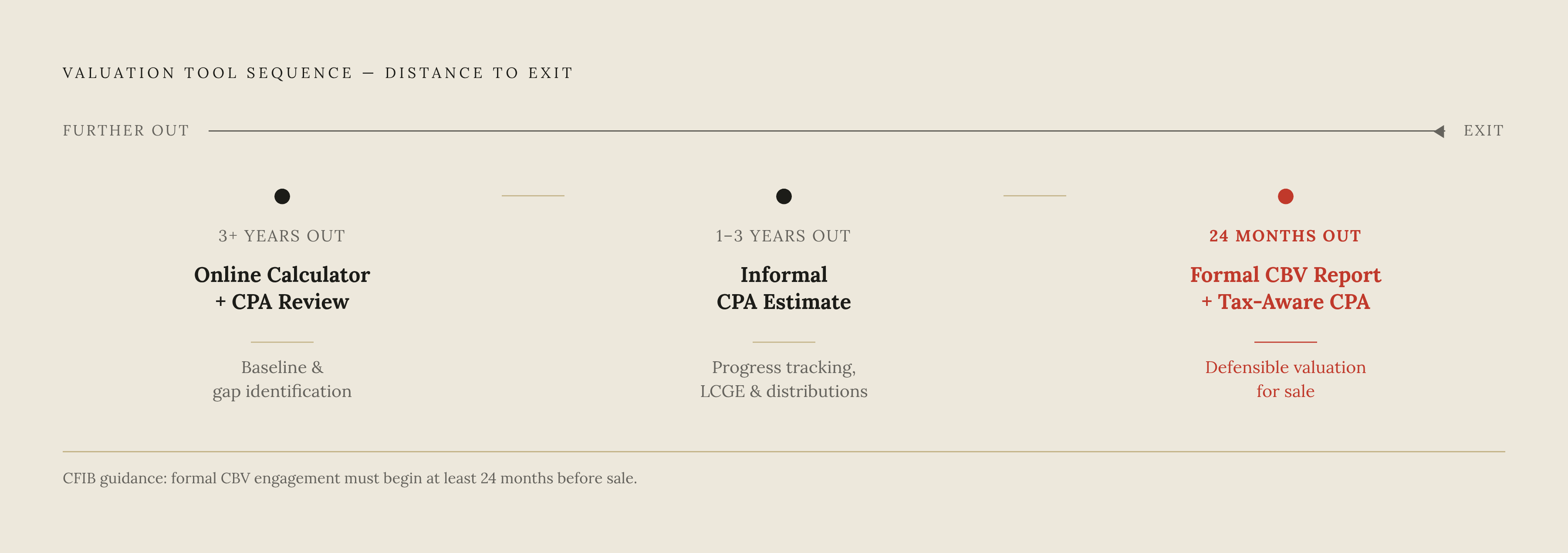
Three or more years out, use a calculator with a CPA review of normalized earnings to establish a working baseline. Address customer concentration, reduce owner dependency, document operating systems, and assess whether the corporate structure is LCGE-eligible. As those changes develop, an informal CPA estimate can track whether the business is becoming more valuable and more transferable.
As the exit moves into the one-to-two-year preparation window, the tool changes to a formal CBV engagement integrated with tax-aware CPA advice. Aim for the beginning of that window. The CFIB’s recommendation is at least 24 months before selling, leaving time to resolve valuation and tax issues. At this stage, the actions include completing any needed passive asset distribution, establishing or updating a family trust where applicable, and preparing financials that are ready for a Quality of Earnings review.
An unsolicited offer does not remove the need for that preparation. Accepting one before testing the market, commissioning a valuation six weeks before listing, or postponing deal-structure questions until a letter of intent is signed compresses the work into the least flexible part of the process. Starting earlier preserves options and gives each tool’s output a stronger foundation when buyers, advisors, and the CRA need to rely on it.